Sexual Crimes in Ancient Egypt: Law, Consent, and Punishment
Sexual crimes in ancient Egypt were not understood simply as moral failures or private misconduct. When sexual acts involved coercion, abuse of power, or violation of bodily autonomy, they entered the domain of law and became matters for investigation and punishment. The legal system distinguished clearly between consensual behavior governed by social norms and acts that constituted criminal harm.
Ancient Egyptian law did not define sexual offenses through abstract notions of immorality. Instead, it focused on consent, force, and social authority. Sexual acts became criminal when they involved compulsion, exploitation, or the infringement of another person’s bodily integrity. This legal perspective allowed courts to separate adultery, which often remained a family or community issue, from sexual assault, which demanded state intervention.
This article examines sexual crimes as legal offenses, not cultural curiosities. It explores how such crimes were defined, how they differed from consensual or socially regulated relationships, how accusations were evaluated, and how punishment was determined. By approaching the subject through law rather than sensation, the analysis reveals how ancient Egypt developed a structured, if imperfect, framework to address sexual violence within its legal order.
What Constituted a Sexual Crime?
In ancient Egyptian law, a sexual act became a crime when it involved coercion, lack of consent, or abuse of authority. The legal threshold was not sexual activity itself, but the violation of bodily autonomy. Acts carried legal consequences only when one party was subjected to force, pressure, or exploitation.
Consent was the central criterion. Sexual relations between adults were generally regulated by social and family norms rather than criminal law. Once consent was absent—due to physical force, intimidation, or unequal power—the act was treated as a legal offense requiring intervention.
Coercion defined criminality. This included overt physical force as well as situations where authority or dependency removed genuine choice. Sexual access obtained through dominance, threat, or imposed obligation crossed into criminal territory, regardless of social status.
Abuse of power further intensified legal concern. When individuals in positions of control—supervisors, officials, or household heads—used their authority to obtain sexual access, the act was not viewed as private misconduct but as a breach of legal and social order.
By grounding sexual crimes in consent, coercion, and authority, ancient Egyptian law distinguished criminal acts from consensual relations. This framework allowed courts to address sexual violence as a bodily offense, not merely a moral failing, aligning legal response with harm rather than custom.
| Legal Aspect | Treatment in Ancient Egypt |
|---|---|
| Definition of Sexual Crime | Sexual acts involving coercion, force, or lack of consent |
| Key Legal Threshold | Violation of bodily autonomy |
| Distinction from Adultery | Adultery treated as social or familial issue, not bodily crime |
| Primary Evidence | Testimony, context, power imbalance, corroboration |
| Aggravating Factors | Abuse of authority, crimes against minors or dependents |
| Punishment Principle | Proportionality based on coercion and harm |
Sexual Crimes vs Adultery
Ancient Egyptian law drew a clear distinction between sexual crimes and adultery, treating them as fundamentally different categories. The separation rested on harm and coercion, not on sexual behavior itself. What mattered legally was whether an act violated another person’s bodily autonomy or disrupted social bonds.
Adultery was primarily a social and familial offense. It concerned breaches of marriage, inheritance, and household stability. In many cases, responses were handled within families or communities, involving compensation, divorce, or social sanction rather than formal criminal prosecution. The law’s interest lay in restoring order, not punishing bodily harm.
Sexual crimes, by contrast, involved force, coercion, or exploitation. When sexual acts occurred without consent, the matter shifted from social regulation to legal offense. The state intervened because the crime targeted the body and personhood of the victim, not merely marital arrangements.
This distinction prevented the criminalization of consensual relationships while allowing firm legal action against sexual violence. By separating adultery from sexual assault, ancient Egyptian law maintained proportionality and focused punishment on acts that caused direct physical and personal harm.
Crimes Against Women and Minors
Sexual crimes against women and minors in ancient Egypt were addressed through a legal lens focused on coercion and vulnerability, not moral judgment alone. The decisive factor was whether an act exploited physical weakness, dependency, or lack of consent, placing such offenses firmly within criminal law.
Women were not treated as passive subjects in legal terms. When sexual harm involved force or abuse of authority, women could be recognized as injured parties, and the offense was understood as a violation of bodily integrity. The law’s concern centered on the act itself rather than assumptions about female behavior.
Crimes involving minors carried particular gravity because consent was inherently absent. Sexual acts against children were understood as abuses of dependency and protection, even when sources describe them indirectly. The legal framework emphasized the imbalance of power, identifying such acts as severe violations requiring intervention.
Household authority did not grant unlimited sexual rights. When guardians, supervisors, or family members exploited their position to impose sexual access, the act crossed into criminal territory. The misuse of control transformed private authority into a legal offense.
By recognizing vulnerability and power imbalance, ancient Egyptian law established boundaries that protected women and minors from sexual exploitation. This approach reinforced the principle that sexual access required consent and that violations of bodily autonomy—especially against those unable to resist—constituted serious legal crimes.
How Sexual Crimes Were Proven
Ancient Egyptian courts approached sexual crimes through practical standards of proof, focusing on coercion, context, and credibility rather than abstract moral claims. Because such acts often occurred in private, proof relied on a convergence of evidence, not a single element alone.
Testimony was central. Statements from the victim, witnesses to the immediate aftermath, or individuals aware of threats or coercive behavior helped establish whether consent was absent. Consistency and plausibility mattered more than status.
Context and circumstance carried significant weight. Evidence such as location, time, isolation, prior authority relationships, or signs of intimidation helped courts assess coercion. When power imbalance was evident—supervisor over worker, guardian over dependent—the threshold for criminality was clearer.
Physical indicators could corroborate claims when present. Injuries, signs of struggle, or distress observed shortly after the incident strengthened allegations, though the absence of visible harm did not automatically negate a claim in cases of coercion.
Admission or partial confession resolved cases decisively when obtained. Even indirect acknowledgment of force, threat, or exploitation could tip judgment when aligned with contextual evidence.
By evaluating testimony alongside context and corroboration, ancient Egyptian law developed a workable evidentiary approach for sexual crimes. This method avoided sensationalism while allowing courts to identify coercion and protect bodily autonomy through reasoned legal assessment.
Legal Punishments for Sexual Crimes
Punishment for sexual crimes in ancient Egypt was determined by coercion, severity of violation, and social impact, not by sexual conduct alone. The legal system treated these offenses as bodily and personal violations, warranting responses stronger than those applied to consensual transgressions or moral infractions.
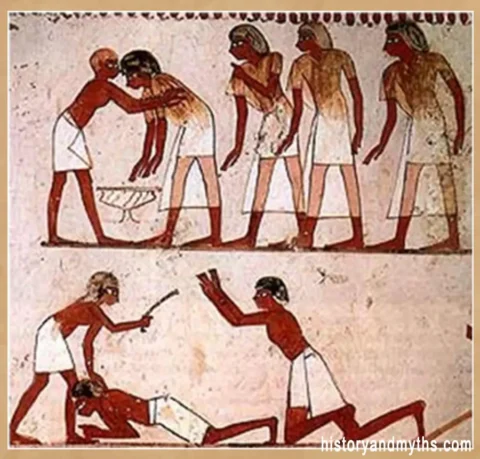
Severe corporal punishment was imposed when sexual acts involved force or abuse of authority. These penalties reflected the seriousness of violating bodily autonomy and served as public deterrence against coercive behavior. The emphasis was on the harm inflicted, not on restoring family honor.
In cases involving abuse of power, punishment intensified. When officials, supervisors, or guardians exploited their position to obtain sexual access, the offense was treated as a breach of both personal and institutional order. Legal consequences targeted the misuse of authority as much as the act itself.
Social and legal sanctions could accompany physical penalties. Offenders risked loss of position, exclusion from communal roles, or permanent damage to reputation. Such outcomes reinforced the principle that sexual violence undermined trust essential to social stability.
Crucially, punishment escalated when crimes involved women under protection or minors, where consent was absent by definition. These cases were recognized as aggravated offenses, justifying stronger intervention.
By aligning punishment with coercion and vulnerability, ancient Egyptian law applied a proportional framework that addressed sexual crimes as serious legal violations rather than private moral failings.
Sexual Crimes as Legal Offenses
- Sexual crime was defined by coercion and lack of consent, not by sexuality itself.
- Adultery was usually treated as a social or household breach, not a bodily offense.
- Abuse of authority transformed “private misconduct” into a public legal violation.
- Proof relied on testimony plus context: isolation, threats, power imbalance, and corroboration.
- Cases involving minors or dependents were treated as aggravated offenses.
© historyandmyths.com — Educational use
Status, Gender, and Sexual Offenses
Status and gender in ancient Egypt shaped the context of sexual crime cases, but they did not redefine the core legal violation. The decisive factors remained coercion, lack of consent, and abuse of power. Law addressed sexual offenses as infringements on bodily autonomy, even while operating within a hierarchical society.
Gender influenced vulnerability rather than culpability. Women were more frequently positioned as victims due to social power dynamics, yet the legal focus stayed on the act and the presence of coercion. When force or exploitation was established, sexual harm to women was treated as a legal offense, not merely a moral lapse.
Status affected expectations and consequences. Individuals holding authority—officials, supervisors, or household heads—were judged more harshly when they abused their position. Exploitation by those entrusted with power transformed private misconduct into a matter of public legal concern, intensifying penalties.
Conversely, the status of the victim did not nullify the offense. Sexual crimes against dependents, workers, or minors were understood as aggravated precisely because of unequal power relations. The law recognized vulnerability as a factor that strengthened, rather than weakened, the criminal case.
By maintaining harm and coercion as the legal center, ancient Egyptian law balanced hierarchy with accountability. Status framed responsibility; gender shaped exposure to risk; but neither displaced the principle that sexual violence constituted a serious legal crime demanding state response.
Key Takeaways
- In ancient Egypt, sexual crimes were defined by coercion, lack of consent, and bodily violation.
- Adultery was often treated as a household or social breach, distinct from sexual violence.
- Power imbalance and abuse of authority were central in evaluating criminality.
- Proof depended on testimony supported by context and corroborating circumstances.
- Crimes against minors or dependents were aggravated because consent was inherently absent.
- Punishment aimed at proportionality, escalating with coercion and social impact.
Frequently Asked Questions
How did ancient Egyptian law define sexual crimes?
Sexual crimes were defined by coercion, lack of consent, or abuse of authority, not by sexual behavior itself.
Were consensual sexual relationships criminalized?
No. Consensual relations were usually regulated by social or family norms rather than criminal law.
What separated sexual assault from adultery?
Adultery concerned marital and household order, while sexual assault involved bodily violation and coercion.
How were sexual crimes proven in court?
Through testimony, contextual evidence such as power imbalance or isolation, and corroboration when available.
Did women have legal standing in sexual crime cases?
Yes. When coercion or force was established, women were recognized as injured parties under the law.
How were crimes against minors treated?
They were considered aggravated offenses because consent was inherently absent.
Did social status affect legal outcomes?
Status influenced context but did not redefine the crime; abuse of authority often intensified punishment.
What kinds of punishment were imposed?
Punishments escalated with coercion and harm, including corporal penalties and social sanctions.
Sources & Rights
- Allam, Schafik. Egyptian Law Courts in Pharaonic Times. Wiesbaden: Harrassowitz, 1973.
- Menu, Bernadette. Egyptian Law. Cairo: Institut Français d’Archéologie Orientale, 1999.
- Westbrook, Raymond. A History of Ancient Near Eastern Law. Leiden: Brill, 2003.
- Kemp, Barry J. Ancient Egypt: Anatomy of a Civilization. London: Routledge, 2006.
- Lichtheim, Miriam. Ancient Egyptian Literature, Volume II: The New Kingdom. Berkeley: University of California Press, 1980.
- McDowell, A. G. Village Life in Ancient Egypt: Laundry Lists and Love Songs. Oxford: Oxford University Press, 1999.
- Janssen, Jac. J. Village Varia: Ten Studies on the History and Administration of Deir el-Medina. Leiden: Nederlands Instituut voor het Nabije Oosten, 1997.
- Černý, Jaroslav. A Community of Workmen at Thebes in the Ramesside Period. Cairo: IFAO, 1973.
- Assmann, Jan. Ma’at: Justice and Order in Ancient Egypt. New Haven: Yale University Press, 2002.
- Eyres, Harry. Ancient Egyptian Law and Society. London: British Museum Press, 2002.
- Quirke, Stephen. The Administration of Egypt in the Late Middle Kingdom. London: SIA Publishing, 1990.
- Robins, Gay. Women in Ancient Egypt. Cambridge: Harvard University Press, 1993.
- Wilkinson, Richard H. Reading Egyptian Art. London: Thames & Hudson, 1992.
- Johnson, Janet H. The Legal Status of Women in Ancient Egypt. Chicago: Oriental Institute, 1996.
- Goedicke, Hans. Studies in Egyptian Law and Society. Baltimore: Johns Hopkins University Press, 1984.
- Leprohon, Ronald J. The Great Name: Ancient Egyptian Royal Titulary. Atlanta: Society of Biblical Literature, 2013.
- Peet, T. Eric. The Great Tomb-Robberies of the Twentieth Egyptian Dynasty. Oxford: Clarendon Press, 1930.
- Toivari-Viitala, Jaana. Women at Deir el-Medina. Leiden: Nederlands Instituut voor het Nabije Oosten, 2001.
- Szpakowska, Kasia. Behind Closed Eyes: Dreams and Nightmares in Ancient Egypt. Swansea: Classical Press of Wales, 2003.
- Shaw, Ian, ed. The Oxford History of Ancient Egypt. Oxford: Oxford University Press, 2000.
- Redford, Donald B., ed. The Oxford Encyclopedia of Ancient Egypt. Oxford: Oxford University Press, 2001.
Written by H. Moses — All rights reserved © Mythology and History