Circumcision in Ancient Egypt: Ritual, Purity, and Social Status
Did ancient Egyptians practice circumcision? The strongest evidence says yes, but it does not prove that the practice was universal, performed at one fixed age, or followed the same meaning in every period of Egyptian history.
In ancient Egypt, circumcision appears to have carried social and ritual significance in some contexts. It could be connected with purity, group belonging, male identity, and readiness for certain adult or institutional roles. At the same time, the surviving evidence is limited, so the topic must be treated carefully rather than turned into a simple rule for all Egyptians.
This article examines the strongest visual and textual evidence for circumcision in ancient Egypt, what the practice may have meant socially, who was most likely to undergo it, why timing remains uncertain, and where modern assumptions go beyond what ancient sources can prove.
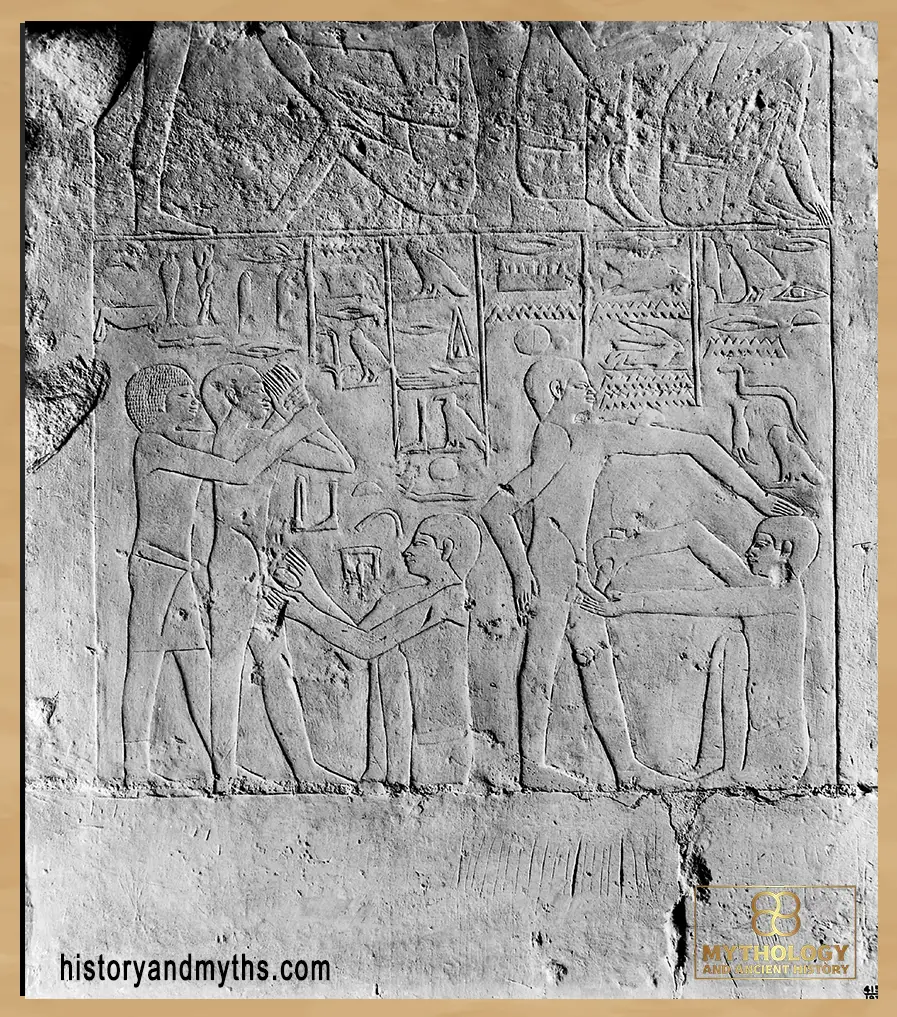
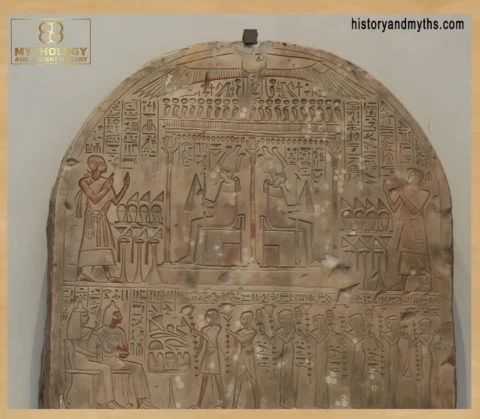
Image: Wall carving showing a circumcision scene, Saqqara (Wellcome Collection, Photo M0005235) — cropped detail — Source: Wikimedia Commons (CC BY 4.0)
The Strongest Evidence: Tomb Scenes and Visual Proof
The most valuable evidence for circumcision in ancient Egypt is not rumor or later commentary, but direct visual documentation. A small number of scenes show the act itself, which is rare in Egyptian art and therefore significant. When a society chooses to depict an intimate, painful procedure, it usually means the act carried recognized meaning beyond the purely private level. It was something that could be talked about, understood, and socially framed.
These images do not tell us everything—especially not who was circumcised in every region or century—but they establish the core fact: circumcision was practiced and known. More importantly, they show it was not treated as an invisible detail. The act appears as something performed in a controlled setting, suggesting procedure, expectation, and possibly training or professional involvement. That supports the idea that circumcision could operate as an organized transition, not an accidental habit.
The evidence also sets a limit. Because the scenes are few, we cannot turn them into a blanket statement that every Egyptian male underwent circumcision in the same way. What the material proves is narrower but still powerful: ancient Egyptians practiced circumcision, and at least in some contexts, it was important enough to be recorded visually—an indicator of public meaning, structured performance, and social recognition.
What Circumcision Meant in Ancient Egypt (Beyond a Medical Procedure)
The clearest mistake in most modern explanations is treating circumcision as either “just hygiene” or “just religion.” In ancient Egypt, it could carry multiple meanings at once, and those meanings were social before they were personal. A body change that is publicly understood and culturally valued becomes a signal. That signal can define who belongs, who is considered properly prepared, and who can enter roles tied to status, purity, or institutional discipline.
Seen from that angle, circumcision could function as a social threshold. It marked a person as someone who had crossed into a recognized category—more controlled, more accountable, and more acceptable within specific settings. That is why circumcision fits the theme of life transitions. It is not important because it happened privately; it is important because the culture gave it a meaning that could be recognized and enforced by others.
This approach also explains why the practice cannot be reduced to one single motive. A procedure can be understood as hygienic by some, as religious by others, and as a marker of identity by the community as a whole. In Egypt, where ritual purity and social order mattered deeply, circumcision could act as a visible boundary between “not yet” and “now eligible,” even if the details varied by period, region, and group.
| Core Question | Best-Supported Answer | What We Cannot Claim | Why It Matters Socially |
|---|---|---|---|
| Did Egyptians practice circumcision? | Yes, the practice is attested and visually depicted in rare cases | That it was performed identically everywhere and always | Shows it carried recognized public meaning |
| Was it a social transition? | In some contexts, it likely marked purity, belonging, and readiness | That it was always a “coming-of-age ceremony” | Acts as a boundary between “eligible” and “not yet” |
| Who underwent it? | Probably varied by group, setting, and social emphasis | That every Egyptian male was circumcised in all periods | Identity and conformity can be institutionally managed |
| At what age? | No single age; timing likely depended on purpose and context | A universal official age across society | Transitions follow social timing, not one calendar rule |
| Female circumcision in pharaonic Egypt? | Evidence is far less direct and cannot be claimed with equal certainty | That it is proven as a pharaonic rite of passage | Separates ancient evidence from modern assumptions |
A Social Transition: Purity, Belonging, and Adult Readiness
Circumcision becomes historically interesting when you stop asking whether it happened and start asking what it accomplished socially. In Egyptian life, purity was not only a spiritual ideal but a practical language of control. Being “clean” could mean being acceptable, trusted, and eligible to enter spaces where bodies, food, and ritual order mattered. A procedure linked to cleanliness therefore had the potential to work as a boundary: those who had crossed it were treated differently from those who had not.
Belonging is the second layer. A society can use body practices to define membership, especially in environments shaped by hierarchy and close supervision. If circumcision was expected within certain circles—elite households, institutional service, or specialized groups—then the act becomes a social passport. It does not grant modern equality, but it signals that the person has been shaped according to a recognized standard, which lowers suspicion and increases acceptance inside the group.
Adult readiness is the third layer and the closest to a “coming of age” meaning. If circumcision was performed near a stage of transition, it could mark readiness for responsibilities that demanded discipline and self-control. That does not require a festival-like ceremony. It only requires that people understood the act as a threshold. Once crossed, a youth is no longer treated as unformed. He is treated as someone who can be held to adult expectations, especially in contexts where status and bodily control were tied together.
Who Was Circumcised (And Who Probably Wasn’t)
One of the easiest ways to ruin this topic is to claim universality without proof. Ancient Egypt was not a single uniform society across three thousand years, and practices could vary by period, region, social status, and institutional environment. The evidence shows circumcision existed and mattered in some contexts, but it does not allow a simple conclusion that every Egyptian male, in every era, underwent it in the same way.
The more historically careful reading is that circumcision was more likely to be meaningful where identity and discipline were actively managed. In elite settings, the body was part of status presentation and controlled behavior. In institutional settings, a person’s eligibility and acceptability could depend on conformity to expected norms, including purity norms. In those environments, circumcision could serve as a recognizable marker that a person had been prepared for membership and responsibility.
At the same time, it is reasonable to assume that circumcision was not equally practiced by all groups or treated as equally important everywhere. If it had been universal, we would expect clearer and broader material signals across the full range of Egyptian society. Instead, the surviving evidence suggests something closer to selective emphasis: a practice that could be widespread in certain circles, strongly symbolic in certain moments, and less visible or less central elsewhere. That selective pattern is exactly what you would expect from a social transition marker rather than a simple medical habit.
- Coming of Age in Ancient Egypt: Puberty, Work, and Adult Roles
- Baby Naming in Ancient Egypt: Rituals, Meaning, and Protection
- Childhood Discipline in Ancient Egypt | How Society Shaped Obedience
- Motherhood and Childhood in Ancient Egypt: Pregnancy, Birth, Care
- Guardianship and Minors in Ancient Egypt: Protecting Children by Law
Age and Timing: Why We Can’t Pin It to One Number
Modern readers often want a clean answer: “At what age did Egyptians circumcise boys?” The honest answer is that ancient evidence does not support one universal age. Circumcision could have been performed at different times for different reasons, and the timing likely depended on what the procedure was meant to accomplish socially. If the goal was early protection or family custom, it could happen in childhood. If the goal was readiness for new roles, it could happen closer to adolescence or institutional entry.
This is where the idea of circumcision as a social transition becomes useful. A transition marker is rarely attached to biology alone; it is attached to social timing. The point is not simply that the body changes, but that society is about to change how it treats the person. If circumcision was linked to purity and eligibility, the relevant “age” might be the moment a boy was expected to enter environments that demanded stricter control—workshops, elite service, or religiously supervised spaces. That would make timing situational rather than universal.
So the best historical conclusion is structured uncertainty. We can say circumcision was practiced, and we can explain why it could function as a threshold. But we should not pretend Egypt had one official age that applied to everyone. A flexible timing model matches both the long span of Egyptian history and the way social transitions actually work: people cross thresholds when the community needs them to, not when the calendar says so.
In ancient Egypt, circumcision could work as more than a medical practice. In certain settings, it marked purity, belonging, and readiness for adult roles. The strongest evidence confirms the practice existed, but it does not prove universal application or one fixed age. Historically, its power came from functioning as a social boundary.
Female Circumcision in Ancient Egypt: What Evidence Can and Can’t Prove
This is the part most pages handle badly, either by making confident claims without ancient proof or by dragging the discussion into modern politics. The safest historical position is simple: the strongest, clearest evidence we have from pharaonic Egypt is for male circumcision, including rare visual depictions. Evidence for female circumcision in the pharaonic period is far less direct, far less secure, and often confused with later practices.
That does not mean the topic is impossible to discuss—it means it has to be discussed with strict standards. Modern prevalence in a region is not evidence that the same practice existed in the same form three thousand years earlier. A historian has to separate continuity claims from what ancient sources actually show. When evidence is weak, the honest answer is not “yes” or “no,” but “we cannot prove it at the same level of certainty.”
So in a high-quality analysis, female circumcision should not be presented as a confirmed “ancient Egyptian rite of passage.” It should be treated as an unresolved question, one where later history and modern assumptions often overpower the limited ancient record. That level of caution is not avoidance—it is what credibility looks like when a topic is sensitive and the evidence is uneven.
Why Circumcision Worked as a Social Boundary
Circumcision mattered in ancient Egypt because it could be used to draw a line between categories of people. Social categories were not abstract ideas; they shaped who could be trusted, who could enter certain environments, and who could be treated as properly formed. A practice that visibly reshaped the body could serve as proof of conformity, especially in a society where discipline and purity were linked to social order.
This boundary effect becomes clearer when you compare circumcision to other transitions. Naming created identity. Coming of age created accountability. Circumcision, in certain contexts, could create eligibility. It marked a person as someone who had been shaped into an accepted form, making him less “unprepared” and more fit for roles that demanded self-control, loyalty, and social predictability. The point was not simply the act, but what the act allowed a person to become.
That is why circumcision can be treated as a social transition without romanticizing it. It was not necessarily celebrated, and it did not have to be universal. It was valuable because it worked as a threshold marker: it could separate insiders from outsiders, disciplined bodies from undisciplined ones, and those considered ready from those still outside the adult world. In a hierarchical culture, that kind of boundary is powerful. It transforms a private procedure into a public signal, and it turns pain into status.
- Circumcision in ancient Egypt was a known practice with rare visual attestations.
- It could function as a social transition linked to purity, belonging, and readiness.
- The evidence does not support a universal rule applying to all men in all periods.
- There was likely no single official age; timing depended on social context.
- Female circumcision cannot be claimed with the same certainty from pharaonic evidence.
FAQ
Did ancient Egyptians practice circumcision?
Yes. Circumcision is attested in ancient Egypt, including rare visual depictions, showing it was a known and socially recognized practice.
Was circumcision a religious ritual or a social tradition?
It could function in multiple ways. In some contexts, it likely marked purity, belonging, and readiness for adult expectations rather than serving only one purpose.
Was circumcision universal in ancient Egypt?
The surviving evidence does not prove that every Egyptian male was circumcised in all periods. The practice likely varied across groups and settings.
At what age was circumcision performed?
There is no single fixed age supported by the evidence. Timing probably depended on social context and the purpose the practice served.
Why is the Ankhmahor tomb scene important?
It is one of the clearest and earliest visual records showing circumcision being performed, which is rare in Egyptian art and historically valuable.
Did circumcision mark adulthood in ancient Egypt?
In certain contexts, it could act as a threshold marker linked to eligibility, discipline, and social acceptance, but it was not necessarily a universal coming-of-age rite.
Was female circumcision practiced in pharaonic Egypt?
Evidence for female circumcision in pharaonic Egypt is far less direct and cannot be claimed with the same certainty as male circumcision.
Sources & Rights
- Bard, Kathryn A. An Introduction to the Archaeology of Ancient Egypt. 2nd ed. Wiley-Blackwell, 2015.
- Brier, Bob, and Hoyt Hobbs. Daily Life of the Ancient Egyptians. 2nd ed. Greenwood Press, 2008.
- David, Rosalie. Religion and Magic in Ancient Egypt. Penguin Books, 2002.
- Ikram, Salima. Ancient Egypt: An Introduction. Cambridge University Press, 2011.
- Janssen, Rosalind, and Jac J. Janssen. Growing Up in Ancient Egypt. Rubicon Press, 1990.
- Megahed, Mohamed M. “Ancient Egyptian Royal Circumcision.” Anthropologie 49, no. 2 (2011): 155–164.
- Meskell, Lynn. Private Life in New Kingdom Egypt. Princeton University Press, 2002.
- Nunn, John F. Ancient Egyptian Medicine. British Museum Press, 1996.
- Quirke, Stephen. Ancient Egyptian Religion. British Museum Press, 1992.
- Redford, Donald B., ed. The Oxford Encyclopedia of Ancient Egypt. 3 vols. Oxford University Press, 2001.
- Ritner, Robert K. The Mechanics of Ancient Egyptian Magical Practice. Oriental Institute of the University of Chicago, 1993.
- Robins, Gay. The Art of Ancient Egypt. Harvard University Press, 2008.
- Teeter, Emily. Religion and Ritual in Ancient Egypt. Cambridge University Press, 2011.
- Wilkinson, Richard H. The Complete Gods and Goddesses of Ancient Egypt. Thames & Hudson, 2003.
- Wellcome Collection. Circumcision Scene from the Tomb of Ankhmahor.
- The Metropolitan Museum of Art. Ancient Egyptian Art Collection.
- The British Museum. Collection Online: Ancient Egypt.
Written by H. Moses
— All rights reserved ©
History and Myths