Heryshef: The Ram-Headed God of Heracleopolis in Ancient Egypt
To the ancient Egyptians, creation was never a single event it was a force that had to be renewed every day, sustained by gods whose power flowed through land, water, and life itself. Among these deities stood Heryshef, the ram-god of Heracleopolis, a figure who embodied both the calm of sacred waters and the raw vitality of creation. His name, often translated as “He Who Is on His Lake,” evokes a god whose essence was rooted in the quiet yet fertile expanses that shaped the early beliefs of Middle Egypt.
Heryshef’s identity blended creative energy, fertility, and kingship. He was thought to rise from the primeval waters, carrying the strength of a great ram and the authority of a solar creator. Later ages linked him with Ra, Atum, and Osiris, reflecting a deity whose nature was fluid and expansive able to merge with the most powerful gods of the Egyptian pantheon. Even the Greeks, encountering his strong ram imagery and associations with might, equated him with Heracles.
Yet despite his prominence in certain regions, Heryshef remains one of the lesser-explored gods today. His cult center, Heracleopolis Magna, once played a crucial role in the political and religious landscape of Egypt, and his iconography ram, lake, scepter, and crown reveals a complex theology that blends creation, protection, and divine authority.
The Meaning of His Name: “He Who Is on His Lake”
The name Heryshef (also rendered Heryshaf or Herishef) carries a meaning that has intrigued Egyptologists for decades: “He Who Is on His Lake.” Unlike many divine titles tied directly to the sky or the underworld, Heryshef’s identity is rooted in water a symbol of life, rebirth, and primordial creation.
In Egyptian thought, a sacred lake was not merely a body of water; it was a threshold where creation emerged and where the gods could manifest their power. By placing Heryshef “on his lake,” the texts portray him as a god who stands upon the surface of creation itself, controlling the life-giving forces that flow from the primeval waters.
This association also reflects his role as a fertility and creator deity, whose power animates both the land and its rulers. The lake of Heryshef may have symbolized the marshlands of Middle Egypt quiet, fertile, and abundant making him a divine embodiment of renewal. It also explains why the Greeks later linked him with Heracles: a figure of strength who rises from the natural world itself.
| Aspect | Details |
|---|---|
| Name Meaning | “He Who Is on His Lake” — a creator force rising from sacred waters. |
| Primary Role | Creator and fertility god linked to renewal, vitality, and kingship. |
| Cult Center | Heracleopolis Magna (Henen-nesut), Middle Egypt. |
| Iconography | Man with a ram’s head; crowns with solar symbols; scepters and ankhs. |
| Key Associations | Linked to Ra, Atum (creator power) and Osiris (renewal & kingship). |
| Greek Interpretation | Identified with Heracles due to strength and protective authority. |
| Sacred Element | A sacred lake symbolizing emergence, rebirth, and divine life-force. |
| Historical Importance | A source of political legitimacy during Heracleopolitan rule. |
Heryshef as a Creator and Fertility God
Heryshef’s earliest identity appears to have been that of a creator god, one whose power emerged from the quiet, life-giving waters of his sacred lake. In this role, he embodied the generative energy that allowed the world to take shape and flourish. His ram form associated across Egypt with virility, strength, and the impulse of creation reinforced this connection.
Unlike the great creator gods of Heliopolis or Memphis, Heryshef’s creative force was more local and immediate. It expressed itself through the fertility of the fields, the prosperity of Heracleopolis, and the renewal of life along the Bahr Yusef and the Faiyum waterways. To his followers, he was not a distant cosmic architect but a living presence whose strength could be felt in the land’s abundance and the resilience of the community.
This link between creation and vitality made him a natural patron of kingship as well. The pharaoh, believed to embody divine power on earth, could draw legitimacy from a god whose essence symbolized renewal and strength the very qualities that held Egypt together in periods of political change.
His Association with Ra, Atum, and Osiris
As Egyptian religion evolved, Heryshef became increasingly connected to some of the pantheon’s most powerful gods Ra, Atum, and Osiris. These associations did not replace his identity; instead, they expanded it, reflecting how local deities were woven into the broader theological framework of Egypt.
Linked with Ra and Atum — Solar Power and Creative Authority
Heryshef’s creator aspect made him naturally compatible with solar deities. Like Ra, he represented strength that renews the world, and like Atum, he embodied the moment of emergence from the primeval waters. In some theological interpretations from Heracleopolis, Heryshef was viewed as a local form of Ra-Atum, expressing their creative power in the Middle Egyptian landscape.
Connection with Osiris — Fertility, Renewal, and Kingship
His ties to Osiris grew stronger in the Middle and New Kingdoms. Both gods symbolized fertility, rebirth, and the sustaining forces of the land. As Osiris became central to state religion, Heryshef was increasingly interpreted as a regional manifestation of Osirian power, especially in his role as a giver of vitality and patron of legitimate rule.
A Flexible Divine Identity
These connections show how the Egyptians understood their gods not as isolated figures, but as layered, interconnected expressions of cosmic power. Heryshef could be a creator, a solar force, and a god of rebirth all at once, adapting to the theological needs of his time without losing his local character.
The Cult Center of Heryshef in Heracleopolis Magna
Heryshef’s religious importance is inseparable from his cult center at Heracleopolis Magna a city that held strategic, political, and spiritual influence throughout Egyptian history. Known in Egyptian as Henen-nesut, it stood at the meeting point between the fertile floodplains of the Nile Valley and the marshy expanses of the Faiyum region. This landscape made it a natural setting for a god whose power derived from water, fertility, and renewal.
Archaeological evidence shows that Heryshef’s temple was already present in the Middle Kingdom, though the site’s significance likely dates back even earlier. The temple underwent major expansions during the New Kingdom, when several pharaohs including Ramesses II left inscriptions linking their authority to the god. This support suggests that Heryshef’s cult offered not just spiritual guidance but also political legitimacy, especially during periods when Heracleopolis served as a regional capital.
The precinct itself included a sacred lake a key element in understanding Heryshef’s identity. Rituals performed around this lake may have reenacted the god’s mythic emergence from the waters, reinforcing his role as a source of life and continuity for the community.
Iconography: The Ram, the Crown, and the Symbols of Creative Power
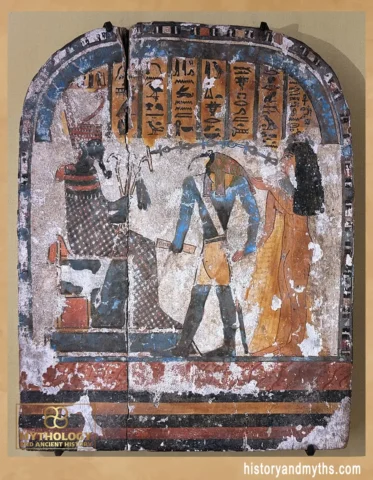
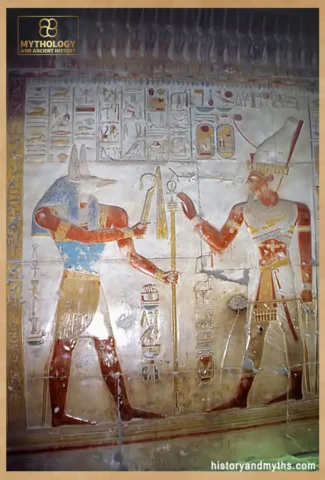
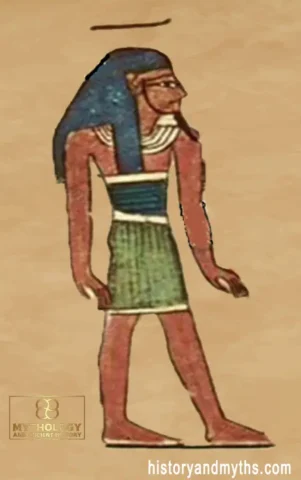
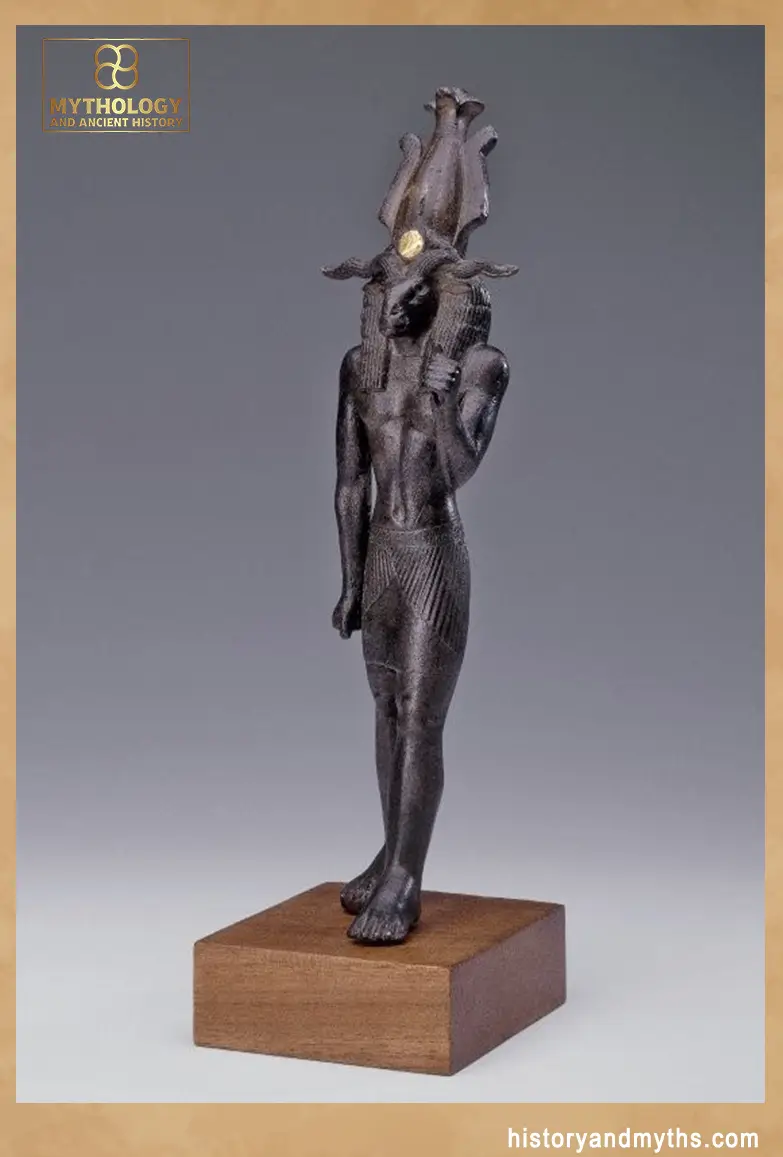
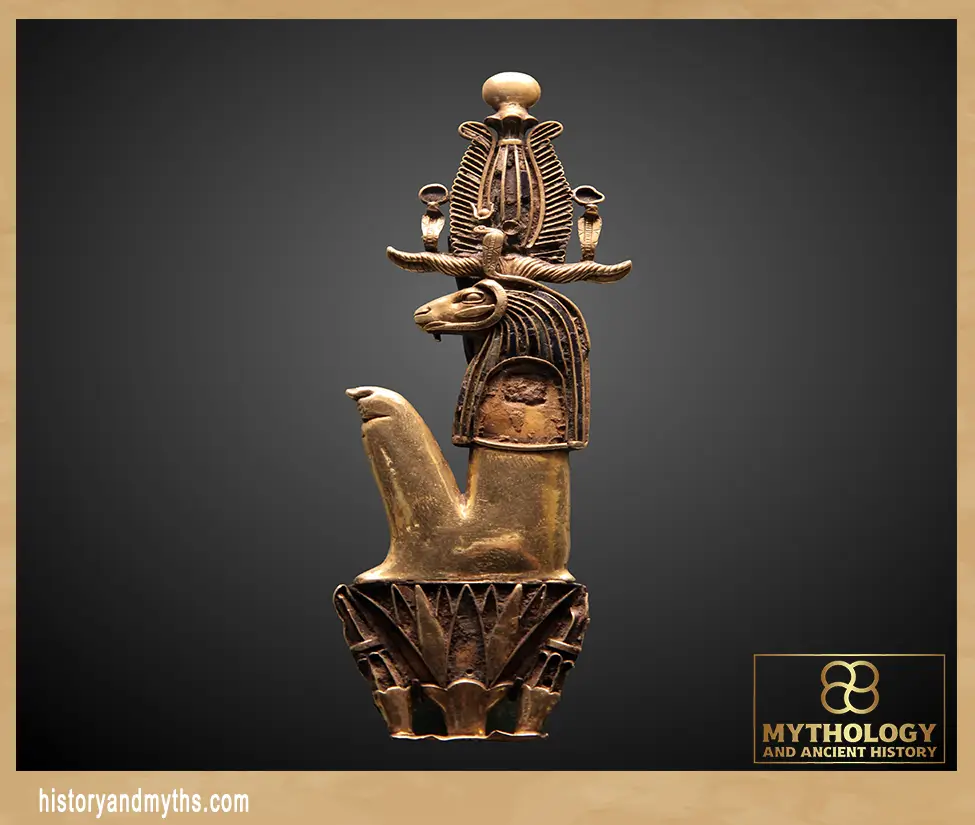
Heryshef’s visual identity is one of the most striking in Egyptian religion. He is almost always depicted as a man with the head of a ram, or sometimes as a full-bodied ram, emphasizing strength, virility, and the force of creation. The ram was a powerful symbol across Egypt, associated with gods like Khnum, Amun, and Banebdjed, but Heryshef’s ram-form carried its own unique meaning rooted not in cosmic abstraction but in the fertile waters of Heracleopolis.
The Crown and Royal Emblems
In many scenes, Heryshef wears a crown adorned with ureai (royal cobras) or solar disks, linking him to the solar creator gods Ra and Atum. These elements highlight his authority and his ability to sustain the divine order.
Sometimes he carries a scepter or ankh, reinforcing his role as both a giver of life and a patron of kingship.
Symbolism of the Sacred Lake
His epithet “He Who Is on His Lake” ties his iconography to water. The lake at his temple, likely used in purification and renewal rituals, reflected the waters from which creation first emerged.
This connection to water gave his imagery a dynamic quality: he was not a static statue but a divine force that rose, moved, and created.
Greek Interpretation: Heracles
When the Greeks encountered Heryshef, they interpreted him as Heracles due to his strength and protective nature. This association is an important part of his image, showing how foreign cultures recognized in him the qualities of a heroic, powerful deity.
Heryshef at a Glance
Heryshef, whose name means “He Who Is on His Lake,” was a creator and fertility god rooted in the quiet, life-giving waters of Heracleopolis Magna. His identity blended the steady power of nature with the authority of kingship, making him a source of renewal and legitimacy for the region.
Depicted with the head of a ram, he embodied strength, vitality, and the generative force of creation. This imagery linked him to major deities such as Ra, Atum, and Osiris, showing how his local worship merged seamlessly with Egypt’s wider theological landscape.
His sacred lake, temple rituals, and political connections reveal a god whose influence extended beyond myth—shaping how communities understood life, authority, and the constant cycle of rebirth.
Heryshef’s Role in Kingship and Political Legitimacy
Although Heryshef began as a local creator and fertility god, his influence gradually expanded into the political sphere. Heracleopolis Magna, his cult center, served at several times in Egyptian history as a seat of regional power, especially during the First Intermediate Period. Rulers who emerged from this region naturally sought to legitimize themselves through the patronage of its principal deity: Heryshef.
A God Who Grants Authority
Texts and inscriptions show that Heryshef was associated with the granting of royal legitimacy, a theme shared with great deities like Amun and Osiris. His creative power rooted in the primeval waters symbolized the strength and renewal needed by any ruler hoping to restore order during times of political fragmentation.
Connection with Osirian Kingship
As Heryshef absorbed aspects of Osiris, his role in legitimizing pharaohs grew even stronger. The king, embodying Horus on earth, drew symbolic authority from all manifestations of Osirian power. Therefore، Heryshef’s temple became a place where divine kingship could be affirmed and celebrated.
Dynastic Shifts and the Rise of His Regional Influence
When Heracleopolis emerged as a political center, especially under the 9th and 10th dynasties, Heryshef naturally rose with it. Even after Theban rulers reestablished dominance, the god retained his status as a powerful regional force a reminder of Egypt’s complex, decentralized religious landscape.
Why Did Heryshef Remain a Regional God?
Although Heryshef acquired associations with major deities such as Ra, Atum, and Osiris, he never became one of Egypt’s dominant national gods. His cult remained closely tied to Heracleopolis Magna, where his identity reflected the local landscape, sacred lake, and political traditions of Middle Egypt. Unlike Amun at Thebes or Ptah at Memphis, Heryshef’s influence did not expand alongside a long-lasting royal capital.
Egyptian religion allowed local gods to absorb the qualities of more widely worshipped deities without replacing them. As a result, Heryshef retained his importance within his own region while becoming part of a broader theological network. This balance illustrates one of the defining features of Egyptian religion: local traditions remained meaningful even as national religious systems evolved.
Legacy and Symbolic Meaning of Heryshef
Heryshef’s legacy lies not in grand myths or dramatic narratives, but in the quiet strength of a deity who represented endurance, renewal, and the sustaining power of water and life. His cult may not have reached the national prominence of Amun or Osiris, but in Heracleopolis he shaped how people understood creation, kingship, and divine protection for centuries.
A God of Renewal Rooted in the Local Landscape
The sacred lake at his temple defined his identity. It symbolized the fertile marshes of Middle Egypt regions where life depended on the rhythm of the water. Heryshef embodied this rhythm: steady, cyclical, and essential. His followers saw in him the assurance that life could regenerate even after disruption.
A Bridge Between Local and National Theology
By merging aspects of Ra, Atum, and Osiris, Heryshef demonstrates how Egyptian religion adapted over time. Local gods were never isolated; they were woven into the broader fabric of cosmic theology. Heryshef’s flexible identity allowed him to remain relevant across different eras and political landscapes.
Echoes in Greek Interpretation
The Greek association with Heracles may seem surprising at first, but it reflects a consistent perception: Heryshef embodied strength rooted in nature, a divine force that protected communities and upheld moral order. In this sense، he stood alongside heroic gods celebrated far beyond Egypt’s borders.
A Forgotten, Yet Meaningful, Presence
Today, Heryshef is one of the quieter figures in Egyptian mythology rarely discussed but deeply revealing. His story is a reminder that ancient religion was shaped not only by the great state cults but also by local deities who carried the values, fears, and hopes of specific communities.
Through Heryshef, we glimpse the world of the Middle Egyptian people: their relationship with water, land, renewal—and the divine forces that bound these elements together.
Key Takeaways
- Heryshef was a creator and fertility god whose power emerged from a sacred lake in Heracleopolis Magna.
- His ram-headed form symbolized strength, vitality, and the generative force that sustained life and kingship.
- He became closely associated with Ra, Atum, and Osiris, reflecting a flexible and layered divine identity.
- The Greeks identified him with Heracles due to his strength and protective nature.
- His cult center played a political role, providing legitimacy to rulers during key historical periods.
- Heryshef’s legacy highlights how local deities shaped Egypt’s religious and cultural landscape alongside major state gods.
Frequently Asked Questions
Who is Heryshef in ancient Egyptian religion?
Heryshef is a creator and fertility god worshipped at Heracleopolis Magna, known as “He Who Is on His Lake,” symbolizing renewal and life-giving power.
What does the name Heryshef mean?
The name means “He Who Is on His Lake,” referring to his connection with sacred waters and the creative force that emerges from them.
Why is Heryshef depicted with a ram’s head?
The ram symbolized strength, vitality, and generative energy. His ram-headed form reflects his role as a creator god and a source of renewal.
Where was Heryshef worshipped?
He was primarily worshipped at Heracleopolis Magna, where his temple and sacred lake formed the center of his religious cult.
How is Heryshef connected to Ra, Atum, and Osiris?
Heryshef shared creative aspects with Ra and Atum and later absorbed Osirian qualities tied to fertility, kingship, and rebirth.
Why did the Greeks identify Heryshef with Heracles?
Because both figures embodied great physical strength and protective authority, leading Greeks to equate Heryshef with the hero Heracles.
What is the significance of Heryshef’s sacred lake?
The lake symbolized the primeval waters of creation and served as the ritual setting for renewal and purification rites connected to the god.
Sources & Rights
- Frankfort, Henri. Kingship and the Gods: A Study of Ancient Near Eastern Religion as the Integration of Society and Nature. University of Chicago Press, 1948.
- Hart, George. A Dictionary of Egyptian Gods and Goddesses. Routledge, 2005.
- Hornung, Erik. Conceptions of God in Ancient Egypt: The One and the Many. Cornell University Press, 1996.
- Leprohon, Ronald J. The Great Name: Ancient Egyptian Royal Titulary. Society of Biblical Literature, 2013.
- Pinch, Geraldine. Handbook of Egyptian Mythology. ABC-CLIO, 2002.
- Quirke, Stephen. Ancient Egyptian Religion. British Museum Press, 1992.
- Te Velde, Herman. Seth, God of Confusion. Brill, 1977.
- Wilkinson, Richard H. The Complete Gods and Goddesses of Ancient Egypt. Thames & Hudson, 2003.
- British Museum. Collection Online.
- Louvre Museum. Collections Database.
- The Griffith Institute, University of Oxford. Topographical Bibliography of Ancient Egyptian Hieroglyphic Texts.
- UCLA Encyclopedia of Egyptology. Regional Cults, Egyptian Religion, and Divine Syncretism.
- World History Encyclopedia. Heryshef.
- Digital Egypt for Universities, University College London. Egyptian Religion and Local Cults.
- Tour Egypt. Heryshef and Heracleopolis Magna.
Written by H. Moses — All rights reserved © Mythology and History