How Fire Was Controlled in Ancient Greek Cities
Fire control in Ancient Greek cities depended on prevention, rapid response, and careful management of daily urban life rather than organized fire departments in the modern sense. Greek homes, workshops, markets, and streets regularly used open flames for cooking, heating, lighting, metalworking, and pottery production, which made crowded urban areas vulnerable to accidental fires.
Cities reduced these risks through building practices, public water access, controlled workshop areas, and immediate community response when fires broke out. Residents relied on buckets, nearby water sources, manual firefighting, and the removal of burning materials to stop flames from spreading through densely built neighborhoods and commercial districts.
Why Fire Was Dangerous in Greek Cities
Fire posed a constant threat inside Greek cities because many parts of daily urban life depended on open flames operating close to homes, workshops, storage areas, and crowded streets. Cooking fires, oil lamps, furnaces, kilns, and metalworking activities all increased the possibility of accidental ignition inside densely populated districts.
Building materials also affected the danger. Although stone appeared widely in public architecture, many roofs, doors, furniture, upper structures, and interior elements still relied heavily on wood and other flammable materials that could spread fire quickly once flames escaped control.
Urban density made the problem worse. Narrow streets and closely packed buildings reduced separation between structures, allowing heat and burning debris to move rapidly through residential and commercial areas if fires were not contained early.
| Fire Control System | How Greek Cities Managed Urban Fire Risk |
|---|---|
| Main Fire Dangers | Open flames, oil lamps, workshops, wooden structures, and dense streets increased urban fire risk. |
| Daily Use of Fire | Greek households and workshops depended on fire for cooking, lighting, heating, and industrial production. |
| Fire Prevention | Cities reduced danger through stone construction, workshop separation, and nearby water access. |
| Emergency Response | Residents responded manually using buckets, stored water, and removal of burning materials. |
| High-Risk Areas | Markets, furnaces, kilns, and workshop districts created the highest concentration of fire danger. |
How Greeks Used Fire in Daily Urban Life
Fire served essential practical functions inside Greek cities and could not be avoided in ordinary urban activity. Households used it daily for cooking food, heating rooms during colder seasons, baking bread, and providing light through oil lamps after sunset.
Workshops depended on stronger and more continuous fire sources for industrial production. Potters operated kilns at high temperatures, metalworkers used furnaces for shaping tools and weapons, and craftsmen relied on controlled heat in many manufacturing processes connected to urban economies.
Markets, religious spaces, and public gatherings also used open flames regularly through lamps, sacrifices, and food preparation. Because fire remained deeply integrated into everyday life, Greek cities focused more on controlling risk than eliminating flame entirely.
How Cities Reduced Fire Risks
Greek cities reduced fire risks by combining practical building choices with organized urban habits that limited the spread of uncontrolled flames. Stone walls, tiled roofing in some areas, and separated work spaces helped contain fires more effectively than fully wooden construction.
Dangerous activities involving furnaces, kilns, or large heat sources were often concentrated in workshop districts rather than scattered randomly through residential neighborhoods. This reduced the chance that industrial fires would spread immediately into crowded housing areas.
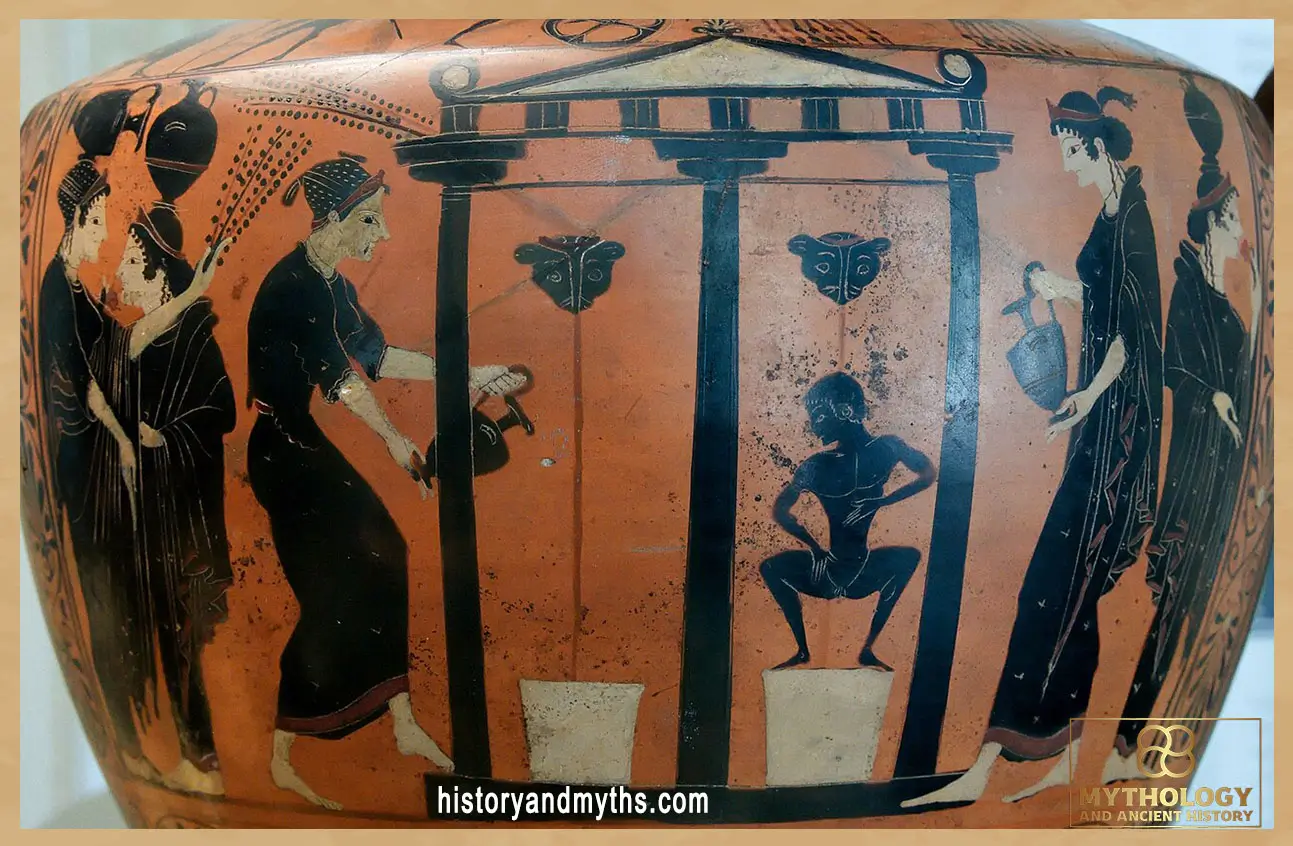
Access to water also mattered. Public fountains, wells, and stored household water provided nearby resources that residents could use quickly during emergencies before flames expanded across connected structures or market spaces.
Why Fire Control Mattered in Greek Urban Life
Ancient Greek cities depended heavily on open flames for cooking, lighting, heating, and industrial work, which made fire one of the most serious dangers inside crowded urban districts. Fire control therefore became part of daily city management through building practices, water access, workshop organization, and rapid local response during emergencies.
© historyandmyths.com — Educational use
How People Responded to Urban Fires
Greek cities relied mainly on immediate local response when fires broke out because no permanent professional fire brigade existed in the modern sense. Neighbors, workers, and nearby residents acted quickly to prevent flames from spreading through surrounding buildings and streets.
People carried water in buckets or containers from fountains, wells, and household storage areas while others removed burning materials, damaged wooden sections, or nearby objects that could feed the fire further. Fast reaction mattered more than complex equipment because urban fires could spread rapidly through crowded districts.
In severe cases, controlling the surrounding area became just as important as extinguishing the flames themselves. Limiting movement, clearing space around burning structures, and preventing panic helped reduce wider destruction inside dense urban neighborhoods.
Why Workshops and Markets Increased Fire Danger
Workshops and commercial districts created some of the highest fire risks inside Greek cities because they concentrated heat, fuel, tools, and large numbers of people within limited urban space. Pottery kilns, metal furnaces, bakeries, and cooking areas all operated with open flames capable of igniting nearby materials if accidents occurred.
Markets added further danger through crowded movement, temporary stalls, oil lamps, wooden storage containers, cloth goods, and cooking activity gathered closely together. A small uncontrolled fire in a busy commercial area could spread quickly before residents organized a response.
For this reason, cities benefited from separating some industrial activity from tightly packed residential zones whenever possible. Managing where intense heat-producing work occurred became part of broader urban safety and infrastructure planning.
Fire control in Ancient Greek cities depended on rapid community response, practical urban organization, and constant awareness of the dangers created by everyday use of open flames. Because cooking, lighting, heating, and industrial production all relied on fire, Greek urban life focused on reducing risk rather than eliminating fire entirely.
Building materials, workshop placement, nearby water access, and manual firefighting efforts all helped cities limit destruction when accidents occurred. Public safety therefore became closely connected to the physical design and daily operation of the Greek urban environment.
Key Takeaways
- Greek cities faced constant fire risk because urban life depended heavily on open flames.
- Cooking fires, oil lamps, kilns, and furnaces increased the danger inside crowded districts.
- Stone construction and workshop separation helped reduce the spread of urban fires.
- Residents responded to fires manually using water, buckets, and removal of burning materials.
- Markets and industrial areas created some of the highest concentrations of fire danger.
- Public water access became important for controlling fires inside Greek cities.
FAQ
Why were fires dangerous in Ancient Greek cities?
Dense housing, wooden structures, oil lamps, workshops, and open flames increased the risk of urban fires.
How did Ancient Greeks use fire in daily life?
Fire was used for cooking, heating, lighting, baking, pottery production, and metalworking.
Did Ancient Greek cities have fire brigades?
No permanent professional fire brigades existed in the modern sense. Residents relied on local community response.
How did people fight fires in Greek cities?
People used buckets, stored water, nearby fountains, and manual removal of burning materials to control fires.
Why were workshops dangerous in Ancient Greece?
Pottery kilns, furnaces, bakeries, and metalworking areas operated with strong open flames that increased fire risk.
Did Greek cities try to prevent fires?
Yes. Cities reduced fire danger through building practices, workshop placement, and access to nearby water sources.
How did markets increase fire danger?
Crowded commercial areas contained wooden stalls, lamps, cloth goods, and cooking activity that could spread flames quickly.
Why was water important for fire control?
Public fountains, wells, and stored household water provided immediate resources during urban fire emergencies.
Sources & Rights
- Garland, Robert. Daily Life of the Ancient Greeks. Westport: Greenwood Press, 2009.
- Wycherley, R. E. How the Greeks Built Cities. London: Macmillan, 1962.
- Owens, E. J. The City in the Greek and Roman World. London: Routledge, 1991.
- Camp, John McK. The Athenian Agora. London: Thames & Hudson, 1986.
- Tomlinson, R. A. Greek Architecture. London: Bristol Classical Press, 1991.
- Morris, Ian. Archaeology as Cultural History. Oxford: Blackwell, 2000.
- Waterfield, Robin. Athens: A History. London: Macmillan, 2004.
- Hansen, Mogens Herman. An Inventory of Archaic and Classical Poleis. Oxford: Oxford University Press, 2004.
- Burford, Alison. Land and Labor in the Greek World. Baltimore: Johns Hopkins University Press, 1993.
- Boardman, John. The Greeks Overseas. London: Thames & Hudson, 1999.
- Amemiya, Toru. Economy and Economics in Ancient Greece. London: Routledge, 2007.
- Vlassopoulos, Kostas. Unthinking the Greek Polis. Cambridge: Cambridge University Press, 2007.
- Travlos, John. Pictorial Dictionary of Ancient Athens. London: Thames & Hudson, 1971.
- Foxhall, Lin. Studying Gender in Classical Antiquity. Cambridge: Cambridge University Press, 2013.
- Pedley, John Griffiths. Sanctuaries and the Sacred in the Ancient Greek World. Cambridge: Cambridge University Press, 2005.
- Cartledge, Paul. Ancient Greece: A History in Eleven Cities. Oxford: Oxford University Press, 2009.
- Osborne, Robin. Greece in the Making. London: Routledge, 1996.
- Longfellow, Brenda. Roman Imperialism and Civic Patronage. Cambridge: Cambridge University Press, 2011.
- Wilson, Andrew. Water Management and Hydraulic Engineering in the Ancient World. Oxford: Oxford University Press, 2008.
- Hodge, A. Trevor. Roman Aqueducts & Water Supply. London: Duckworth, 2002.
Written by H. Moses — All rights reserved © Mythology and History