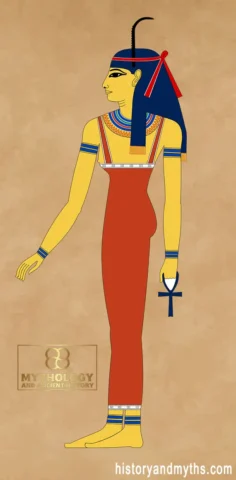
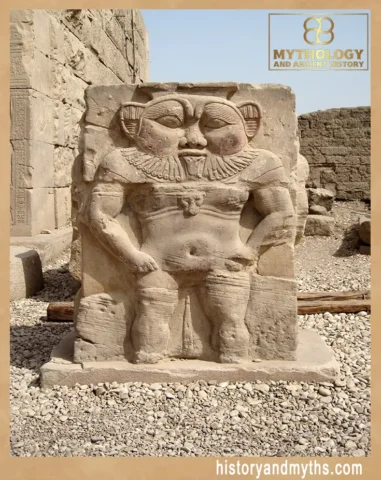
Anhur — The Egyptian Warrior God Who Restored Divine Order
In ancient Egypt’s imagination, the balance of the world was never guaranteed. Order could slip into chaos, the sun could disappear behind anger, and even the gods themselves could turn away from creation. In the middle of this tension stood a warrior deity whose role was not destruction, but restoration. Anhur—also known as Onuris—was the god who brought back what was lost, who pursued disorder across the edges of the world, and whose spear symbolized a cosmic responsibility rather than simple force.
To most modern readers he is introduced as “a god of war,” but the Egyptians saw something far more layered. Anhur was the one who chased the Eye of Ra when she fled in rage, the one who crossed foreign deserts to retrieve her, and the one whose return restored the harmony that creation depended on. He was a hunter, a guardian, and a reconciler—an unusual combination that made him one of the few deities whose stories linked the battlefield with the moral restoration of the world.
And behind his fierce image lies a philosophical question the Egyptians had been trying to answer for millennia:
What kind of power is needed to bring back a force that does not wish to return?
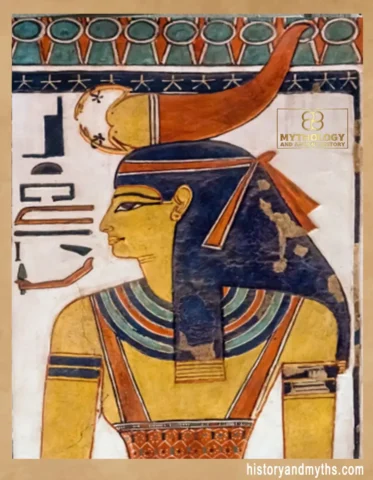
Anhur’s myths were their answer. His four-plumed crown, his lioness consort Menhit, his fusion with the god Shu in later theology—all carry clues about how the ancients thought about strength, duty, and the fragile line between chaos and order.
Who Was Anhur? A Warrior God With a Purpose Beyond Battle
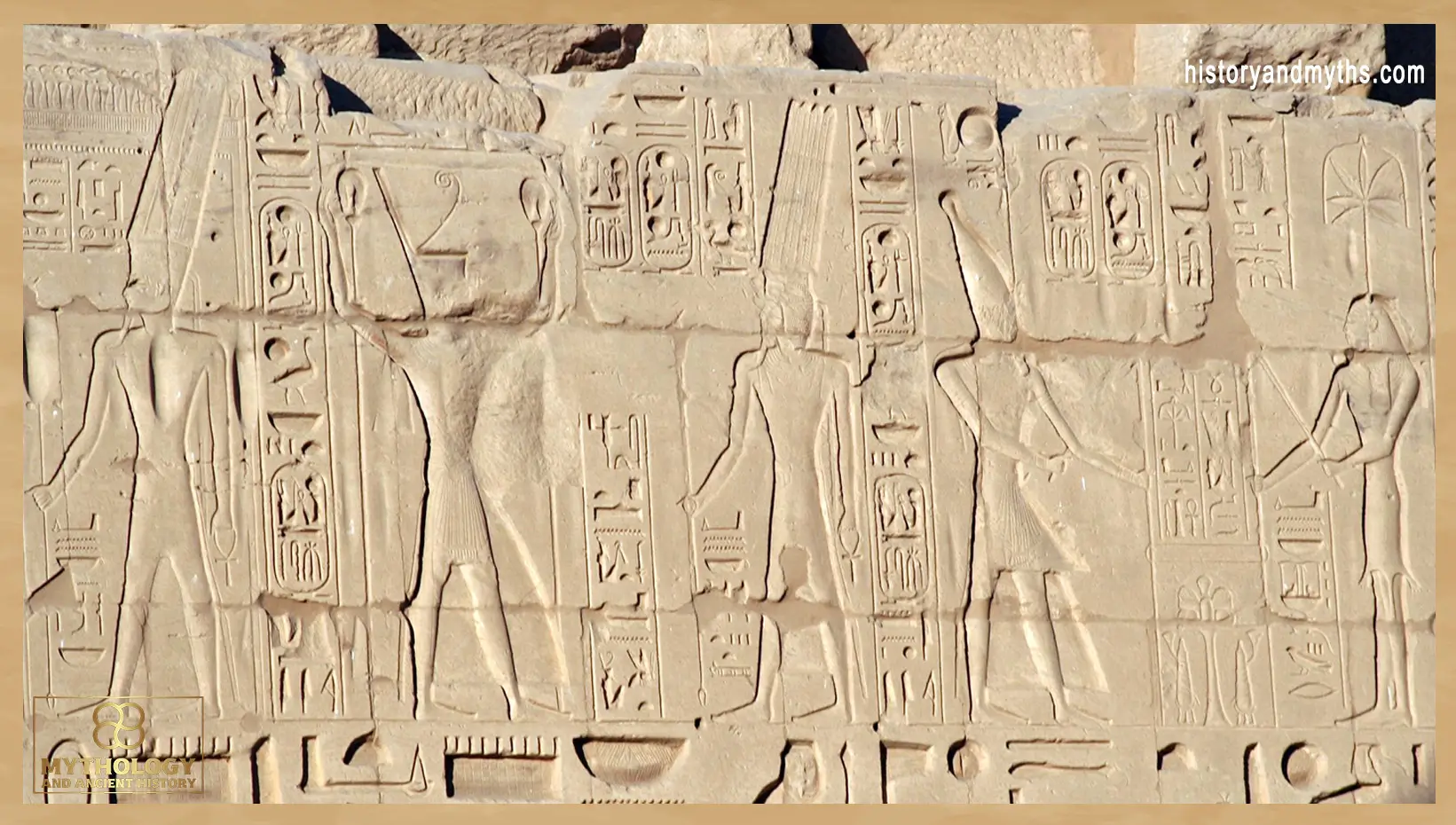
Most descriptions reduce Anhur to a simple “god of war,” but this title alone misses the deeper role he played in Egyptian thought. To the priests of Thinis and Abydos—his earliest cult centers—Anhur embodied the force that restores what has been disturbed. He did not fight for territorial glory or divine rivalry; he fought to correct imbalance. His name itself may reflect this mission: “the One Who Leads Back,” a reference to his pursuit of the Eye of Ra when she abandoned the world in anger. This myth became the template through which Egyptians understood his identity. A god who does not merely defeat enemies, but retrieves what is sacred and returns it to its rightful place.
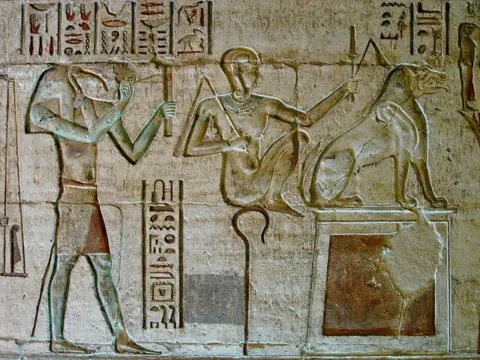
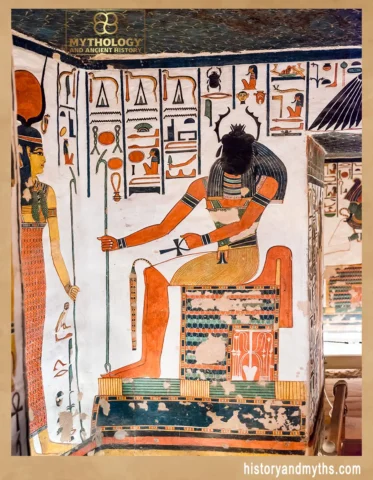
This is also why Anhur appears alongside royal ideology. Pharaohs invoked him not just for victory, but for legitimacy, framing their campaigns as acts that “bring back order” in a cosmic sense. In temple reliefs from the New Kingdom to the Greco-Roman period, he is shown with a spear, a tall four-plumed crown, and a posture that communicates motion—almost as if he is always on the verge of setting out again. His essence, to the Egyptians, was tied to action: movement outward to confront chaos, and movement back inward carrying restoration.
| Name | Anhur (Onuris / Onouris) |
| Domain | War, restoration, retrieval of divine order |
| Primary Role | The god who “brings back what is lost,” especially the Eye of Ra |
| Symbols | Four-plumed crown, long spear, forward-striding posture |
| Consort | Menhit (lioness goddess of fierce divine power) |
| Cult Centers | Thinis, Abydos, later adopted in Greco-Roman temples |
| Theological Evolution | Merged with Shu as a cosmic stabilizing force |
| Key Myth | Retrieving the Eye of Ra from distant lands |
The Myth of the Returning Goddess — Anhur and the Lost Eye of Ra
One of the most intriguing stories connected to Anhur does not begin on a battlefield, but with a disappearance. In Egyptian cosmology, the Eye of Ra—the fierce, feminine extension of the sun god—could abandon creation when angered or neglected. When she left, the world suffered: rivers lost their rhythm, crops faltered, and the protective glare of the sun dimmed. Her absence symbolized more than a missing deity; it represented the withdrawal of divine order itself.
In this myth, Anhur becomes the god entrusted with a task no ordinary warrior could fulfill: to cross distant deserts, confront whatever forces kept the Eye away, and persuade—or compel—her to return. This journey reflects a theological truth the Egyptians held deeply: chaos is not an external enemy alone; sometimes it is what happens when a necessary force refuses its role. The challenge was not merely physical. Anhur’s mission required the ability to face a divine being whose rage had already destabilized the world.
When he finally brought her back, the restoration was not described as a triumph of violence. Instead, priests emphasized his ability to retrieve what was lost, a power Egyptians regarded as fundamentally different from simply defeating an enemy. His return with the Eye of Ra re-lit the sun’s authority, rebalanced the world’s moral tension, and reshaped Anhur’s identity into something more profound than a spear-bearing god.
He became a symbol of the force that reconciles, retrieves, and re-establishes the sacred rhythm of existence.
For this reason, the myth appears in several temple contexts as a ritual reenactment of renewal. Bringing the Eye home was not just a mythic episode—it was a cosmic principle. And Anhur was the divine figure who made that principle visible.
Symbols and Iconography — What Anhur’s Crown, Spear, and Appearance Really Mean
The image of Anhur in Egyptian art is instantly recognizable, yet often misunderstood. His tall four-plumed crown and long spear are usually described as “signs of war,” but the symbolism behind them reaches far beyond violence. Each element carries a specific theological meaning connected to his role as a restorer of order.
The four-plumed crown, unique among Egyptian deities, communicates elevation—literally and conceptually. Feathers in Egyptian iconography often represent the air, the sky, and the spaces through which divine presence moves. Multiplying them into four towering plumes suggests not just height, but directionality: a god able to ascend, to travel, and to reach beyond the ordinary sphere of the gods. It visually encodes Anhur as a deity who goes outward on missions, not one who waits within temple walls.
The spear he carries is equally misunderstood. Rather than a symbol of aggression alone, the spear marks precision—a force used with clarity and purpose. In temple inscriptions from the New Kingdom, Anhur is invoked as the one who “goes to bring back what is distant.” The spear, in this sense, becomes the emblem of a targeted return, the instrument of a god who retrieves rather than destroys.
His typical depiction in stride, with one leg forward, reinforces this idea of movement. Egyptian art is highly deliberate: when a god is shown advancing, it is a theological statement, not an artistic flourish. Anhur is not static because his essence is not static. He is the forward-motion deity, the one whose very posture expresses his cosmic duty.
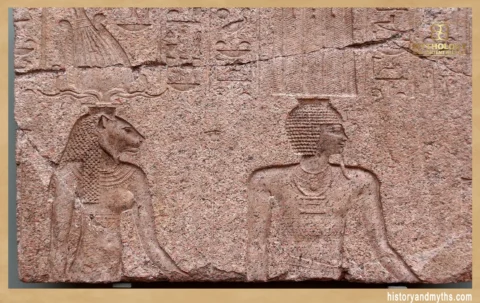
And finally, his close association with the lioness goddess Menhit adds another symbolic layer. In Egyptian thought, lionesses embodied raw divine force—aggression, heat, and untamable power. For Anhur to be linked with Menhit is to situate him within that spectrum while still positioning him as the more stabilizing presence. Together, they form a pair that represents both the surge of divine energy and the act of guiding it back into balance.
Anhur and Menhit — A Divine Partnership Rooted in Power and Restoration
In the theology of ancient Egypt, divine pairs were never arbitrary. When two deities were joined, the relationship expressed a principle of balance—two forces that complete or regulate one another. The pairing of Anhur and the lioness goddess Menhit is one of the clearest examples of this dynamic.
Menhit, whose name suggests “the One Who Slaughters” or “the Powerful One,” embodies the fierce and uncontrolled heat associated with the desert sun and the raw fury of divine aggression. She represents the moment when sacred force becomes overwhelming—when the Eye of Ra blazes too fiercely or when cosmic anger threatens creation. Her power is essential, but dangerous when unrestrained.
Anhur, by contrast, is the force that channels this intensity and returns it to purpose. Where Menhit symbolizes unleashed divine energy, Anhur symbolizes the act of retrieving, directing, and stabilizing that energy. This is why, in some theological traditions, the two are depicted in ritual roles where Menhit acts as the fiery manifestation and Anhur as the one who restores equilibrium.
Their union therefore expresses a deeply philosophical idea:
power is not complete unless it includes both the surge and the return.
Menhit provides the heat; Anhur provides the movement back toward order. Their roles mirror the myth of the returning Eye of Ra, where Anhur’s mission is not to extinguish divine wrath, but to guide it home.
This partnership also influenced royal ideology. Kings invoked Anhur for victory and Menhit for protective ferocity, using the pair to frame warfare as morally justified action—a controlled fire rather than chaotic destruction. In this sense, Anhur and Menhit became a symbolic template for how Egyptians imagined rightful force: scorching when necessary, but always brought back into balance.
From Warrior to Cosmic Principle — Anhur’s Later Fusion with Shu
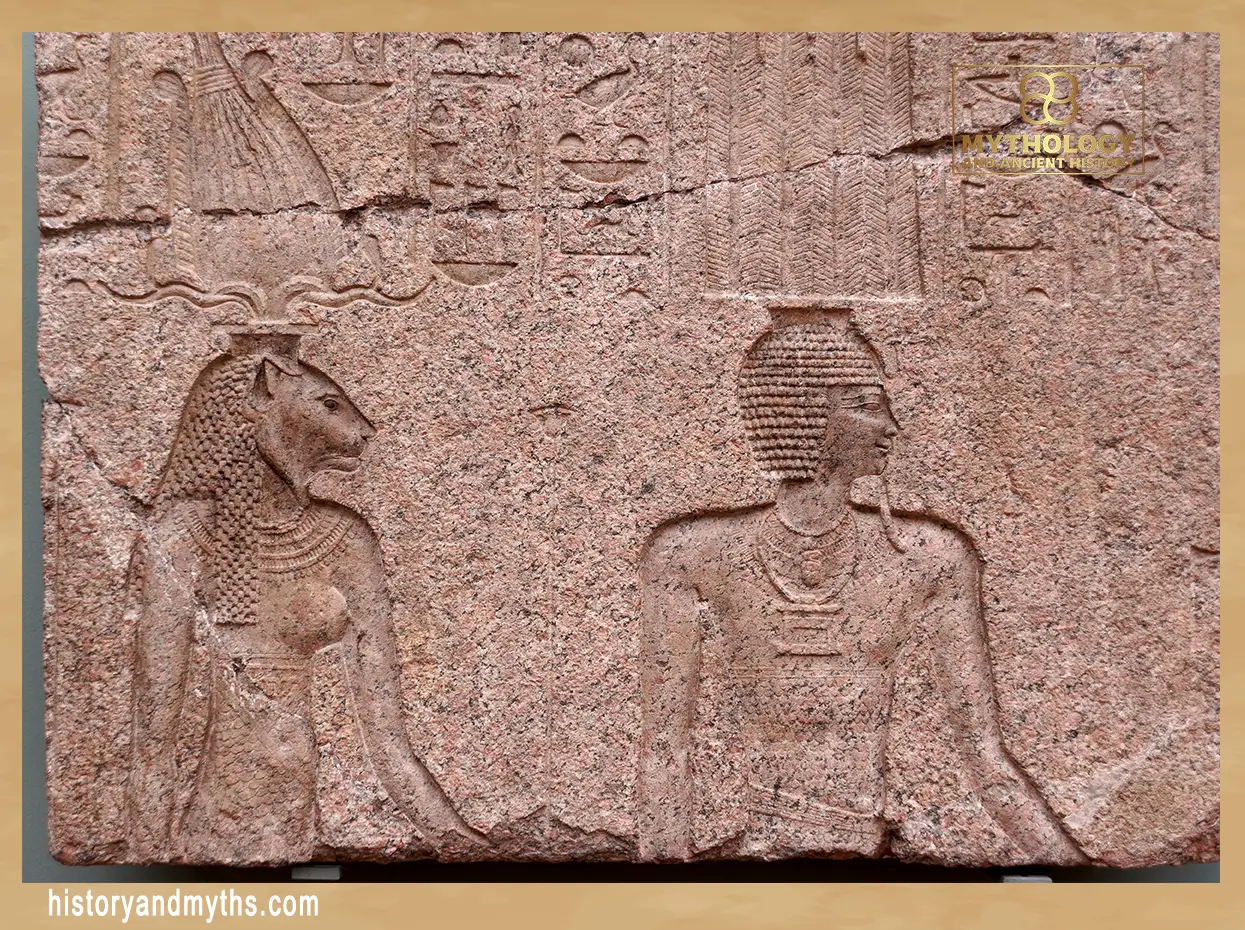
As Egyptian religion evolved, many deities merged not out of confusion, but to express deeper theological ideas. The association of Anhur with Shu—the god of air, light, and separation—reveals how the Egyptians began to understand Anhur’s role as more than martial strength.
Shu is the deity who holds the sky and earth apart, creating the vital space in which life, breath, and order can exist. His function is cosmic stabilization. When Anhur became increasingly linked to Shu, especially in later periods, it was not a simple replacement but a conceptual elevation. Anhur’s identity as the god who “brings back what is distant” aligned naturally with Shu’s task of maintaining the ordered structure of the world.
Both deities deal with distance, separation, and restoration of balance:
- Shu separates Nut and Geb to form the world.
- Anhur separates chaos from order by retrieving what has been lost.
- Shu creates space for life.
- Anhur restores the forces needed to keep that space stable.
The fusion also explains their shared iconography. The tall four-plumed crown that marks Anhur resembles the lofty symbolism of air and elevation associated with Shu. In some traditions, the merged deity was called “Anhur-Shu,” reflecting a god whose authority extended from the battlefield to the framework of the cosmos itself.
This theological evolution mattered because it redefined how Egyptians interpreted strength. Anhur was no longer only the one who acts outward to confront disorder; he also became the one who upholds the world’s internal architecture. His mythic journey after the Eye of Ra transformed into a broader cosmic principle:
order must continually be retrieved, upheld, and re-established.
In this way, the integration of Anhur with Shu did not diminish his identity—it universalized it. The warrior became a stabilizer, the hunter became a guardian of cosmic structure, and the returning force became part of the world’s ongoing balance.
Worship and Cult Centers — How Anhur’s Devotion Spread From Thinis to the Wider Egyptian World
Anhur’s earliest home was the region of Thinis and Abydos in Upper Egypt, an area deeply associated with kingship, ancestral memory, and the boundary between the mortal world and the divine. His presence there was not accidental. Thinis had a long tradition of celebrating protective and martial deities, and Anhur fit naturally into a landscape shaped by both military pride and ritual continuity. Local priests described him not just as a warrior, but as the god who ensured that what belonged to Egypt would always return to Egypt—territory, stability, and cosmic favor.
As the Egyptian state grew more centralized, Anhur’s cult expanded alongside royal ideology. During the Middle and New Kingdoms, he became associated with state-sponsored rituals and military ceremonies. Pharaohs invoked him before campaigns, and temple inscriptions recorded him as a divine patron who guaranteed not just victory, but the moral justification behind it. His role reinforced the idea that legitimate conflict was an act of restoring order, not seeking conquest for its own sake.
By the time of the Greco-Roman period, Anhur took on a broader identity. Foreign soldiers serving in Egypt—especially Nubian and Libyan troops—found in him a deity who matched their own martial traditions. This contributed to the spread of his cult beyond its original heartland. Some temples began to portray him with Hellenistic stylistic features, and his name appeared in forms such as “Onuris,” showing how he bridged Egyptian and Greek religious worlds.
In addition, his fusion with Shu gave him a new ritual importance. Shrines that once honored Shu alone began to incorporate Anhur’s iconography, and vice versa. This made him part of the cosmological liturgy, not only the military one. Priests recited hymns presenting him as both the one who “travels outward” and the one who “upholds the space of creation,” blending his warrior and cosmic identities into a single theological role.
Even though no massive temple complex dedicated solely to Anhur has survived intact, the inscriptions that remain show a deity who was present in festivals, state ceremonies, and everyday protective rituals. His cult was practical, symbolic, and deeply intertwined with how Egyptians imagined the maintenance of order.
What Did Anhur Represent? Understanding His Role in the Egyptian Worldview
To understand Anhur is to understand a central concern of Egyptian religion: the fragile boundary between order and disorder. The Egyptians did not see the world as stable by default. Stability had to be renewed, guarded, and reclaimed. Every sunrise, every successful harvest, every peaceful day represented a victory in an ongoing struggle to maintain balance. Anhur embodied precisely the force that enabled this renewal.
He represented the act of retrieval—a concept that sits between protection and restoration. While many gods defended Egypt from external threats, Anhur dealt with a more subtle danger: the loss of something essential. This could be the Eye of Ra, divine favor, stability, or even the moral rhythm that held society together. His mythological journeys symbolized the principle that what is lost must not remain lost; it must be brought back for the world to function.
Another dimension of his role lies in his connection to legitimacy and rightful power. Pharaohs invoked him to present their authority not as domination, but as an extension of cosmic duty. Anhur’s victories were framed as acts that re-establish what is proper—not campaigns of expansion, but missions of balance. This made him a god whose symbolic weight exceeded the battlefield. His presence confirmed that strength used in the service of order was sacred.
His later fusion with Shu further clarifies this meaning. By aligning Anhur with the god who separates sky from earth, Egyptian theologians signaled that retrieval and stabilization were two expressions of the same cosmic function. If Shu created the necessary “space of life,” Anhur ensured that the elements within that space stayed where they belonged. Together, they expressed the idea that creation is not a single event, but a continuous process of anchoring, returning, and preserving harmony.
At a practical level, Anhur also represented the disciplined use of force. In Egyptian art and inscriptions, his spear is not an emblem of violence but of precision. His posture conveys readiness, not aggression. He stands as the model of strength that knows its role, a divine reminder that power has meaning only when it restores rather than disrupts.
In all these ways, Anhur served as a philosophical anchor in Egyptian thought—a deity who personified the courage to retrieve, the clarity to act, and the responsibility to rebuild what keeps the world whole.
Anhur at a Glance
- More than a war god: Anhur represents the power that restores balance, not merely the force that wins battles.
- Unique mythic role: He retrieves the Eye of Ra when she abandons creation—symbolizing the return of stability and divine order.
- Iconic imagery: His four-plumed crown signals elevation and movement, marking him as a deity who travels outward to confront disorder.
- Divine partnership: With Menhit, he embodies the relationship between fierce divine energy and the disciplined force that guides it back to purpose.
- Cosmic evolution: Later merged with Shu, expanding his role from a regional warrior to a stabilizer of the cosmos.
- Royal significance: Pharaohs invoked him to justify campaigns as acts of restoring order, not conquest.
- Cross-cultural presence: Adopted by Greek observers—identified with Ares but seen as more controlled and purposeful.
© historyandmyths.com — Educational use
Roles and Functions — How Egyptians Invoked Anhur in Daily Life and State Rituals
Anhur’s position in Egyptian religion was not limited to myth or temple imagery. He fulfilled a series of practical, ritual, and symbolic roles that shaped how both ordinary people and the state understood protection, legitimacy, and the restoration of order.
1. Protector of the King and State Power
In royal ideology, Anhur was invoked as the force that justified military action. He was not merely the god who ensured victory; he was the god who transformed conflict into an act of restoring balance. Pharaohs called upon him before campaigns to frame their battles as cosmic duties rather than political ambitions. This connection made him an essential component of coronation rituals and festival reenactments where kings affirmed their role as guardians of order.
2. Patron of Soldiers and Elite Warriors
In artistic scenes and inscriptions, soldiers often appealed to Anhur as a divine model of courage and discipline. He represented not reckless aggression, but the ideal warrior who knows when to strike and why. Foreign troops serving in the Egyptian army—Libyan, Nubian, and others—also adopted him because his identity resonated with their own martial traditions. In this way, Anhur became a bridge between Egyptian and non-Egyptian military cultures.
3. Restorer of Lost Forces
This function is unique to Anhur and distinguishes him from all other war deities. Egyptians turned to him for symbolic restoration—recovering favor, harmony, or divine attention. Ritual texts mention him in contexts where balance had been shaken, even in non-military settings. His mythic retrieval of the Eye of Ra made him the patron of “returning what has gone away,” whether literal or spiritual.
4. Stabilizer of Cosmic Order (after his fusion with Shu)
When theologians linked Anhur with Shu, his role expanded into the cosmic sphere. He became part of the machinery that holds creation together. Hymns describe him as “the one who upholds the spaces of life,” placing him alongside deities who maintain the structure of the universe. This elevated him from local warrior god to a cosmic stabilizer whose actions affected not just Egypt, but the framework of existence.
5. Guardian in Festivals and Processions
In temple festivals, Anhur often appeared in processions carrying spears or ritual emblems. His forward-striding posture made him an ideal figure to lead symbolic journeys representing renewal, return, and the safeguarding of sacred spaces. He was a visible reminder that protection is not passive—it must be enacted.
6. Symbol of Disciplined Power in Daily Piety
For ordinary Egyptians, Anhur symbolized the kind of strength one should aspire to: purposeful, restrained, and aligned with moral duty. His imagery appeared on amulets and offerings left by people seeking courage, clarity, or the ability to navigate difficult decisions.
Through these roles, Anhur became a multifaceted deity. He was feared for his precision, admired for his resolve, and respected for the balance he restored. His influence stretched from the battlefield to the cosmos, from the king’s throne to the private hopes of common worshippers.
Legacy and Later Interpretations — How Anhur Survived Through Greco-Roman Religion and Modern Scholarship
By the time Egypt entered the Greco-Roman period, Anhur had already evolved from a regional warrior deity into a figure with layered cosmic and ethical meanings. This made him particularly adaptable in a world where Egyptian and Greek cultures were intersecting. Instead of fading, his identity took on new dimensions.
Greek observers identified him with Ares, but not the chaotic Ares of Homer. They saw in Anhur a more disciplined and purposeful form of martial power—a god whose violence was justified by restoration rather than rage. This comparison helped the Greeks interpret Egyptian religion through their own framework, but it also highlighted the distinctiveness of Anhur’s character. He was the restorer, the pursuer of what must return, a warrior whose mission served cosmic order.
In temple inscriptions from the Roman era, Anhur appears beside deities who represented universal stability, such as Shu and Thoth. This placement reflects how priests increasingly viewed him as a cosmic principle. His spear, once an emblem of targeted force, came to symbolize the divine ability to cut through confusion and re-establish clarity—physical, spiritual, or moral.
Even after active worship declined, Anhur remained significant in the intellectual memory of Egypt. Medieval writers preserved fragments of his myths, often without naming him directly, while modern Egyptology restored his place through archaeological findings in Abydos, Thinis, and temple reliefs from Edfu and Dendera. Scholars today view Anhur as a key figure for understanding how the Egyptians imagined controlled power, legitimate authority, and the continual need to retrieve what sustains creation.
His legacy also survives in the broader philosophical questions he raises:
What does it mean to act with strength for the sake of balance?
How does a society preserve what is essential when it slips away?
And what role should power play in correcting the world rather than reshaping it for its own sake?
In this light, Anhur stands not only as a god of war, but as a symbol of responsibility—one whose spear points outward to confront disorder, and inward to restore the harmony that allows life to continue.
Key Takeaways
- Anhur was not simply a god of war—he personified the act of restoring what is lost, especially the Eye of Ra.
- His four-plumed crown and spear symbolize movement, purpose, and cosmic elevation rather than aggression alone.
- His partnership with Menhit expresses the union of fierce divine power with the disciplined force that returns it to balance.
- Anhur’s fusion with Shu transformed him into a cosmic stabilizer, connecting his martial strength with the structure of creation.
- Egyptian kings invoked him to frame warfare as a moral duty—restoring order instead of expanding territory.
- In the Greco-Roman world, he was identified with Ares but seen as more controlled, purposeful, and tied to cosmic harmony.
- His legacy survives as a symbol of responsible power: force used not to dominate, but to retrieve, protect, and restore.
Frequently Asked Questions about Anhur (Onuris)
Who was Anhur in ancient Egyptian mythology?
Anhur was an ancient Egyptian god of war and restoration, known for retrieving what had been lost—especially the Eye of Ra—and for helping maintain cosmic order.
Is Anhur the same as Onuris?
Yes. Onuris (and sometimes Onouris) is the Greek-influenced form of the name Anhur; all refer to the same deity, though “Anhur” is closer to the original Egyptian form.
What does Anhur’s name mean?
Many scholars understand his name as “the one who leads back” or “the one who brings back,” reflecting his role in returning the Eye of Ra and restoring balance.
What was Anhur’s role in the myth of the Eye of Ra?
In this myth, Anhur is sent to pursue the Eye of Ra when she leaves creation in anger. He travels to distant lands, persuades or compels her to return, and with her return, cosmic order is renewed.
Why is Anhur shown with a four-plumed crown and a spear?
The four-plumed crown emphasizes elevation, movement, and reach across the world, while the spear symbolizes precise, purposeful force used to restore order rather than simple aggression.
Who was Menhit, and how is she related to Anhur?
Menhit is a lioness goddess embodying fierce divine power. As Anhur’s consort, she represents raw force, while he represents the disciplined power that guides that force back toward balance.
How did Anhur’s role change when he was linked with Shu?
When Anhur was merged with Shu, he gained a wider cosmic role. He was no longer only a war god but also a stabilizer of creation, helping maintain the space in which life and order exist.
How did the ancient Greeks view Anhur?
Greek writers often compared Anhur to Ares, but saw him as a more controlled and purposeful war god whose strength was tied to restoring order rather than uncontrolled rage.
Was Anhur widely worshipped in Egypt?
Anhur’s earliest cult centers were in Thinis and Abydos, but his worship spread through military and state rituals, later reaching a wider audience in the Greco-Roman period.
What makes Anhur different from other Egyptian war gods?
Unlike deities who focus mainly on victory, Anhur represents disciplined, restorative power. His defining feature is bringing back what is essential for the world to remain in balance.
Sources & Rights
- Frankfort, Henri. Ancient Egyptian Religion: An Interpretation. University of Chicago Press.
- Hart, George. A Dictionary of Egyptian Gods and Goddesses. Routledge.
- Pinch, Geraldine. Egyptian Mythology: A Guide to the Gods, Goddesses, and Traditions of Ancient Egypt. Oxford University Press.
- Wilkinson, Richard H. The Complete Gods and Goddesses of Ancient Egypt. Thames & Hudson.
- Assmann, Jan. Egyptian Solar Religion in the New Kingdom. Kegan Paul International.
- Lesko, Leonard. “Theological Implications of Divine Syncretism in Egypt.” Journal of Near Eastern Studies.
- Bleeker, C. J. The Egyptian God Shu. Brill.
- O’Connor, David. “Abydos and the Cult of Osiris.” In Egyptian Religion and Society, edited by Byron Shafer.
- Traunecker, Claude. The Gods of Egypt. Cornell University Press.
Written by H. Moses — All rights reserved © Mythology and History