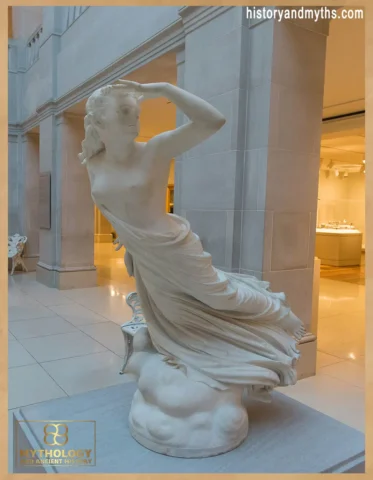
Nephele: The Greek Cloud Nymph of Illusion and Mercy
Among the many figures who drift between heaven and earth in Greek myth, few are as elusive and poetic as Nephele, the living cloud. Her name itself means “cloud” in ancient Greek, and she exists at the threshold between vapor and flesh — a spirit of mist given human form. Unlike the mighty Olympians or tragic mortals, Nephele’s essence is fleeting: she is creation, illusion, and transformation all at once.
In one story, Zeus shapes Nephele from the air itself to resemble his wife Hera, a phantom of divine jealousy meant to deceive the reckless Ixion. In another, she becomes the wife of King Athamas of Boeotia, mother of Phrixus and Helle, whose flight on the golden ram would mark the beginning of the legend of the Golden Fleece. Between these two myths — the divine and the mortal — Nephele floats like her own element: never bound, always shifting.
Yet beneath her vaporous grace lies a profound symbol. Nephele represents the fragile meeting of illusion and reality, the moment when the unseen takes form. To the Greeks, she was not only a character but an idea — the spirit of clouds, of change, of that thin, trembling veil that separates gods from mortals.

The Creation of Nephele: Zeus’s Phantom of the Clouds
The earliest and most striking account of Nephele begins with Zeus’s deception of Ixion, one of the darkest and most cautionary tales in Greek myth. Ixion, a mortal king invited to dine among the gods, grew so arrogant that he lusted after Hera herself. To test him — and to expose his transgression — Zeus gathered the mist of heaven and shaped it into an image of the queen of Olympus. This shape, luminous yet empty, was Nephele: a divine illusion made of vapor.
When Ixion embraced the phantom, believing it to be Hera, the act fulfilled Zeus’s trap. From this union of mortal desire and celestial mist were born the Centaurs, wild beings of dual nature — half man, half horse — embodying the untamed mixture of heaven and earth. Thus, Nephele’s first appearance in myth was as the mother of paradox, her body the meeting point of delusion and creation.
Through her, the Greeks expressed a truth that reached beyond morality: that passion can give form to illusion, and illusion can give birth to life. The story of Nephele and Ixion was more than a myth of deceit — it was a meditation on illusion as a creative force, showing how even the gods used deception to mirror the weaknesses of humankind.
Nephele, the cloud made flesh, carried no guilt of her own; she was the instrument of divine justice, and at the same time, a reminder that all forms — even the most beautiful — are temporary shapes of air.
| Aspect | Details (Nephele) | Notes |
|---|---|---|
| Name & Meaning | Nephele — from Greek “νεφέλη,” meaning “cloud.” | Personification of clouds |
| Type | Minor goddess / cloud nymph | Embodies transformation & illusion |
| Parentage | Created by Zeus from the mists of heaven | Shaped in Hera’s likeness to deceive Ixion |
| Consorts | Ixion (divine illusion), Athamas (mortal husband) | Bridges divine and mortal realms |
| Children | Centaurs (by Ixion), Phrixus & Helle (by Athamas) | Origin of the Golden Fleece myth |
| Symbolism | Illusion, mercy, transformation, impermanence | Represents the spirit of clouds and change |
Nephele and Athamas: The Cloud That Became a Mother
After her brief, spectral role in the trial of Ixion, Nephele reappears in a different mythic form — no longer a phantom of Hera, but a living woman, married to the mortal King Athamas of Boeotia. In this version, she is no longer merely illusion: she becomes the embodiment of transformation, the cloud that takes on warmth, love, and human sorrow.
Nephele bore Athamas two children, Phrixus and Helle, whose destiny would ripple through Greek legend. But their marriage soon darkened when Athamas abandoned her for Ino, the ambitious daughter of Cadmus. Betrayed and heartbroken, Nephele withdrew, leaving her children vulnerable to Ino’s jealousy. Ino, seeking to destroy them, plotted to bring famine upon the land and to demand their sacrifice to appease the gods.
In the moment of crisis, the divine still remembered the cloud-mother. Nephele, moved by her children’s peril, sent a golden ram with wings — a creature born from her own essence of air and light — to carry them away. The ram lifted Phrixus and Helle into the sky, escaping the sacrificial pyre. As they fled across the sea, Helle fell, giving her name to the Hellespont, while Phrixus survived and reached Colchis, where he offered the ram to Zeus. Its golden fleece would become one of the most famous relics in Greek myth — the prize sought by Jason and the Argonauts.
Through this story, Nephele’s role expands far beyond a divine trick: she becomes the origin of salvation and legend, a mother whose sorrow and protection shaped one of mythology’s greatest quests. Her cloud-born nature made her both intangible and eternal — the guardian who could vanish from sight yet leave behind miracles.
The Symbolism of Nephele: Illusion, Transformation, and Mercy
Beneath the myths that surround her—both the phantom who deceived Ixion and the mother who saved her children—lies the deeper poetry of Nephele’s nature. She is not a goddess of power, but of transition. Her being is mist, and mist in Greek thought stood for everything that blurs the borders between divine and mortal, appearance and essence, truth and dream.
When Zeus shaped Nephele, he created more than a weapon of deception: he birthed the idea of illusion as creation. From her came the Centaurs, creatures neither fully human nor fully beast—symbols of the struggle within nature and within the human soul. When she became the wife of Athamas, the same fluid nature allowed her to cross from heaven to earth, to become woman, mother, and protector. She is the metamorphosis of air into compassion.
In the old Greek cosmology, clouds were the garments of the gods, veils that hid or revealed divine will. Nephele, as the living cloud, personified that veil. She could obscure truth or deliver mercy; she was as capable of deception as of salvation. Her myths reveal the dual face of nature itself—the power to harm through storm or to bless through rain.
Philosophically, Nephele mirrors the ancient understanding of impermanence: that all forms are temporary condensations of a greater spirit. Just as clouds dissolve back into sky, so every human story returns to its unseen source. In this sense, Nephele was a cosmic reminder that beauty and sorrow alike are moments of condensation in the vast weather of existence.
☁️ The Essence of Nephele at a Glance
- Origin: Formed by Zeus from the mist of heaven to resemble Hera.
- Nature: Cloud nymph and personification of illusion and mercy.
- Dual Myths: Deception of Ixion → Birth of Centaurs; Mother of Phrixus and Helle → Golden Fleece legend.
- Element: Air and vapor — symbol of impermanence and transformation.
- Philosophical Meaning: Embodies the fleeting boundary between gods and mortals, reality and illusion.
- Legacy: Name survives in words like “nebula,” “nephology,” and the concept of clouds in art and science.
From Mist to Myth: Nephele’s Place in the Greek Imagination
The Greeks lived beneath skies that changed by the hour — a land of sudden storms, dazzling sun, and veils of vapor sliding over mountain peaks. For them, weather was not impersonal; it was divine language. Within that worldview, Nephele stood as the personification of the shifting heavens, a cloud made conscious. Her stories allowed ancient listeners to see the moods of the sky not as chance but as emotion given form — jealousy, sorrow, tenderness, and mercy expressed through rain and light.
Unlike the Olympian gods, Nephele never ruled or punished. She appeared and vanished, shaping events through presence rather than command. To poets like Pindar and later writers of the Hellenistic age, she embodied the paradox of nature: soft yet powerful, capable of giving life or ending it. The same cloud that deceived Ixion could also cradle Phrixus and Helle toward safety.
In temple hymns and rural rituals, clouds often symbolized the approach of divine will — a covering that both conceals and reveals. Nephele’s myth, then, explained why the sky hides truth within beauty. The Greeks could look upward at passing clouds and see in them her ancient story: the ghostly outline of Hera, the fleeing mother, the merciful veil that moves between humankind and the lightning of Zeus.
Her image became a meditation on perception itself. Every shape in the sky was a reminder that reality is as fleeting as a cloud — and that, like Nephele, what appears insubstantial can change the course of fate.
Nephele’s Descendants and the Lineage of Air and Motion
Though her form was born of vapor, Nephele left behind a lineage that shaped mythic history. Through her brief union with Ixion came the Centaurs, creatures of duality — half-man, half-horse — whose wild nature symbolized the tension between instinct and intellect. They embodied the same inner conflict that defined their mother: part ethereal, part earthly. In her, the Greeks saw the moment when the intangible takes body; in them, they saw the struggle that follows.
Her mortal children, Phrixus and Helle, carried her story into the human world. Their escape upon the golden ram not only introduced one of mythology’s most famous artifacts — the Golden Fleece — but also continued Nephele’s elemental legacy. The ram’s shining wool, gleaming like sunlight through mist, was a fragment of her own divine substance. It was as though the heavens themselves had sent a piece of cloud to guide mortals toward redemption.
The Centaurs, wild and divided; the ram, luminous and saving — all trace back to Nephele’s essence as the power of air transformed into motion. Through her, the Greeks imagined the invisible currents of the world — wind, breath, storm — as living agents with emotion and will. Her descendants, whether beasts or heroes, represent the perpetual movement of spirit through matter.
Even long after her name faded from common worship, Nephele’s legacy endured in every myth of flight, illusion, and transformation. Wherever the Greeks envisioned a boundary crossed — sky to earth, thought to flesh, dream to form — they invoked her invisible presence.
The Philosophy Behind the Cloud: Nephele as an Ancient Metaphor
Beyond her narrative role, Nephele survives as one of the oldest philosophical metaphors in Greek thought — an image that allowed poets and thinkers to speak about perception, illusion, and the mutable nature of reality. Her body of mist and her twofold story—creation and compassion—encapsulate a truth that the early philosophers later explored in different terms: that everything visible is temporary condensation, and that permanence exists only in the unseen.
In pre-Socratic cosmology, especially in the thought of Anaximenes, air was the primal element from which all things condensed or dissolved. Nephele, whose very name means “cloud,” personifies that process in mythic form. She is the living illustration of aer becoming psyche—air becoming soul. Her existence gives poetic voice to the natural cycle of transformation: from vapor to rain, from illusion to understanding.
To dramatists and poets, this gave her emotional power. Euripides hints at her essence when he describes clouds as “the breath of the gods,” and later Roman poets saw in her the gentler face of divinity — one that forgives through transience. In her, the Greeks found a consoling paradox: that even illusions have meaning, and even sorrow can take on beauty when viewed through the light of impermanence.
Thus, Nephele is not only a mythological figure but an archetype of becoming — proof that existence itself is a kind of weather, ever-changing yet always part of the same sky.
Nephele’s Cultural Echoes: From Ancient Skies to Modern Symbolism
Though her name faded from temples and hymns, Nephele’s presence never truly vanished. Like her element, she drifted through time, leaving traces in poetry, philosophy, and art that reimagined her as a symbol of change and perception. The Hellenistic poets used her as shorthand for fleeting beauty — the kind of loveliness that cannot be possessed. Roman writers like Ovid and Seneca referred to clouds as the “robes of the gods,” preserving Nephele’s ancient meaning as a living veil between worlds.
During the Renaissance, artists and thinkers revived her essence without naming her. The recurring motif of the woman made of mist or light, seen in allegorical paintings and poems about illusion, directly echoes Nephele’s dual nature: divine and transient, real and unreal. Later, Romantic poets such as Shelley and Keats turned her image into metaphor — the soul as vapor, the spirit that changes form but never essence.
In modern readings, scholars interpret Nephele as an early reflection of female creative power: a being shaped not by vanity or punishment but by transformation. She is a rare mythic woman who acts without vengeance — she saves her children, embodies nature’s softness, and demonstrates that creation can come from compassion rather than control.
Even today, her symbolism resonates. In an age that struggles with the boundaries between the tangible and the digital, Nephele’s myth speaks freshly: the cloud as memory, as illusion, as divine storage of the past and present. She remains the perfect metaphor for humanity’s shifting world — both ancient and modern, ephemeral yet eternal, the cloud that still remembers.
Legacy of Nephele: The Cloud that Connects Heaven and Earth
In the end, Nephele’s story drifts far beyond her brief appearances in myth. She embodies the tension at the heart of Greek religion — the line where the divine touches the mortal and vanishes again. Through her, the Greeks expressed their oldest intuition: that everything sacred passes through change, and that divinity is not found in permanence but in motion.
As the phantom who deceived Ixion, she revealed how desire can shape illusion into flesh. As the mother who saved Phrixus and Helle, she transformed sorrow into deliverance. As the spirit of clouds, she gave the Greeks a language for impermanence — teaching that what fades is not lost but renewed. Every time the sky gathered its silver folds and poured rain upon the fields, it was, to ancient eyes, Nephele returning — blessing the earth she once walked as woman, wife, and mother.
Her name still lingers in the modern tongue: nephos in Greek, nebula in Latin, nephology in science — all descendants of her myth. Through them, the concept of Nephele continues to shape how humanity describes the sky, the weather, even the imagination. She is a goddess made of language now, her body transformed into every word that names the cloud.
And perhaps that is her truest immortality — not the worship of temples, but the breath that keeps her alive in every tongue that looks upward and names the shifting air. Nephele endures not in stone, but in the mist that moves between thought and creation.
🔑 Key Takeaways — Nephele, the Cloud Nymph
- Nephele means “cloud” in Greek — she embodies transformation, illusion, and mercy.
- Created by Zeus to resemble Hera, she exposed Ixion’s desire and became the mother of the Centaurs.
- Later as the wife of Athamas, she saved her children Phrixus and Helle through the winged golden ram.
- Her myths link illusion and compassion — deception that births life, sorrow that brings salvation.
- She symbolizes the impermanence of form — a divine metaphor for change and renewal.
- Her name endures through words like nebula and nephology, showing how myth becomes language.
❓ Frequently Asked Questions about Nephele
Who is Nephele in Greek mythology?
Nephele is a cloud nymph (minor goddess) — a personification of the cloud formed by Zeus, and later the wife of Athamas.
What does the name “Nephele” mean?
It derives from the Greek word νεφέλη meaning “cloud.”
How is Nephele linked to Ixion and the Centaurs?
Zeus shaped Nephele in Hera’s likeness to expose Ixion; from Ixion’s union with the cloud phantom came the Centaurs.
What is Nephele’s story with Athamas, Phrixus, and Helle?
As Athamas’s wife, she bore Phrixus and Helle; to save them from sacrifice, she sent a winged golden ram to carry them away.
How does Nephele connect to the Golden Fleece?
Phrixus reached Colchis on the golden ram and dedicated it; its fleece became the famous Golden Fleece sought by Jason.
Is Nephele considered a goddess or a nymph?
She’s primarily treated as a nymph and natural personification, often counted among minor goddesses of sky and weather.
Did the ancients worship Nephele in temples?
No specific cults or temples are securely attested; she appears mainly in literary myth rather than formal worship.
What does Nephele symbolize?
Illusion, transformation, mercy, and the impermanence of form — the cloud as a living veil between gods and mortals.
How is Nephele depicted in art?
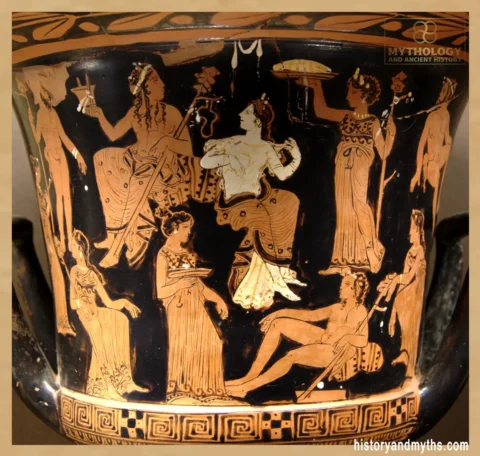
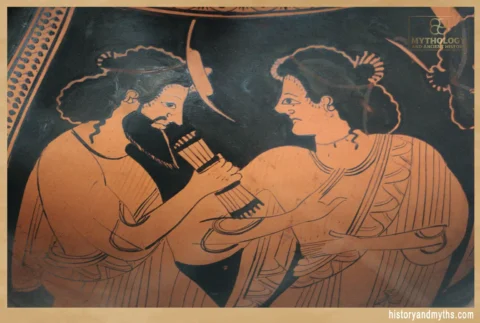
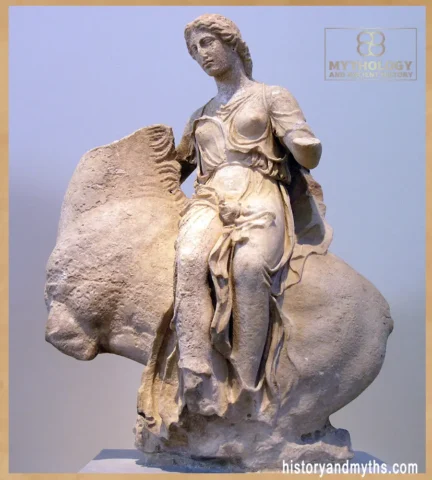
There are no firm identifications by name; related scenes may show nymphs, Hera’s phantom motif, or the rescue by the golden ram.
How do you pronounce “Nephele”?
Commonly: “NEF-uh-lee” (English), from Greek Ne-FE-lee.
Sources & Rights
- Apollodorus. The Library. Translated by Sir James George Frazer. Harvard University Press, 1921.
- Hesiod. Theogony. Edited and translated by M. L. West. Oxford University Press, 1966.
- Pindar. Pythian Odes. Translated by William H. Race. Loeb Classical Library, 1997.
- Hyginus. Astronomica. Edited by Mary Grant. University of Kansas Publications, 1960.
- Ovid. Fasti. Translated by James G. Frazer. Loeb Classical Library, 1931.
- Smith, William. Dictionary of Greek and Roman Biography and Mythology. Little, Brown, and Company, 1873.
- Allen, Richard Hinckley. Star-Names and Their Meanings. G. E. Stechert, 1899.
- Kerenyi, Karl. The Gods of the Greeks. Thames and Hudson, 1951.