The Pleiades — The Seven Sisters of Greek Mythology
In the stillness of the ancient night, seven points of light rose together in the eastern sky. To the Greeks, they were not distant suns but living souls — the Pleiades, daughters of Atlas and Pleione, sisters bound by both love and sorrow. They shimmered like droplets of divine memory, each carrying her own story of devotion, motherhood, and transformation. Their names — Maia, Taygete, Alcyone, Celaeno, Sterope, Merope, and Electra — whispered through temples, poetry, and navigation charts alike, linking heaven to earth through myth and starlight.
The Pleiades were more than a constellation; they were a bridge between the visible and the unseen. To sailors, their rising signaled the start of safe voyages; to farmers, it marked the turning of the seasons; to poets, it revealed the eternal rhythm of loss and renewal. Each sister embodied a different shade of the divine feminine — gentle yet powerful, nurturing yet transient, destined to shine forever while longing for the mortal lives they left behind.
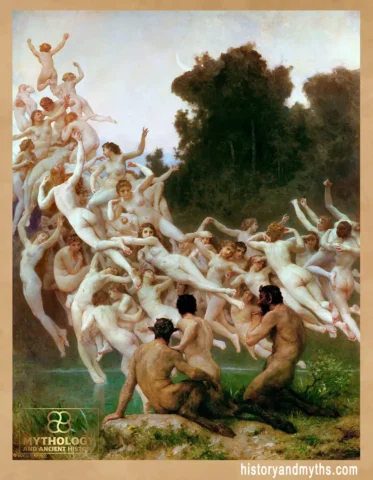
Their origin was celestial, their fate poetic. Born to Atlas, the Titan who bore the weight of the sky, and Pleione, the sea-nymph who embodied watery reflection, they were bound from birth to the elements — air, light, and ocean. When Orion, the great hunter, pursued them across the earth, they fled in fear until Zeus, moved by compassion, lifted them into the heavens. There, they became immortal, their flight forever frozen as a dance of light.
But immortality, for the Greeks, was never without grief. Some said one sister — Merope, who married a mortal — grew dim with shame; others claimed Electra hid her light after witnessing the fall of Troy. Thus, even in their radiance, the Pleiades carried the melancholy of love and loss, their constellation forever flickering with stories of longing.
To gaze upon them was to remember that even the heavens hold memory — that every point of light above us might once have been a heartbeat, a voice, or a tear.
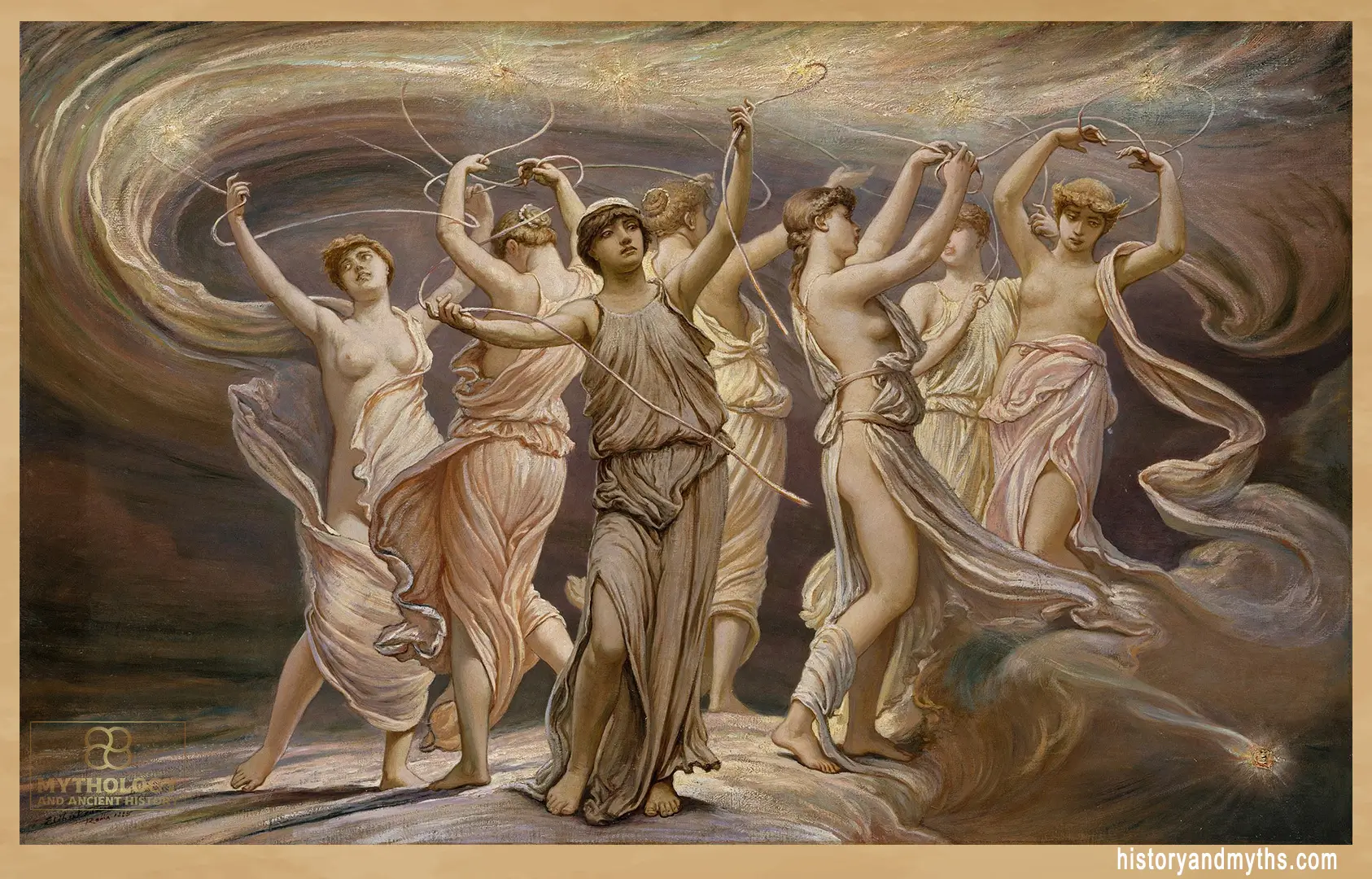
Who Are the Pleiades? — Daughters of Atlas and Pleione
In the genealogy of the Greek cosmos, the Pleiades stood between Titans and gods, between the fading age of elemental powers and the rise of Olympian order. They were born to Atlas, the Titan condemned to bear the heavens, and Pleione, a nymph of the Aegean seas whose name meant “to sail” or “to increase.” From their father they inherited endurance; from their mother, motion — the restless shimmer of life. Together they became symbols of grace under weight, light bound to duty.
The seven sisters were known by name across the ancient world:
Maia, the eldest and gentlest, became the mother of Hermes by Zeus; Taygete, sacred to Artemis, fled from Zeus’s desire and was transformed into a doe; Alcyone, the calm one, was said to weep eternally for her lost husband; Celaeno, dark and mysterious, bore Poseidon’s sons; Sterope, also called Asterope, represented the sparkle of starlight itself; Merope, who married a mortal, Sisyphus, dimmed her light out of shame; and Electra, whose lineage gave birth to Troy, turned away her face when her descendants perished. Each name was a verse in the cosmic poem of womanhood — diverse, luminous, and bound by fate.
Their mother Pleione often traveled near the Pleiades constellation itself — the ancients said her star followed theirs like a guardian, gliding across the sky to protect her daughters from Orion’s endless pursuit. To the Greeks, this celestial dance was more than astronomy; it was the dramatization of divine compassion, the image of a mother who could not rest while her children fled through eternity.
As myth spread from Greece to the wider Mediterranean, the Pleiades became known to sailors and shepherds as the “Seven Sisters”, a name that carried both tenderness and awe. Their rising at dawn marked the beginning of the sailing season; their setting in autumn signaled the harvest’s end. In every age, their movement through the heavens defined rhythm, time, and survival. To invoke the Pleiades was to call upon the balance of nature — light returning after darkness, the promise that the seasons would turn once more.
Thus, while each sister held her own destiny, together they formed a single symbol — the unity of light. Their brilliance was not one of conquest or power but of endurance, of women who fled mortality only to illuminate eternity. Even their faintest star told a story: that memory, love, and loss could be written across the heavens for all generations to see.
The Seven Pleiades and Their Divine Lineage
| Name | Consort | Children | Symbolic Role |
|---|---|---|---|
| Maia | Zeus | Hermes | Gentle wisdom; mother of eloquence |
| Taygete | Zeus | Lacedaemon | Chastity and the spirit of the hunt |
| Alcyone | Ceyx | No mortal offspring | Love, loss, and calm after storms |
| Celaeno | Poseidon | Lycus, Eurypylus | Mystery and depth of the sea |
| Sterope (Asterope) | Ares | Oenomaus | Radiant spark; lineage of warriors |
| Merope | Sisyphus | Glaucus | Humility and mortal love |
| Electra | Zeus | Dardanus, Iasion | Memory and grief; lost light of Troy |
© historyandmyths.com — Educational use
The Myth of Pursuit — Orion, Transformation, and the Stars
Like all myths that survive the centuries, the story of the Pleiades is one of pursuit, fear, and divine transformation. The great hunter Orion, son of Poseidon, once saw the seven sisters wandering through the forests of Boeotia and was struck by their beauty. Obsessed by desire, he began to chase them across the mountains and plains, vowing to claim them for himself. For years they fled, never resting, their laughter and terror mingling in the winds that swept over the hills.
The gods, watching from Olympus, pitied the sisters’ endless flight. Zeus, moved by compassion — or perhaps by recognition of their divine grace — transformed them into doves and then lifted them into the heavens. There, they became the cluster of stars known forever as the Pleiades. Yet even among the constellations, their story did not end. Orion was placed in the sky as well, his bright belt forever chasing their light across the firmament. The eternal pursuit continued — this time written in stars, not on earth.
The transformation was both rescue and curse. The sisters escaped the mortal danger of Orion, but in doing so they lost the warmth of life and touch. The Greeks often saw in this story the paradox of divinity: that immortality is both gift and exile. The Pleiades were safe from harm, but they would never again know the scent of the sea, the sound of wind through olive trees, or the closeness of human love. Their beauty became cold, their laughter became silence — frozen as a celestial warning about the price of perfection.
Later poets added layers to the myth. Some said Artemis herself intervened, turning the sisters into stars to preserve their purity. Others told that their father, Atlas, unable to defend them while burdened with the sky, wept as they rose — his tears becoming the morning dew. The Romans later adapted the tale, linking the cluster’s rising and setting to seasonal cycles, turning the myth into a cosmic calendar.
But beneath every retelling lay the same truth: that the heavens themselves are shaped by emotion. The pursuit of Orion was not only a story of lust and escape; it was a metaphor for the eternal tension between desire and freedom, between mortal longing and divine deliverance. The Pleiades fled the hunter — yet in doing so, they became the very lights by which sailors and dreamers still navigate the darkness.
Mothers of Heroes — The Divine Lineage of the Pleiades
While the stars of the Pleiades shimmered far above the mortal world, their stories reached deep into it. Each sister, before her ascension, touched the lives of men and gods — giving birth to heroes, kings, and founders of nations. Their blood flowed in the veins of mortals who would later shape the myths of Greece itself. To speak of the Pleiades was to trace the ancestry of courage and tragedy alike.
Maia, the eldest and most nurturing, was beloved by Zeus, and from their union came Hermes, the messenger god — swift, clever, and born in a hidden cave on Mount Cyllene. Her motherhood embodied the divine spark of invention and eloquence. Through Maia, the Pleiades gained a voice that could travel between worlds.
Taygete, pursued by Zeus but rescued by Artemis, was transformed into a doe to preserve her chastity. Yet her fate remained intertwined with the divine; later, her son Lacedaemon founded Sparta, one of Greece’s proudest kingdoms. Through her, the spirit of endurance and discipline — the essence of Sparta — was born.
Alcyone, whose name means “calm sea,” became a symbol of both devotion and sorrow. She married Ceyx, son of Eosphorus, and when he perished in a storm, she threw herself into the waves in despair. The gods, moved by compassion, transformed them both into halcyon birds. Her myth gave birth to the ancient saying of the “halcyon days” — those rare moments of peace amid the tempests of life.
Celaeno, dark and mysterious, united with Poseidon, lord of the sea, and bore several divine sons, among them Lycus and Eurypylus, rulers of distant lands. Sterope (Asterope) also lay with a god — Ares, the fierce deity of war — and gave birth to Oenomaus, a king destined to fall to his daughter’s suitors.
Merope, the most human of them all, married the mortal Sisyphus, condemned to roll his boulder in Hades forever. For her mortal choice, her star was said to shine faintest in the heavens — a punishment that transformed shame into symbol. To the Greeks, Merope was the embodiment of the cost of love — the reminder that mortality dims even the brightest divine light.
And Electra, as we have seen, bore Dardanus, founder of the Trojan race, whose descendants would later fight and die in the greatest epic of them all. Her grief, said the poets, made her star fade or vanish — the “Lost Pleiad” whose sorrow still glimmers faintly in the night sky.
Together, these stories weave a tapestry of divine motherhood. The Pleiades were not merely stars or spirits of the air; they were the mothers of civilization, the unseen roots of kingdoms and heroes. Their beauty was creative, not passive — a beauty that gave life, guided dynasties, and linked the mortal to the eternal. Through their children, they extended their light — each hero, each city, each story a reflection of the stars that birthed them.
Thus, to look upon the constellation of the Pleiades was not just to witness the heavens, but to see the genealogy of myth itself — a constellation both literal and symbolic, tracing the ancestry of gods and men alike.
Mythic Essence of the Pleiades
- Daughters of Atlas and Pleione, the Pleiades embody the meeting of endurance and grace.
- Each sister became a mother of heroes — linking the heavens to human destiny through divine lineage.
- Their transformation into stars ended the pursuit of Orion but began their eternal dance across the sky.
- Represent the feminine principle of continuity — love, memory, and light that endures beyond mortality.
- Known in many cultures worldwide — from the Greek “Pleiades” to Japan’s “Subaru” and the Māori “Matariki.”
- The “Lost Sister” symbolizes the universal human experience of grief, absence, and the search for belonging.
© historyandmyths.com — Educational use
Symbolism and Meaning — Light, Memory, and the Lost Sister
The story of the Pleiades is more than an origin myth; it is a meditation on light itself — how it burns, fades, and remembers. To the ancient Greeks, the sisters were not only celestial markers but symbols of time, emotion, and the fragile thread that binds the living to the divine. Each star carried a story, and each story became a reflection of the human heart gazing upward.
Light, in Greek thought, was sacred — a living presence of truth and revelation. The Pleiades embodied that sanctity, their appearance each spring heralding renewal and navigation, their disappearance in autumn signaling rest and endings. Farmers sowed their fields by their rising; sailors charted their voyages by their glow. Even philosophers saw in them the pattern of cosmic order — harmony arising from unity. Seven sisters, seven tones of creation, each distinct yet inseparable.
But behind the beauty of the constellation lies a haunting detail: one star seems missing. Ancient observers noticed that while seven names were remembered, only six bright points could be seen clearly. Thus was born the myth of the Lost Sister — a symbol of absence, regret, and eternal remembrance. Some said Merope’s dimmed star reflected her shame for marrying a mortal. Others claimed Electra hid her light, veiling herself in mourning for Troy’s destruction. Whichever tale one believes, the meaning is the same — that love and grief are written in the very fabric of the heavens.
This sorrowful star became a mirror for human loss. Just as the Pleiades flee Orion forever, so too do people chase what they cannot hold — memory, perfection, the faces of those long gone. The constellation became a reminder that even loss can shine, that forgetting is never complete when the sky itself carries remembrance. In poetry and ritual, the Greeks turned this cosmic sadness into comfort: the idea that beauty, even when dimmed, still endures.
The Pleiades also represented the feminine principle of continuity — not through power, but through connection. They were mothers, mourners, guides. Unlike the Olympian goddesses of triumph or vengeance, the Pleiades symbolized resilience, the quiet endurance that turns suffering into meaning. Their myth told the world that strength could be soft, and immortality could be tender.
And perhaps this is why their story has survived millennia. Every generation, looking up at their faint blue light, sees itself reflected — the longing for home, the ache of memory, the hope that something bright still endures beyond the horizon of time.
Legacy — From Greek Sky to Modern Astronomy
Though millennia have passed since the poets of Greece first named the Pleiades, their light has never dimmed from human imagination. Across cultures and continents, they remain one of the most universally recognized constellations — a cluster of beauty and memory suspended in the firmament. The Greeks called them “Pleiades,” the Romans “Vergiliae,” the Japanese “Subaru,” and the Māori “Matariki.” Each name, though different in tongue, means the same thing — family, return, renewal.
For astronomers, the Pleiades are a stellar nursery, a group of young, hot blue stars born roughly 100 million years ago in the Taurus constellation. Yet to the human spirit, they remain much older — as old as storytelling itself. Science has revealed their composition and distance, but myth gives them something no telescope can: a heartbeat. Between myth and measurement, the Pleiades stand as proof that wonder endures even when mystery is explained.
Artists across centuries continued to reimagine the Seven Sisters — in frescoes, marble, and song. Renaissance painters draped them in silks of starlight; Romantic poets saw them as symbols of lost innocence. In modern times, their name adorns ships, telescopes, and even automobiles — the Subaru emblem still proudly displays six clustered stars, echoing the ancient sky. The mythology that began as whispered hymns on Greek hillsides has become global, woven into the very language of light and motion.
The Pleiades also carry a quieter legacy — one of connection through time. They appear in the myths of Egypt, Persia, and the Americas, often as sisters, doves, or guiding spirits. Perhaps their visibility, bright and delicate, speaks directly to the human heart — the longing to find kinship in the heavens, to believe that the stars themselves remember us. The ancients once looked up and saw their gods; we look up and see our origins. Between those two gazes lies the unbroken thread of wonder.
In this way, the Pleiades have become more than myth, more than astronomy — they are a mirror of the human condition. We see in them our own story: love, loss, endurance, rebirth. They remind us that the sky above is not silent but filled with voices — the voices of seven sisters who fled death, found light, and now watch over every dream that dares to rise.
Key Takeaways — The Eternal Sisters of the Night Sky
- The Pleiades are seven star-nymphs — daughters of Atlas and Pleione — whose myth unites love, loss, and immortality.
- Each sister’s lineage shaped mythic history: Maia as mother of Hermes, Electra as ancestress of Troy, Merope as the mortal star, and others as divine matriarchs.
- Their transformation into stars ended Orion’s pursuit but began their eternal dance across the heavens.
- The “Lost Sister” reflects humanity’s universal themes of memory, grief, and the enduring presence of what has been lost.
- Across cultures, the Pleiades symbolize renewal, navigation, and kinship — appearing in myths from Greece to Japan and beyond.
- They remain both scientific wonder and poetic truth — proof that the stars above us still carry the emotions of those who once dreamed beneath them.
© historyandmyths.com — Educational use
Frequently Asked Questions
Who are the Pleiades in Greek mythology?
The Pleiades are seven star-nymphs, daughters of Atlas and Pleione, transformed into a stellar cluster.
What are the names of the Seven Sisters?
Maia, Taygete, Alcyone, Celaeno, Sterope (Asterope), Merope, and Electra.
Why are only six stars easily visible if there are seven sisters?
Ancient tradition says one sister hides or shines dimly—the “Lost Sister,” often Merope or Electra.
Who are the parents of the Pleiades?
Atlas, the Titan who bears the heavens, and Pleione, a sea-nymph associated with the Aegean.
What is the myth involving Orion and the Pleiades?
Orion pursued the sisters; Zeus rescued them by placing them among the stars, with Orion set to chase them eternally.
Why are the Pleiades called “mothers of heroes”?
Several bore famed offspring—Maia mothered Hermes; Electra mothered Dardanus; others birthed rulers and heroes.
Which sister dimmed from marrying a mortal?
Merope, who wed Sisyphus, is often said to shine faintest out of shame for her mortal marriage.
How did the Pleiades guide agriculture and navigation?
Their heliacal rising and setting marked sowing, harvest, and safe sailing seasons in the ancient Mediterranean.
What cultures have other names for the Pleiades?
Romans: Vergiliae; Japanese: Subaru; Māori: Matariki—each linking the cluster with renewal and kinship.
What is Electra’s link to Troy?
Electra’s son Dardanus founded the Trojan line; her grief for Troy made her a candidate for the “Lost Sister.”
Sources & Rights
- Hesiod. Theogony. Translated by Hugh G. Evelyn-White. Loeb Classical Library, Harvard University Press, 1914.
- Apollodorus. The Library. Translated by Sir James George Frazer. Loeb Classical Library, Harvard University Press, 1921.
- Homeric Hymns. Translated by Hugh G. Evelyn-White. Harvard University Press, 1914.
- Pausanias. Description of Greece. Translated by W. H. S. Jones and H. A. Ormerod. Harvard University Press, 1918.
- Nonnus of Panopolis. Dionysiaca. Translated by W. H. D. Rouse. Harvard University Press, 1940.
- Grimal, Pierre. Dictionary of Classical Mythology. Oxford: Blackwell, 1990.
- Hard, Robin. The Routledge Handbook of Greek Mythology. London: Routledge, 2004.
- Burkert, Walter. Greek Religion. Cambridge, MA: Harvard University Press, 1985.
- Bell, Robert E. Women of Classical Mythology: A Biographical Dictionary. Oxford University Press, 1993.
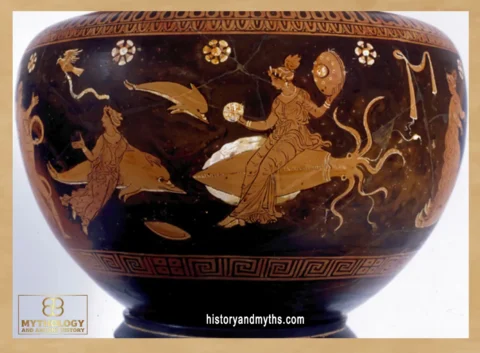
- Image source: The Pleiades (Paestan red-figure bell-krater, 340–330 BC), attributed to Python. National Archaeological Museum, Naples, Room 36 (2nd floor). Photo by Marie-Lan Nguyen (2008). — Source: Wikimedia Commons (CC BY-2.5).
Written by H. Moses — All rights reserved © Mythology and History