Celaeno — The Dark Pleiad of Greek Mythology and Storms
Among the seven shining daughters of Atlas and Pleione, one name has always drifted in shadow — Celaeno, the Dark Pleiad. While her sisters gleam in myth and star alike — Maia the nurturing, Alcyone the serene, Electra the radiant — Celaeno lingers at the edge of memory, veiled in mystery and silence. Her name, drawn from the ancient Greek Kelainō (Κελαινώ), means the dark one, a title that seems to whisper both warning and wonder.
In the fragile line between storm and calm, Celaeno stands as a reminder that even within light, there must be shadow. She is the Pleiad of thunderclouds and deep skies — a figure of quiet intensity rather than brilliance. In her story, there are no heroic hymns or marble temples, yet her presence endures in the heavens themselves: a faint star glowing in the cluster of the Seven Sisters, a secret kept by the night.
The Greeks saw in her not absence but balance — the truth that brightness needs darkness to be seen. Through her name and nature, Celaeno came to embody the hidden forces of change, the storm before renewal, and the still power of obscurity that moves unseen beneath the world’s harmony.
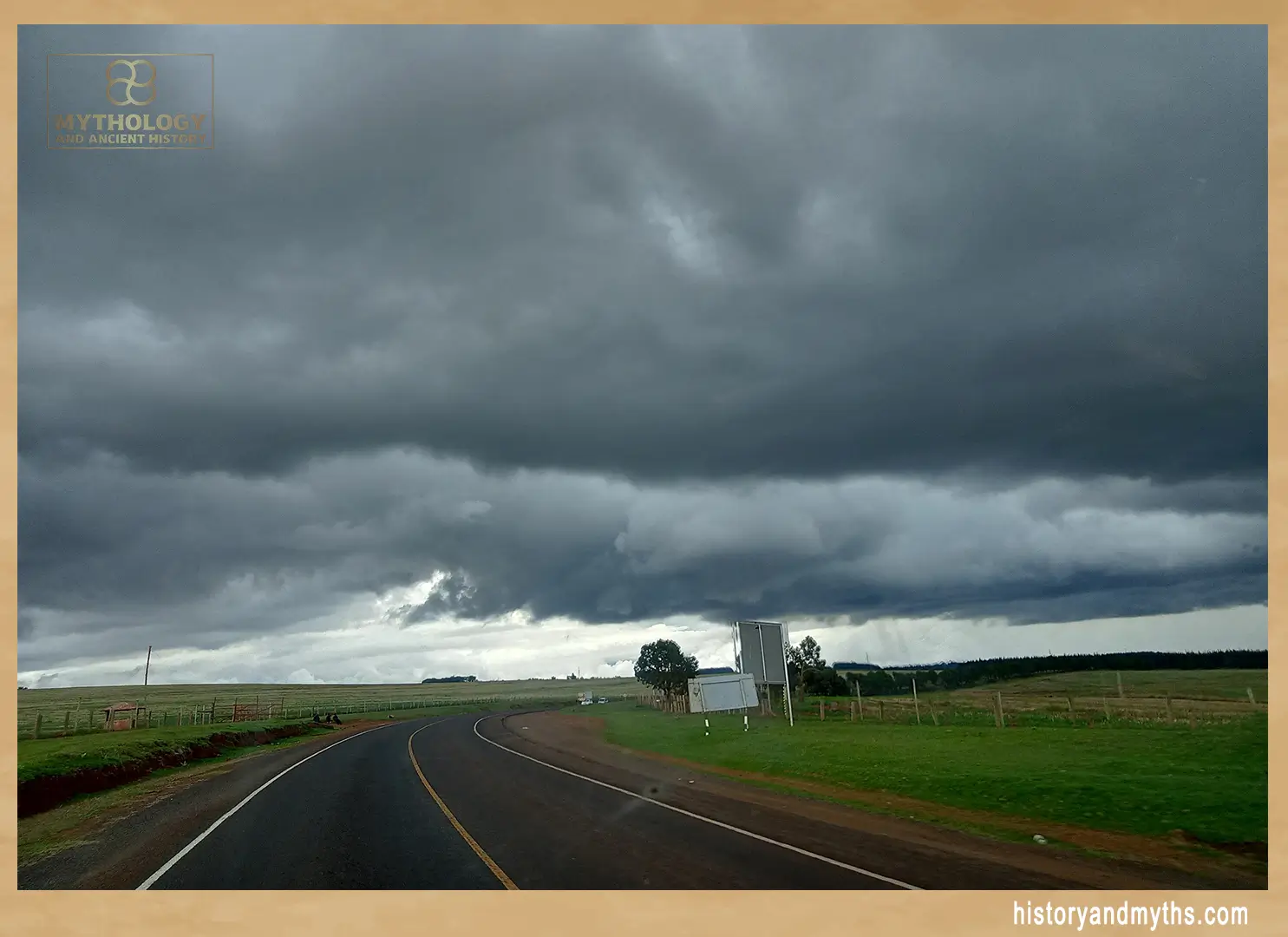
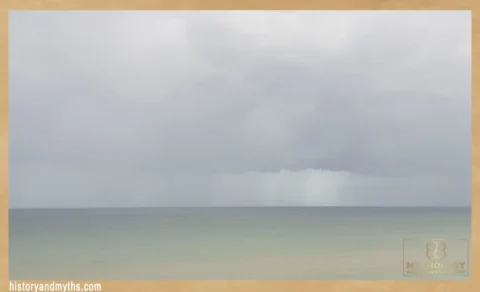
Image: Symbolic representation of Celaeno, the Dark Pleiad — storm clouds approaching, Kenya (2023). Photo by Kenothia. — Source: Wikimedia Commons (CC BY-SA 4.0 license).
Origins and Lineage of Celaeno
Celaeno was born of the Titan Atlas, the eternal bearer of the sky, and Pleione, the Oceanid nymph who guarded the flocks of the heavens. Alongside her six sisters — Maia, Electra, Taygete, Alcyone, Sterope, and Merope — she formed the constellation the Greeks called the Pleiades, the daughters of rain and starlight. Each sister embodied a different aspect of the world’s rhythm: fertility, love, navigation, or storm. Celaeno’s domain was the shadow between light and tempest, the fleeting moment when clouds obscure the stars yet promise renewal through rain.
In the genealogies of ancient mythographers, Celaeno’s presence is subtle but significant. She was said to have been loved by Poseidon, god of the sea, who united with her amid the clouds and waves — an image of air and water, storm and depth. From their union were born Lycus and Nycteus, twin sons who carried her name into the royal lineages of Thebes. Some later writers claimed she also bore Eurypylus and Triton, suggesting a symbolic bridge between sky, sea, and mythic descent.
Though rarely worshipped, Celaeno’s story existed wherever the Greeks looked upward and saw the faint cluster of stars rising over the horizon. To them, she was not forgotten but hidden — one of the faintest lights among her sisters, a presence that must be sought, not seen. In that subtlety lay her power: she represented the unseen energy that holds the cosmos together, the dark harmony behind visible beauty.
| Aspect | Details |
|---|---|
| Name | Celaeno (Κελαινώ) — “The Dark One” in ancient Greek |
| Parents | Atlas (Titan of the Sky) and Pleione (Oceanid nymph) |
| Siblings | The Pleiades: Maia, Electra, Taygete, Alcyone, Sterope, and Merope |
| Consort | Poseidon, god of the sea |
| Children | Lycus and Nycteus (founders of Theban lineages), sometimes Eurypylus or Triton |
| Symbolism | Storms, transformation, mystery, and hidden strength |
| Celestial Form | Star 16 Tauri — a faint member of the Pleiades cluster in Taurus |
| Etymology | From Greek *kelainos*, meaning “black, dark, or stormy” |
© historyandmyths.com — Educational use only
Myths and Roles of Celaeno — The Dark Sister of the Pleiades
While many of the Pleiades were woven into tales of divine unions and heroic descent, Celaeno’s myth flowed through quieter, darker waters. The ancient poets wrote of her not as a goddess of radiance but as a force of transition — the hush before the storm. In Hesiod’s lost fragments, her name is linked to the word kelainos, meaning “blackened sky” or “storm-cloud,” suggesting she personified the celestial darkness that precedes both dawn and tempest.
One of her earliest roles was tied to Poseidon, whose restless nature matched her own. Their meeting, as the sea mist rose to meet the sky, was said to birth sons who embodied twilight and depth. Among them, Lycus and Nycteus, founders of royal Theban lines, carried her heritage into mortal realms, while others claimed she was the mother of Eurypylus, who ruled the far western isles. In every version, her children inherited something of their mother’s nature — a blend of mystery, strength, and melancholy.
Unlike her sisters Maia or Alcyone, who symbolized nurture and calm, Celaeno represented the shadowed half of divinity — the necessity of obscurity within creation. She was invoked not for love or fertility, but for balance, the understanding that growth demands both light and darkness. To the philosophers of later ages, she became the embodiment of metamorphosis unseen — the slow, invisible transformations that shape both weather and soul.
Sailors and poets alike believed that when Celaeno’s star dimmed in the heavens, storms would soon follow. To them, she was the unspoken warning, the gathering of clouds that precedes cleansing rain. Her myth lived not in shrines, but in the wind’s restlessness before thunder — a presence that could not be worshipped, only felt.
Celestial Identity — The Star Celaeno in the Pleiades
High above the world she once symbolized, Celaeno shines faintly in the cluster the ancients called the Seven Sisters — a crown of starlight adorning the shoulder of the bull, Taurus. To the astronomers of Greece, her light was dim yet steadfast, one of the quietest among the Pleiades, known today as 16 Tauri. To poets, that dimness carried meaning: a star veiled in mist, a spark that refused to vanish even when lost in the brightness of her kin.
The Greeks believed each Pleiad bore her own fate written in the heavens. Some blazed with joy, others flickered in mourning; Celaeno’s glow was the most subdued, a whisper of radiance through shadow. Sailors read her presence in the night sky as a subtle omen — if her light faded into the haze, storms would rise; if she shone clear, the winds would rest. The sea and sky conspired to make her their messenger.
In later ages, scholars identified her as one of the spectral-type B-stars, burning at over 12,000 Kelvin — paradoxically, a fire hidden behind dust. Modern telescopes still find her wrapped in interstellar cloud, as though the myth never ended: the dark one surrounded by storm. Yet through all that obscurity, her blue-white light endures, reminding the watchers of earth that mystery is not absence. In Celaeno’s faint shimmer, the ancients saw an eternal truth — that even the quietest stars have stories, and even darkness has its light.
🌌 Symbolism of Celaeno in Greek Mythology
- The Dark Pleiad: Represents the shadowed harmony within light — the unseen balance of the cosmos.
- Storm & Transformation: Embodies the change that follows chaos, the cleansing power of the storm before renewal.
- Daughter of Atlas and Pleione: Unites sky and sea through her lineage and her union with Poseidon.
- Celestial Mystery: Her faint star (16 Tauri) shines through interstellar dust — symbol of hidden strength.
- Human Reflection: Echoes the quiet, introspective nature of the soul — the inner calm that steadies creation.
© historyandmyths.com — Educational use only
Symbolism and Meaning of Celaeno — The Shadow that Balances the Light
In the mythology of the Greeks, darkness was never the enemy of light — it was its mirror, its measure, and its source of depth. Within this ancient harmony, Celaeno stood as the embodiment of that hidden balance. Her very name, “the dark one,” revealed that she was not forgotten, but rather the unspoken necessity behind every gleam. Just as a painting requires shade to give shape to color, so too did the heavens require her to give meaning to brilliance.
Her symbolism reached beyond myth into philosophy. To the Orphic poets, she represented the mystic night from which the cosmos was born — a maternal void that precedes creation. To sailors, she was the omen of change, the thin veil of cloud that warns of wind but also promises renewal. To mystics of the later Hellenistic age, Celaeno became the patroness of introspection — the awareness that peace is found not by escaping the storm but by listening to its silence.
While her sisters were adored for their light, Celaeno’s quiet dignity lay in what she concealed. She embodied the power of restraint, the wisdom of waiting, and the inevitability of transformation. Her myth reminds us that life’s rhythm depends on intervals of obscurity — that rest, reflection, and even sorrow have sacred purpose. Without shadow, the world would be blinding; without silence, its music meaningless.
Thus, in Celaeno, the ancients saw a truth both cosmic and human: that the unseen can sustain the seen, that every storm clears to reveal a sky reborn. She was not the absence of light, but its depth — the calm weight of eternity pressing gently on the heart of creation.
Legacy and Reflection — The Enduring Mystery of Celaeno
Though the name of Celaeno rarely graced the lips of poets, her shadow lingered through centuries of art, astronomy, and reflection. The ancients who first charted her faint star understood that mystery is not a flaw of creation — it is its heartbeat. Where others saw brightness, they saw balance; where others feared darkness, they found rhythm. And so, while her sisters blazed through stories of heroes and divine mothers, Celaeno remained the quiet pulse of the heavens, proof that what is least seen can be most essential.
In later literature, her spirit found new life under different names. The Roman poets reimagined her as the storm-bringer who clears the path for rebirth, while Renaissance scholars interpreted her as the celestial counterpart of melancholy — the shadow of thought that gives art its depth. Even in modern astronomy, her faint blue-white light inspires metaphors for hidden strength and resilience. In her, scientists find a cosmic paradox: a burning sun masked by interstellar dust, a star that glows unseen.
To philosophers, Celaeno came to represent the human psyche’s hidden half — the dreams, fears, and reflections that never meet daylight but shape our actions nonetheless. She is the inner voice before decision, the quiet before revelation. Just as her dim star steadies the Pleiades’ geometry, so does the unseen part of the soul steady the visible self. The Greeks, with their intuitive wisdom, placed her exactly where she belonged: not in the spotlight, but at the heart of harmony.
Today, when telescopes trace the Seven Sisters across the night sky, her name still echoes softly in the scientific catalogues. Celaeno — 16 Tauri. Yet beyond the data, she survives as a metaphor for presence within silence. In an age that worships noise and brilliance, her myth reminds us that meaning often hides in the dimmest corners of experience. Her faint light, filtered through cosmic dust, tells a story older than temples and truer than prophecy — that even in obscurity, there is grace.
Celaeno’s legacy, then, is not one of disappearance but endurance. She teaches that the unseen is not lost, and that the world’s gentlest voices often sing the deepest truths. Long after empires fade and constellations shift, she endures in her rightful place — the dark sister of the Pleiades, calm amid eternity’s storm.
🌩️ Key Takeaways — Celaeno, the Dark Pleiad
- Celaeno was one of the seven Pleiades, daughters of Atlas and Pleione, known as “the dark one.”
- Her name means blackened or stormy sky, reflecting her association with tempests and transformation.
- She was loved by Poseidon and became the mother of Lycus and Nycteus, connecting the heavens to mortal kings.
- In the night sky, she appears as the faint star 16 Tauri — veiled in cosmic dust, symbolizing hidden strength.
- Celaeno represents balance between light and shadow, reminding humanity that even darkness has its purpose.
© historyandmyths.com — Educational use only
Frequently Asked Questions
Who is Celaeno in Greek mythology?
Celaeno is one of the Pleiades, daughters of Atlas and Pleione. Known as “the dark one,” she represents the shadowed balance within the Seven Sisters’ myths.
What does the name “Celaeno” mean?
From Greek Kelainō (Κελαινώ), it means “the dark/black one,” often associated with storm clouds and the dim light before renewal.
Who are Celaeno’s parents and siblings?
Her parents are the Titan Atlas and the Oceanid Pleione. Her sisters are Maia, Electra, Taygete, Alcyone, Sterope (Asterope), and Merope.
Who is Celaeno’s consort, and does she have children?
Ancient sources pair her with Poseidon; she is said to be the mother of Lycus and Nycteus (and in some accounts Eurypylus or Triton).
Is Celaeno associated with storms?
Yes. Her name and ancient references link her to dark skies and tempests, symbolizing transition and transformation.
What star corresponds to Celaeno?
In astronomy, Celaeno corresponds to 16 Tauri, a faint blue-white member of the Pleiades cluster in Taurus.
Was Celaeno widely worshiped?
No. Like most Pleiades, she had little formal cult; her presence is primarily mythic and symbolic rather than cultic.
How does Celaeno differ from other Pleiades?
Unlike Maia’s nurturing or Alcyone’s calm, Celaeno embodies the necessary shadow—storm, mystery, and hidden strength within cosmic harmony.
What does Celaeno symbolize today?
She serves as a metaphor for the power of the unseen: balance, introspection, and the quiet changes that precede renewal.
How is Celaeno connected to Theban lineages?
Through her sons Lycus and Nycteus, Celaeno’s mythic lineage reaches the royal houses of Thebes in later traditions.
Sources & Rights
- Apollodorus. The Library. Translated by Sir James George Frazer. Cambridge, MA: Harvard University Press, 1921.
- Hesiod. Fragments. In Early Greek Myth. Edited and translated by Timothy Gantz. Baltimore: Johns Hopkins University Press, 1993.
- Ovid. Metamorphoses. Translated by A. D. Melville. Oxford: Oxford University Press, 1986.
- Hyginus. Fabulae. Translated and edited by Mary Grant. University of Kansas Publications in Humanistic Studies, 1960.
- Smith, William. Dictionary of Greek and Roman Biography and Mythology. London: John Murray, 1873.
- Atsma, Aaron J. Theoi Project: Celaeno – The Dark Pleiad. Greece, 2000.
- Grimal, Pierre. The Dictionary of Classical Mythology. Oxford: Blackwell Publishing, 1996.
- Allen, Richard H. Star Names: Their Lore and Meaning. New York: Dover Publications, 1963.
Written by H. Moses — All rights reserved © Mythology and History.