Potamoi: Greek River Gods, Sons of Oceanus and Tethys
In the world of ancient Greece, rivers were more than water — they were living forces that shaped the land and the lives of those who dwelled beside them. Every stream that cut through the valleys, every rushing current that descended from the mountains, was believed to carry a divine pulse. From these waters rose the Potamoi, the river gods — sons of the Titan couple Oceanus and Tethys, brothers of the Oceanids and fathers of countless nymphs.
To the Greeks, the Potamoi embodied the mystery and power of flowing water. Each river had its own god, its own voice, and its own story. When farmers offered libations to ensure fertile soil or when travelers prayed for safe passage across dangerous torrents, they were not speaking to an element but to a living deity. These river gods could be generous and life-giving, yet also fierce and destructive — the same waters that sustained could also drown.
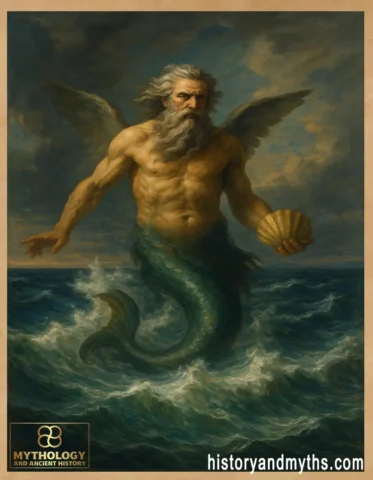
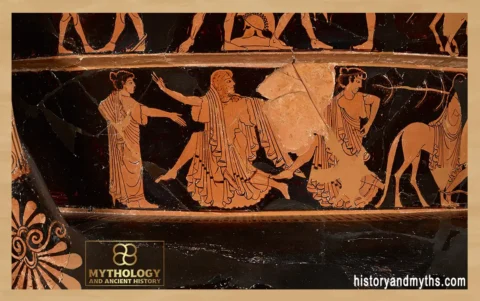
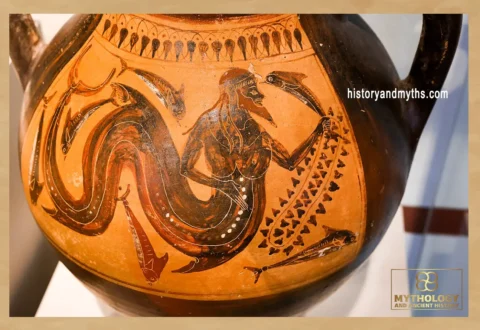
In art and poetry, the Potamoi appeared as strong, bearded figures reclining beside their rivers, sometimes with the horns of a bull or a jug from which the stream eternally poured. They symbolized both the permanence and the change that defined nature — forces too ancient to be tamed, too essential to be ignored. To worship a river was to acknowledge the heartbeat of the earth itself, and in that rhythm, the Greeks found divinity.
Origins and Lineage — Children of the Endless Ocean
The Potamoi were born from the first waters that encircled the world. Their parents, Oceanus and Tethys, were among the eldest of the Titans — the primordial forces who ruled before Zeus and the Olympians. From their vast and boundless union flowed every river, spring, and sea known to humankind. The ancient poets imagined Oceanus not as a sea within the earth, but as a cosmic current surrounding it, a living border that joined heaven and land. From that endless circle came his sons, the Potamoi, who carried fragments of his divinity into every part of Greece.
The Greeks believed there were thousands of these river gods, each one the spirit of a real river. Their number was said to reach three thousand, echoing the countless streams that carved through the Greek landscape. Some were mighty and well-known — Achelous, the largest and most revered; Alpheus, the river who loved the nymph Arethusa and followed her across the sea; Scamander, who fought Achilles beside the walls of Troy. Others were humble and unnamed, their worship surviving only in fragments of local myth.
As children of the primordial ocean, the Potamoi formed the living arteries of the world. They connected the mountains to the sea, the divine to the mortal. Their waters nourished crops, marked territorial boundaries, and inspired countless legends. Where the Olympian gods ruled the heavens, the Potamoi ruled the veins of the earth — unseen yet indispensable, ancient as the soil itself.
| Aspect | Details |
|---|---|
| Name | Potamoi — the River Gods of ancient Greek mythology. |
| Etymology | From Greek potamos (ποταμός), meaning “river.” |
| Parentage | Sons of the Titans Oceanus and Tethys. |
| Number | Traditionally said to be 3,000, representing every river in the Greek world. |
| Major River Gods |
Achelous — greatest and eldest of all rivers; Alpheus — lover of the nymph Arethusa; Scamander — fought Achilles in the Trojan War; Inachus — first king and river of Argos. |
| Depiction | Bearded male reclining beside a jug or bull-horns; sometimes a man-headed bull. |
| Domain & Symbolism | Fertility, boundaries, purification, and the eternal motion of nature. |
| Worship | Local offerings of wine, honey, oil, and first fruits poured into the river. |
| Related Deities | Naiads (freshwater nymphs); Oceanids (sea nymphs); Poseidon; Demeter. |
Rivers with Names — The Great Potamoi of Greek Legend
Though the Potamoi were countless, a few rivers flowed more deeply through myth than others. These were not mere waterways, but personalities — gods with tempers, loves, and rivalries that mirrored the people who lived along their banks.
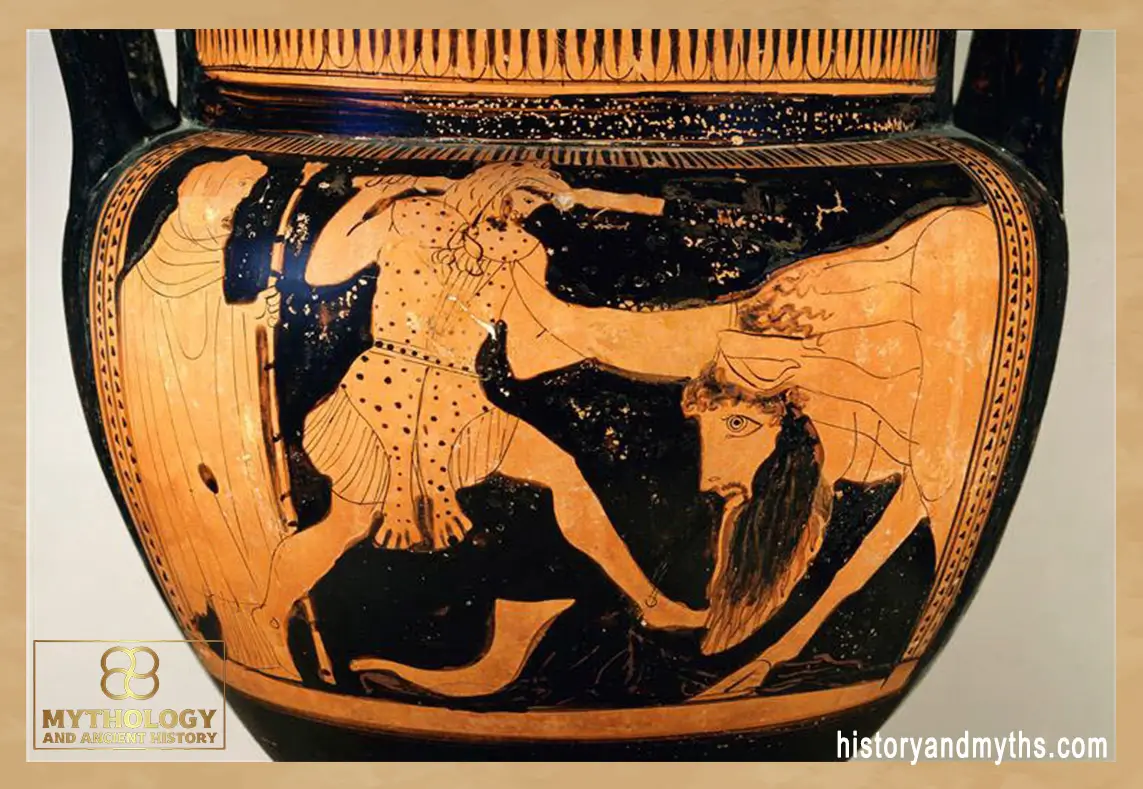
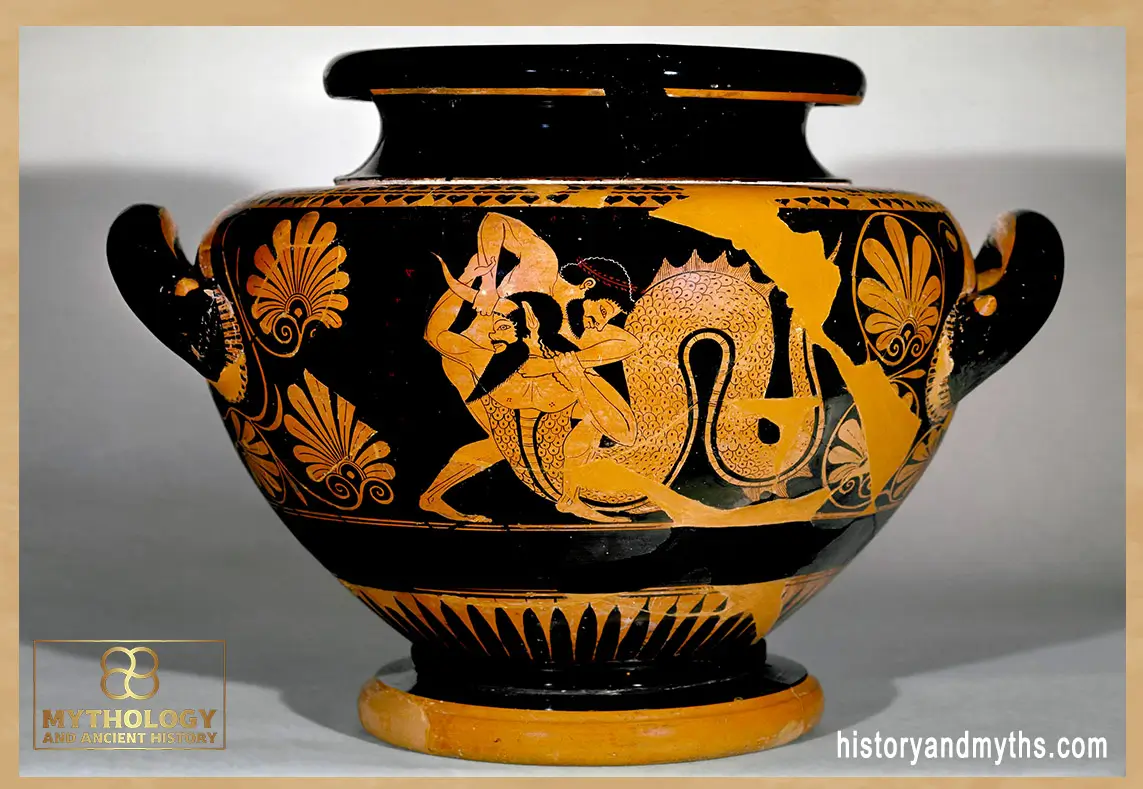
The most powerful among them was Achelous, the broad and winding river of western Greece. He was worshiped as the oldest and greatest of all river gods, and poets called him the “father of all waters.” His strength was so immense that he once fought Heracles for the hand of Deianira. In their struggle, Achelous took the form of a serpent, then a bull, but Heracles broke off one of his horns — a symbol of the river’s might and the taming of nature by human courage. That broken horn became the Cornucopia, the horn of plenty, a lasting emblem of abundance drawn from water’s eternal gift.
Further south flowed Alpheus, a river of Elis and Arcadia, whose story was one of longing. He loved the nymph Arethusa, who fled his pursuit until the goddess Artemis transformed her into a spring across the sea, on the island of Ortygia. Yet Alpheus, undeterred, mingled his waters with hers beneath the waves — a myth that transformed geography into romance. To the Greeks, it was proof that love, like a river, always finds its course.
Another famed river god was Scamander, who guarded the plains of Troy. When Achilles slaughtered too many warriors on his banks, the river rose in fury, roaring against the hero in a flood of vengeance. Scamander’s rage symbolized nature rebelling against human violence — the eternal balance between life and destruction.
Other Potamoi, such as Inachus, Cephissus, and Eurotas, were tied to the founding myths of cities and dynasties. They served as ancestral deities, binding people to place. In their currents flowed both history and identity — reminders that civilization itself was born beside the water.
Worship and Ritual — Honoring the Gods Who Flow
In the daily rhythm of Greek life, water was sacred long before philosophy tried to explain why. The Potamoi, as the living embodiment of rivers, received worship that was simple but deeply sincere. Every region had its own way of showing reverence to the stream that gave it life. A river could bless crops, cleanse the body, or mark the boundary between mortal and divine space — and so, each was treated as a god deserving of care.
At the start of every journey, travelers poured libations into the river they crossed, whispering prayers for safe passage. Farmers offered the first fruits of harvest beside the current, asking for steady rains and fertile soil. In some places, such as Aetolia and Arcadia, annual sacrifices were made to local river gods, often alongside the worship of Demeter or Poseidon, deities who also governed fertility and water. The link between land and river was unbreakable: where the earth thrived, so too did the god who nourished it.
Unlike the Olympians, the Potamoi did not have great temples of marble or gold. Their sanctuaries were the rivers themselves — shaded banks, stone altars, and springs bubbling from the ground. Offerings of honey, wine, and oil were poured directly into the water, creating ripples that symbolized the connection between human hands and divine nature. For the Greeks, to pollute a river was not just a crime against nature — it was sacrilege, an insult to the god that sustained them.
This reverence was more than ritual; it was an ancient acknowledgment of dependence. The Greeks saw in the Potamoi the reminder that human order existed only because water continued to flow. In their gratitude and fear, they built a theology of respect — one that modern civilization, so often at odds with the natural world, would later forget.
- Greek Name: Ποταμοί (Potamoi) — from potamos, “river.”
- Parentage: Sons of the Titans Oceanus and Tethys, making them brothers of the Oceanids and fathers of the Naiads.
- Domain: All flowing freshwater — rivers, streams, and deltas across Greece.
- Nature: Male deities symbolizing strength, fertility, and the eternal motion of life.
- Number: Said to be three thousand, representing every known river in the ancient world.
- Major Figures: Achelous (eldest and strongest), Alpheus (lover of Arethusa), Scamander (river of Troy), Inachus (river of Argos).
- Worship: Local rites and offerings poured directly into rivers; sacred to fertility and purity.
- Symbols: Flowing jug, bull horns, reclining male figure, and endless water.
- Mythic Role: Guardians of nature’s boundaries — connecting land, sea, and the divine.
- Artistic Legacy: Common in Greek and Roman sculpture, reliefs, and coins as symbols of prosperity and life.
The Faces of Rivers — Art and Symbolism of the Potamoi
In the imagination of ancient artists, the Potamoi were not invisible forces but figures of great dignity — embodiments of movement, strength, and continuity. Greek sculptors often portrayed them as reclining gods with muscular forms and flowing beards, their bodies half human, half natural. They leaned upon overturned jars, from which water poured eternally, symbolizing the ceaseless flow of rivers. This motif, later adopted by Roman artists, appeared on temples, fountains, and even city coins, where the image of a river god represented prosperity and renewal.
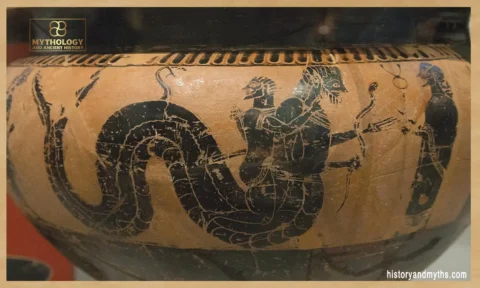
The bull horns often carved upon their heads were not mere decoration. They represented the power and unpredictability of rivers — calm one moment, violent the next. Some depictions showed Potamoi as man-headed bulls, a form that captured both the beauty and danger of moving water. In vase paintings and reliefs, they appear alongside nymphs, heroes, and gods, forming bridges between divine and earthly scenes.
In literature, the Potamoi were invoked as witnesses to oaths, guardians of truth, and boundaries between worlds. When Achilles fought Scamander in the Iliad, the river’s surge was both literal and symbolic — the natural world resisting human excess. To cross a river in myth was to enter new territory, often spiritual or moral as much as physical. Thus, rivers and their gods became metaphors for transition: birth, purification, and death all took place through water.
The symbolism extended beyond religion into philosophy. Early thinkers like Thales and Heraclitus saw water as the origin and essence of all things. In this sense, the Potamoi were not only deities but manifestations of the cosmic principle of flow — the eternal motion that sustains the universe. To see a river was to see change made visible, and the Potamoi gave that change a face.
Boundaries of the Divine — Potamoi, Naiads, and the Oceanids
In the complex map of Greek water deities, every current had a keeper. Yet the Greeks understood that these beings were not rivals but relatives — each reflecting a different face of the same divine element. The Potamoi, Naiads, and Oceanids formed a sacred trinity of flow: rivers, springs, and the great encircling sea.
The Potamoi, as male river gods, embodied power, direction, and fertility. Their waters gave life to cities and kingdoms, acting as natural borders and pathways. The Naiads, their daughters, represented intimacy — the small springs and wells that touched human life most directly. Where the Potamoi roared with strength, the Naiads whispered with grace. Together they symbolized the balance between force and nourishment.
Beyond them stretched the vastness of the Oceanids, the countless daughters of Oceanus and Tethys who personified the cosmic waters that encircled the world. They were not tied to any single source, but to the universal sea from which all rivers flowed. Thus, every drop that ran through a Potamos and every spring guarded by a Naiad was a fragment of Oceanus himself — the endless cycle of return.
This hierarchy of water spirits revealed the Greek sense of unity within diversity. The world’s waters were not random or chaotic; they were kin, connected by birth and purpose. To honor a river or a spring was to acknowledge the divine web that bound the universe together. The Potamoi stood at the heart of that order — the flowing link between heaven, earth, and the sea beyond sight.
Eternal Currents — The Legacy of the River Gods
The rivers of Greece still run where the ancients once prayed, their waters tracing the same paths that poets and farmers knew thousands of years ago. Though the names of the Potamoi have faded from worship, their presence endures in the landscapes they shaped and in the language of myth that still flows through Western thought.
When later civilizations adopted Greek symbols, the image of the reclining river god — half man, half stream — became a timeless emblem of nature’s vitality. Roman fountains, Renaissance gardens, and Baroque sculptures all carried echoes of the Potamoi, the same way water carries memory through its endless course. Even in modern art, where rivers are painted as forces of renewal or destruction, the ancient sense of divinity remains: water as soul, motion, and time.
Philosophers and poets never stopped hearing the river’s voice. From Heraclitus’ belief that one never steps into the same river twice, to the Romantic vision of water as emotion and change, the essence of the Potamoi persists — the understanding that life, like the river, is always in motion. Their myth reminds us that to exist is to flow, to yield and to carve one’s path anew.
The Greeks did not separate the natural from the sacred; they found gods in the earth beneath their feet and the rivers that carried their reflection. In honoring the Potamoi, they honored continuity — the power that connects generations, civilizations, and the living world itself. As long as rivers move, so will the memory of the gods who once gave them voice.
- The Potamoi were the ancient Greek river gods — sons of Oceanus and Tethys, representing every river on earth.
- Each river had its own deity and personality, blending mythology with geography and local identity.
- Famous Potamoi include Achelous, Alpheus, Scamander, and Inachus — symbols of strength, love, and natural power.
- They were honored through offerings of wine, honey, and fruits poured directly into rivers as acts of reverence and gratitude.
- In art, they appeared as reclining bearded men with jugs or bull horns, symbolizing flowing energy and fertility.
- The Potamoi embodied nature’s eternal motion — both gentle and destructive, divine yet deeply human in essence.
Frequently Asked Questions about the Potamoi
Who were the Potamoi in Greek mythology?
The Potamoi were the river gods of ancient Greece — divine sons of Oceanus and Tethys who personified every river and stream in the world.
How many Potamoi were there?
Ancient sources say there were three thousand Potamoi, representing all known rivers across the Greek world.
Who were the most famous Potamoi?
Notable river gods include Achelous, the eldest; Alpheus, who pursued the nymph Arethusa; Scamander, the river of Troy; and Inachus, river of Argos.
How were the Potamoi worshiped?
They were honored through offerings of wine, honey, and oil poured into rivers and streams, often during local fertility or purification rites.
What did the Potamoi symbolize?
They symbolized fertility, renewal, boundaries, and the eternal motion of life — the divine flow connecting land and sea.
How were the Potamoi depicted in art?
Artists showed them as reclining bearded men with bull horns or jugs of flowing water, representing the strength and unpredictability of rivers.
What is the difference between Potamoi and Naiads?
The Potamoi were male river gods; the Naiads were their daughters — female nymphs of springs, lakes, and fountains.
Did the Greeks believe the rivers were alive?
Yes. Every river, spring, and stream was believed to possess a living spirit — a god or nymph who governed its flow and purity.
Do the Potamoi appear in Greek literature?
They appear in Homer’s Iliad, Hesiod’s Theogony, and numerous myths involving Heracles, Achilles, and the nymphs.
What is their legacy today?
The Potamoi remain symbols of nature’s vitality and balance — reminders that water connects all forms of life.
Sources & Rights
- Hesiod. Theogony. Translated by H. G. Evelyn-White. Loeb Classical Library, 1914.
- Homer. Iliad. Translated by A. T. Murray. Harvard University Press, 1924.
- Pausanias. Description of Greece. Translated by W. H. S. Jones. Harvard University Press, 1918.
- Ovid. Metamorphoses. Translated by A. D. Melville. Oxford University Press, 1986.
- Burkert, Walter. Greek Religion: Archaic and Classical. Harvard University Press, 1985.
- Grimal, Pierre. The Dictionary of Classical Mythology. Blackwell Publishing, 1990.
- Hard, Robin. The Routledge Handbook of Greek Mythology. Routledge, 2004.
- Theoi Project — “Potamoi (River Gods).” Accessed 2025. theoi.com.