Oceanids: Greek Water Nymphs, Daughters of Oceanus and Tethys
Before the Greeks named their seas and rivers, they imagined a boundless current circling the world—Oceanus—and a nurturing power that sent fresh waters through the earth—Tethys. From this vast union sprang the Oceanids, “three thousand” daughters whose presence was felt wherever water rose to the light: in springs and fountains, along riverbanks and meadow streams, and even in the quiet pools where travelers paused to drink. They were not distant Olympians but intimate guardians of place—spirits of flow, purity, fertility, and memory.
Ancient poets gave some of these daughters names that still echo: Styx, whose waters sealed the oaths of gods; Doris and Electra, ancestresses who knit divine families together; Metis, wisdom itself, swallowed so that thought could be reborn as sovereignty. Others remain little more than whispers on the page, a litany of locales and qualities—the way a culture writes its sacred geography into myth. To meet an Oceanid was to meet the character of a place: a spring’s clarity, a valley’s grace, a river’s resolve.
What makes the Oceanids compelling is this tension between the countless and the particular. They form a chorus of nature’s voices, yet each daughter is a single, local song. Through them, Greek religion treated water not as resource but relationship: a living bond between land and life, between households and the earth’s hidden veins. Their stories—scattered across genealogies, hymns, and later retellings—show how myth preserves memory: of places once revered, rites once performed, promises once kept beside running water.
Origins and Lineage — Daughters of the Cosmic Waters
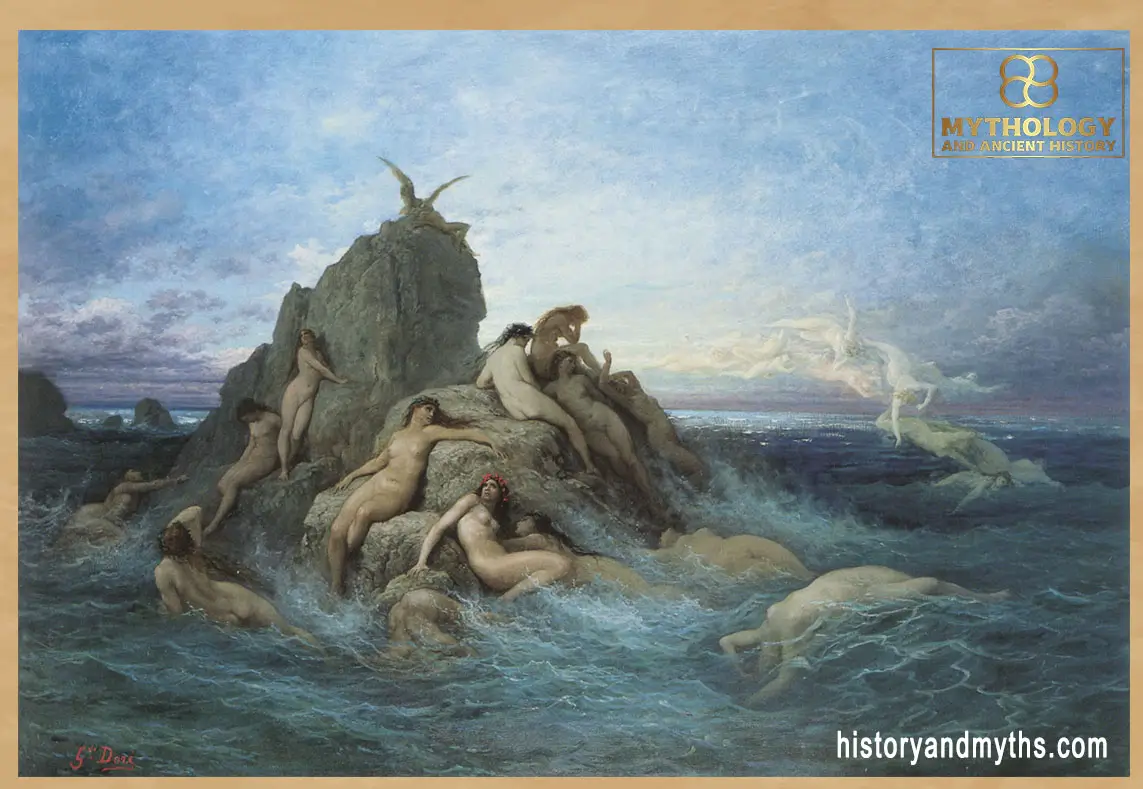
According to Hesiod’s Theogony, the Oceanids were born from the endless embrace of Oceanus and Tethys, two of the eldest Titans who ruled before the Olympians. Oceanus was imagined as a vast river encircling the world, the outermost boundary of land and sky, while Tethys personified the nourishing springs that fed every source of fresh water. From their union came three thousand daughters — spirits of the streams, fountains, and gentle flows that sustained life itself.
Unlike the Olympian gods, whose domains were defined by power and hierarchy, the Oceanids represented the living map of nature. Each daughter embodied a specific place or quality: Doris the bounty of the sea, Eurynome the wide current, Electra the brightness of clear water, and Styx, whose dark stream marked the oaths of heaven. Through them, the Greeks wove their geography into theology — every spring and river had a divine name, every act of drinking or bathing was a gesture toward a sacred presence.
The Oceanids were also bridges between divine generations. Some became consorts of gods and Titans, giving birth to powerful offspring who would shape the myths of the world to come. Doris married Nereus, giving rise to the fifty Nereids, sea nymphs beloved by sailors; Styx became the mother of Victory and Strength; Metis was swallowed by Zeus to birth Athena, goddess of wisdom. Through these unions, the gentle daughters of water became the quiet architects of divine order.
| Aspect | Details |
|---|---|
| Name | Oceanids — the three thousand water nymph daughters of Oceanus and Tethys. |
| Type | Mythological nymphs and divine spirits of freshwater, fountains, and springs. |
| Parentage | Titans Oceanus (the cosmic river) and Tethys (the nurturing source). |
| Number | Three thousand sisters representing every river, spring, and sea current of the world. |
| Major Figures |
Doris — mother of the Nereids; Styx — guardian of oaths; Metis — mother of Athena; Electra — mother of Iris and the Harpies; Eurynome — mother of the Graces. |
| Symbolism | Purity, fertility, continuity, and the feminine aspect of the natural world. |
| Depiction in Art | Portrayed as graceful women emerging from water or holding urns, symbolizing eternal flow. |
| Worship | Honored at springs and fountains through offerings of honey, milk, and wine poured into sacred waters. |
| Related Deities | Oceanus, Tethys, Potamoi (river gods), Nereids, Naiads. |
Names and Faces — The Most Famous of the Oceanids
Although ancient poets spoke of three thousand Oceanids, only a few emerged vividly in myth and art. Their names carried meanings that revealed both their nature and their domain — drawn from words for brightness, flow, gentleness, and power. These were not random labels but linguistic offerings, poetic reflections of how the Greeks perceived water as life itself.
Among the most celebrated was Styx, the dread river that encircled the underworld. She stood apart from her sisters, chosen by Zeus himself as the sacred stream upon which even the gods swore their oaths. To break a vow by her waters meant exile from Olympus for nine long years — proof that truth, like water, must remain pure.
Doris, gentle and maternal, became the wife of Nereus, the “Old Man of the Sea.” Together they gave birth to the Nereids, fifty daughters who filled the seas with grace and protection for sailors. Through her, the Oceanids extended their reach from freshwater to salt — from riverbanks to the open sea.
Another was Metis, whose name means “wisdom” or “counsel.” She was the first wife of Zeus and the mother of Athena, though swallowed by her husband so that divine intelligence could live within him. Through Metis, the Oceanids entered the Olympian narrative not as minor spirits, but as the origin of thought itself.
Electra, whose name means “shining” or “amber,” linked the Oceanids to the heavens. As the mother of Iris, the rainbow messenger, and the Harpies, she symbolized the meeting of air and water — the place where rain becomes light. Her lineage joined the flowing world below with the radiant skies above.
Each of these figures — Styx, Doris, Metis, Electra — served as a living current within the mythic landscape. They transformed water into symbol: of wisdom, purity, motherhood, and divine justice. Through them, the Oceanids became the subtle weavers of connection between the mortal and the eternal.
Sacred Springs and Silent Rites — Worship of the Oceanids
For all their gentleness, the Oceanids were not forgotten in ritual. Their presence lingered wherever clear water met human need — at fountains in cities, sacred pools beside temples, and wild springs deep in the countryside. The Greeks did not worship them as distant goddesses, but as intimate spirits who listened when a traveler poured a libation or when a mother prayed for her child’s health beside a stream.
Offerings to the Oceanids were simple: honey, oil, milk, or the first drops of wine from a feast. At dawn, priests of Demeter and Artemis sometimes invoked them before purification rites, calling on their “fresh hands” to cleanse and bless. In rural shrines, small stone altars stood near springs with carved names of local nymphs — each one likely an Oceanid once loved by that region’s people.
To pollute a spring was to offend the Oceanids, and ancient law codes occasionally mention fines for defiling holy water. Their worship blurred the line between religion and ecology: they reminded mortals that every drop sustaining life was divine. The Oceanids did not demand temples of marble; the running current itself was their sanctuary, and the silence of reflection their hymn.
- Greek Name: Ὠκεανίδες (Okeanides) — daughters of Oceanus and Tethys.
- Type: Water nymphs / divine spirits of springs, streams, and flowing freshwater.
- Number: 3,000 sisters representing every river and source on earth.
- Major Figures: Doris (mother of the Nereids), Styx (oaths and the underworld river), Metis (wisdom and mother of Athena), Electra (mother of Iris and the Harpies), Eurynome (mother of the Graces).
- Domains: Purity, fertility, renewal, balance between land and sea.
- Parentage: Titans Oceanus and Tethys, the primordial pair of the cosmic waters.
- Symbolism: Feminine flow of nature — nourishing, healing, and endlessly moving.
- Depiction: Graceful maidens with flowing hair and urns of water — images of serenity and continuity.
- Worship: Honored at springs and fountains with offerings of honey, milk, and wine to keep waters pure and alive.
- Legacy: Their image survived in Roman and Renaissance art, becoming the eternal symbol of water as life and memory.
Symbols of Flow — The Art and Meaning of the Oceanids
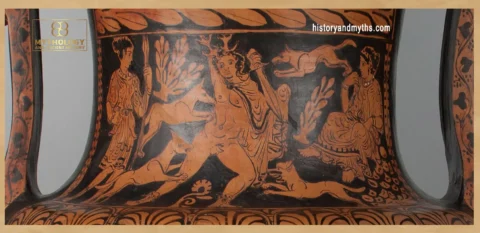
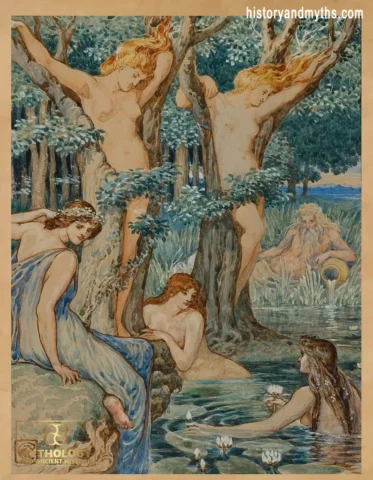
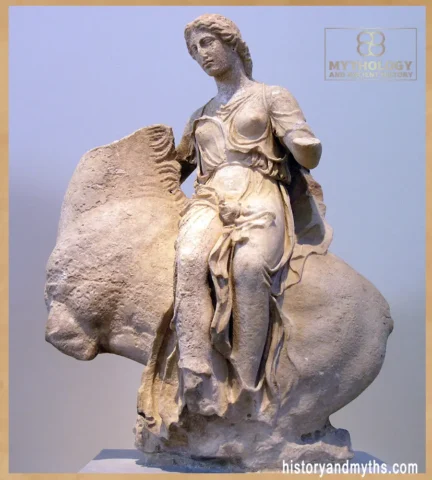
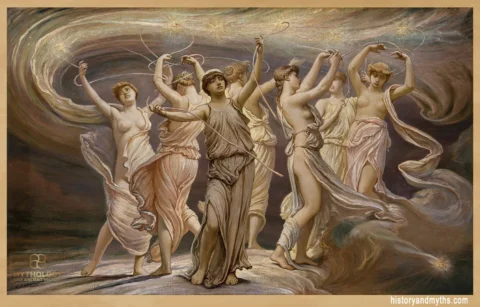
In Greek art, the Oceanids rarely appeared as individuals; instead, they formed a flowing chorus of movement and grace. On painted vases and temple reliefs, they are shown dancing beside rivers or leaning over urns from which water pours eternally — a visual metaphor for continuity. The sculptors of the Classical and Hellenistic ages loved to capture that moment between motion and stillness: a nymph turning her head toward the current, hair caught like ripples in marble.
This imagery was more than decoration. It expressed the Greek conviction that beauty and holiness were intertwined. The Oceanids, as embodiments of pure water, symbolized renewal and clarity — physical, moral, and spiritual. Artists gave them the faces of idealized women, yet their gaze was never vain; it reflected the world’s dependence on unseen forces. Just as the Potamoi represented masculine vigor, the Oceanids personified the feminine aspect of water — calm, nurturing, and endlessly adaptable.
In Roman mosaics and later in Renaissance paintings, the Oceanids reappeared as personifications of fountains and river nymphs. They held shells or jugs, reclined beside dolphins, or floated amid sea flowers. Even as centuries passed, their meaning endured: water as soul, water as memory. Every image of a woman emerging from the sea or resting by a spring carried their echo — the eternal reminder that to touch water is to touch divinity.
The Geography of the Oceanids — Mapping the Sacred Waters
To the ancient Greeks, geography was never only about land and distance — it was the memory of the divine. Through the Oceanids, myth transformed geography into theology: each daughter of Oceanus and Tethys personified a part of the world’s living waters. Their names and legends became a map of sacred places, a fluid chart of how nature and divinity merged.
Some Oceanids embodied entire regions. Asia represented the vast lands beyond the Aegean, her name echoing through millennia as both continent and spirit. Europa, another daughter, lent her name to the western lands, linking divine lineage with human geography. These were not just poetic titles — they reflected the way early Greeks mythologized direction, territory, and belonging.
Others were tied to specific rivers and springs. Styx, the dark Arcadian stream, defined the boundaries between life and death, while Clymene and Electra were linked to clear springs and coastal brightness. Doris, connected to the Aegean shores, became a maternal figure whose waters nourished both gods and mortals. Each name served as both an address and a prayer — a way of speaking to nature that was both reverent and intimate.
In Arcadia, Thessaly, and Attica, local sanctuaries bore inscriptions to “daughters of Oceanus,” showing that the Oceanids were not abstract ideas but living presences associated with real sites. Pilgrims traveling to sacred springs often brought offerings to unnamed nymphs, yet in literature, those same waters were given names from the Oceanids’ lineage. This blending of geography and genealogy allowed the Greeks to see their homeland as a living family of spirits, where every valley had a sister and every current a voice.
When ancient geographers like Strabo and Pausanias described rivers and coastlines, they often repeated the same mythic names, unconsciously preserving the memory of these nymphs. Even centuries later, the map of Greece remained haunted by their presence — a landscape of divine daughters whose bodies were rivers, whose hair was rain, and whose breath became mist at dawn. To follow their names across the world is to follow the ancient Greek understanding that place itself is sacred, and that every flowing line of water carries ancestry as deep as time.
Mothers, Wives, and Weavers — The Oceanids’ Role in Divine Genealogies
In the complex web of Greek divinity, the Oceanids stood quietly at the center of creation. Though they were never queens of Olympus, their influence ran deep — like groundwater feeding every river. Through marriage, motherhood, and myth, they connected the first generation of Titans to the radiant age of the Olympians, preserving the sacred flow between the old order and the new.
Among their ranks were women whose names became symbols of cosmic principles. Metis, whose name meant “wisdom,” was the first consort of Zeus and the mother of Athena. When the king of the gods swallowed her to absorb her cunning, he inherited the Oceanids’ oldest gift — foresight. Through Metis, intelligence itself became divine, and from her waters of thought, wisdom was reborn in the mind of Olympus.
Doris, gentle and generous, carried the fertility of rivers into the sea. As wife of Nereus, she gave birth to the Nereids, guardians of calm waters and protectors of sailors. Her daughters, like their mother, bridged the worlds of freshwater and salt, symbolizing how life moves from one state to another without losing its purity. Electra, luminous as her name suggests, married the sea-god Thaumas, giving birth to Iris, the rainbow messenger who joined earth and heaven with color and light. From this union of brightness and depth, myth found its palette of transcendence.
There was also Styx, whose waters bound oaths even among immortals. She united with Pallas, giving birth to the personifications of divine power — Nike (Victory), Kratos (Strength), Bia (Force), and Zelus (Zeal). Her devotion to Zeus during the Titanomachy earned her river eternal sanctity, making her lineage the embodiment of loyalty rewarded.
Beyond these famous names, countless other Oceanids married gods, spirits, and heroes, weaving invisible threads through every mythic genealogy. Each alliance joined sky to sea, wisdom to will, or beauty to form. Through their unions, they maintained the equilibrium their parents had created — Oceanus, the infinite current encircling the earth, and Tethys, the nurturing source that gave all waters life.
Seen this way, the Oceanids were not secondary figures but essential mediators — the quiet continuity that kept the divine family whole. In every myth where a god is born, a nymph appears in the background, carrying the echo of their waters. The Greeks may have sung louder hymns to Zeus or Poseidon, but beneath those songs flowed the Oceanids’ melody — the sound of creation itself continuing to breathe.
Cultural Echoes — From Greek Springs to Modern Symbolism
The voices of the Oceanids did not fall silent with the fading of ancient temples. Their spirit — the sanctity of water, the feminine strength within nature — continued to echo across art, poetry, and philosophy for over two thousand years. When the Greek world gave way to Rome, artists carried their image into fountains and gardens. Marble figures of reclining nymphs and flowing urns replaced the old sanctuaries, but the meaning endured: water as both beauty and renewal.
In Roman art, the Oceanids merged with local water deities to become nymphae aquarum, keepers of the springs that supplied cities and villas. Every fountain was imagined as a living presence, an Oceanid reborn in stone. Even as myths turned into decoration, the ancient belief persisted — that to beautify water was to honor it.
Through the Renaissance, painters rediscovered their form. Artists like Botticelli and Raphael drew upon the classical archetype of the water-born maiden: serene, luminous, and life-giving. Though their names were forgotten, the Oceanids lived on in the flowing hair, translucent drapery, and mirrored seas of these works. The Birth of Venus, rising from the foam, may owe as much to the Oceanids’ legacy as to Aphrodite herself — the same language of water, purity, and divine femininity.
During the Romantic era, poets reawakened the Oceanids in verse. In the rippling imagery of Shelley, Wordsworth, and Keats, nature spoke again with the voice of water. They were not invoking the gods directly, but the idea the Oceanids embodied — that emotion and nature are one flowing current. For them, the spring or brook was a mind, a mirror of human feeling, just as it had been for the Greeks who once whispered prayers to unseen nymphs.
Even modern environmental thought carries a faint echo of these ancient spirits. The notion that water has personality, that rivers and oceans possess rights or voices of their own, repeats an intuition older than civilization. In a time when nature is often reduced to resource, the Oceanids remind us of another vision — one where the world is alive, aware, and responsive to care.
From archaic hymns to modern activism, from temple spring to city fountain, their presence flows unbroken. The Oceanids began as mythic daughters of the world’s first waters, but they endure as symbols of continuity: between art and ecology, between the sacred and the real. Their legacy is not merely in the stories they inspired, but in every human gesture that seeks to protect what still moves and breathes beneath the sun.
Voices of Water — The Philosophy and Legacy of the Oceanids
Behind the grace of the Oceanids lay an idea older than any temple: that water is the essence of existence. The early Greek philosophers, from Thales to Heraclitus, echoed the same truth the poets had already sung — that all life flows from a single source and that change itself is divine. In mythic language, the Oceanids expressed what philosophy would later reason: the world lives because it moves, because it flows.
Through their endless variety, the Oceanids turned geography into theology. Each spring and stream became a thread in the fabric of creation, each local spirit a reminder that holiness was not confined to Olympus. Their stories taught that even the smallest current carried the pulse of the cosmos. To honor them was to practice humility — to see in nature not possession, but kinship.
Their legacy survived long after their names faded. Medieval poets invoked nameless water spirits, Renaissance artists painted nymphs in marble stillness, and Romantic writers saw in every lake a mind that dreams. These echoes were not coincidence; they were continuity. The Oceanids’ world never vanished — it transformed. From ancient sanctuaries to modern rivers, their spirit remains wherever water reflects the sky.
In this way, the Oceanids endure not only as mythic daughters of Oceanus and Tethys, but as the very language through which humanity first spoke to nature. Their flowing voices whisper still, beneath the noise of time — urging remembrance of a truth as old as the world itself: that to protect the waters is to protect life.
- The Oceanids were the three thousand water nymph daughters of Oceanus and Tethys, spirits of springs, streams, and rivers.
- They bridged the Titans and the Olympians, becoming mothers of gods such as Athena, Iris, and the Graces.
- Famous Oceanids include Styx (oaths and truth), Doris (mother of the Nereids), Metis (wisdom), and Electra (light and rainbows).
- They were honored at sacred springs and fountains, symbolizing purity, fertility, and renewal of life.
- In art and poetry, they embodied the feminine essence of water — calm, nurturing, and eternal.
- The Oceanids’ influence survived through Roman, Renaissance, and Romantic art as symbols of continuity and living nature.
Frequently Asked Questions about the Oceanids
Who were the Oceanids in Greek mythology?
The Oceanids were the 3,000 water nymph daughters of Oceanus and Tethys, spirits of springs, rivers, and fresh waters across the world.
Are the Oceanids considered goddesses?
They were divine nymphs rather than full Olympian deities, representing the life-giving and nurturing powers of nature.
What are the names of the most famous Oceanids?
Some of the best known are Styx, Doris, Metis, Electra, and Eurynome — each tied to important myths and divine offspring.
What did the Oceanids symbolize to the ancient Greeks?
They embodied purity, fertility, and the eternal flow of water — connecting land, life, and divinity.
How were the Oceanids worshipped?
The Greeks honored them at fountains and springs through simple offerings of honey, milk, and wine poured into the water.
What is the difference between Oceanids and Nereids?
Oceanids were freshwater spirits, while Nereids were sea nymphs — both descended from water deities but representing different domains.
Do the Oceanids appear in modern culture?
Yes — they inspired countless works of art, literature, and environmental symbolism as eternal images of living nature.
Sources & Rights
- Apollodorus. The Library of Greek Mythology. Translated by Robin Hard. Oxford University Press, 1997.
- Hesiod. Theogony. Translated by Hugh G. Evelyn-White. Loeb Classical Library, Harvard University Press, 1914.
- Homeric Hymns. In The Homeric Hymns and Homerica. Translated by Hugh G. Evelyn-White. Harvard University Press, 1914.
- Pausanias. Description of Greece. Translated by W.H.S. Jones and H.A. Ormerod. Harvard University Press, 1918.
- Smith, William. Dictionary of Greek and Roman Biography and Mythology. London: Taylor and Walton, 1849.
- Hard, Robin. The Routledge Handbook of Greek Mythology. London and New York: Routledge, 2004.
- Grimal, Pierre. The Dictionary of Classical Mythology. Oxford: Blackwell Publishing, 1996.
- Burkert, Walter. Greek Religion: Archaic and Classical. Harvard University Press, 1985.
Written by H. Moses — All rights reserved © Mythology and History