The origins of the Sumerians remain one of the most debated questions in ancient history. Scholars have proposed multiple theories—ranging from Anatolia and Iran to the Indus Valley and the Arabian Gulf—to explain where the Sumerians came from and how they emerged in southern Mesopotamia. This article examines the main origin theories and the evidence behind each.
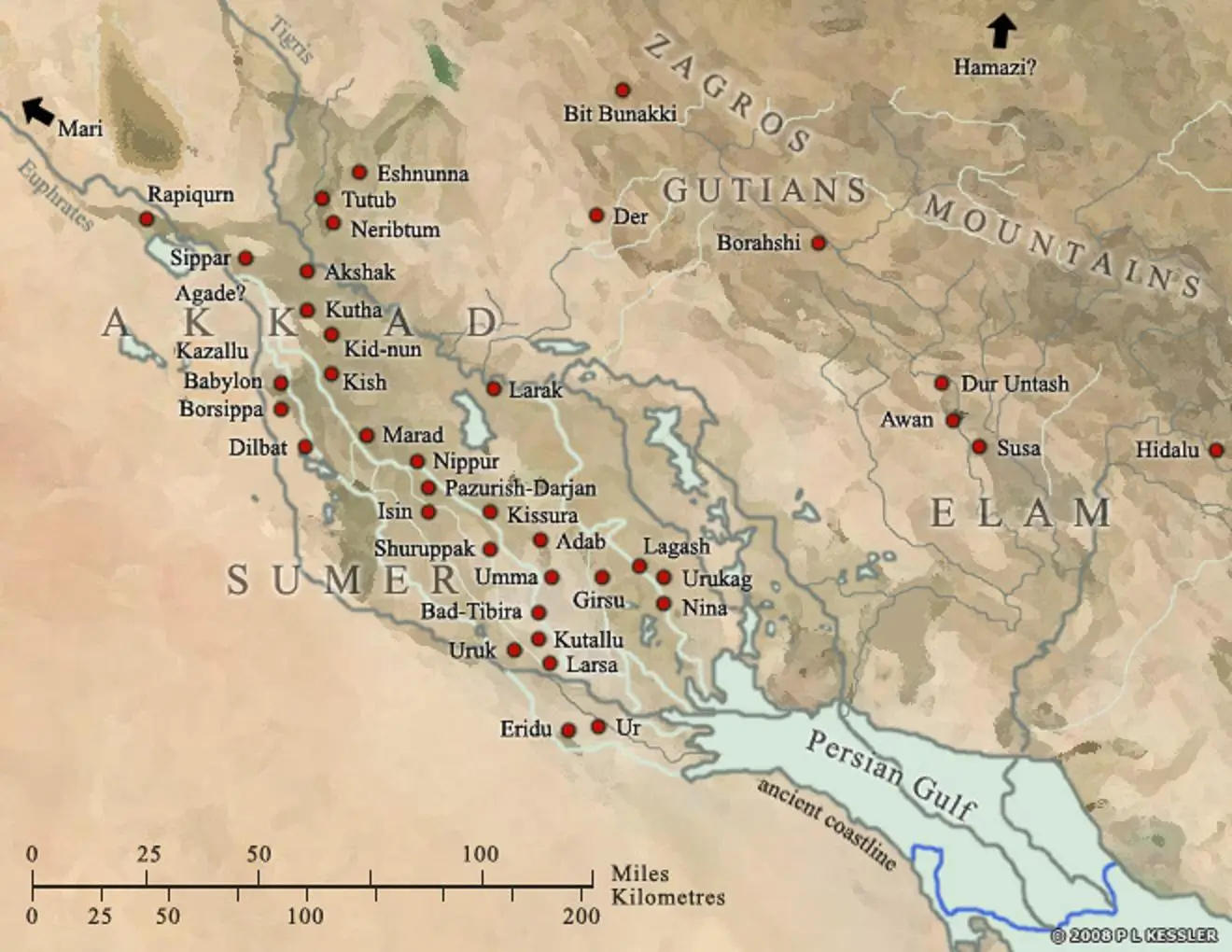
ancient land of sumer
Origin Theory
Proposed Region
Main Evidence
Key Weakness
Anatolian Theory
Asia Minor
Linguistic comparisons
No direct linguistic relatives
Central Asian Theory
Central Asia / China
Writing and phonetic parallels
Speculative linguistic links
Iranian (Zagros) Theory
Zagros Mountains
Symbols, seals, mountain imagery
Mythological over-interpretation
Indus Valley Theory
Harappa & Mohenjo-Daro
Seals, trade objects
Trade ≠ ethnic origin
Dilmun Theory
Persian Gulf
Mythology, archaeology in Bahrain
No proof of primary homeland
Mesopotamian Theory
Southern Iraq
Continuous local development
No earlier external homeland identified
1. Anatolian Origin Theory: Did the Sumerians Come from Asia Minor?
Depending on the type of Sumerian language, which is composed of unconjugated syllables such as Aryan or Semitic languages, and has unchanging roots and its basic grammatical unit is the verbal compound and not the single word, some researchers have compared it to many other glued languages such as Turkish, Hungarian, and some Caucasian languages, especially the ancient Turanian language, where Rollinson early on raised such an opinion, then followed by Obert, and the discovery of the Sumerian language was still in its infancy, and Samuel Noah Kramer talked about the possibility that the Sumerian language belongs to the Turanian pattern. However, it is widely believed that the Sumerian language is not related to any of these attached languages, and perhaps the closest hypothesis to explain the uniqueness of the Sumerian language is that it belongs to a language family that became extinct in prehistoric times and only the Sumerian language spoken by the Sumerians in the Mesopotamian civilization survived.
2. Central Asian Origin Theory: Are the Sumerians Linked to Early China?
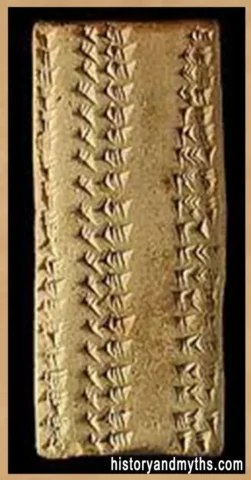
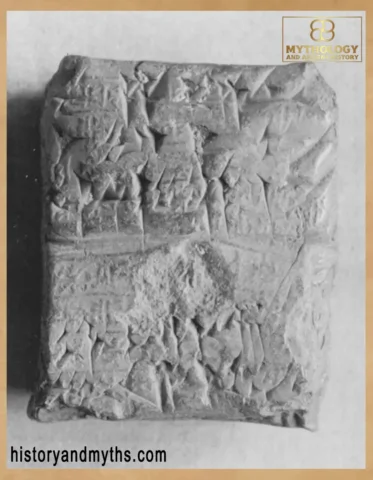
Some researchers believe that the Sumerians came from the plateaus and highlands of Central Asia, and that they travelled south towards Iran until they settled in southern Iraq. Their evidence for this Iranian route is the similarity of Ubaid period pottery coloured pottery in Iraq and Iran (which, of course, does not prove their point, but rather the spread of Ubaid period pottery towards Iran. The two researchers (Pali and litt) have gone further, and through their meticulous research into Chinese and Sumerian cuneiform writing in their book (Chinese and Sumerians), they concluded that there is a striking similarity between the first phonetic stages of Mesopotamian cuneiform writing (invented by the Sumerians) and the first stages of the early Chinese They created a comparative Chinese-Sumerian dictionary of many words that share common meanings and sounds, and concluded that the ancestors of the Chinese and Sumerians came from mountainous origins in Central Asia in two directions, one of which went to China and the other penetrated Iran and settled in southern Iraq. Both retained the primitive common writing of their ancestors with their common sounds.
3. Iranian Origin Theory: The Zagros Mountains Hypothesis
Some researchers have noticed that the Sumerians use a single symbol in their writing and language that signifies both the mountain and the homeland (Kur). They believed that this indicates that they meant that their homeland is the mountain, and they put a possibility for the nearest mountains adjacent to the southern Mesopotamian Valley, the Zagros Mountains.
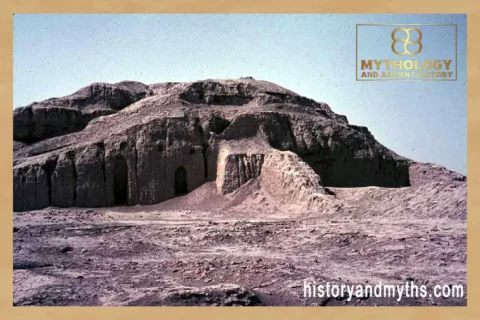
This opinion was reinforced by the fact that the Sumerians did not build their temples on flat ground like houses and palaces, but on elevated ground This made them associate the temple as a sacred place with the homeland as a place from which they came, and that this place is the Iranian mountains east of Sumer.
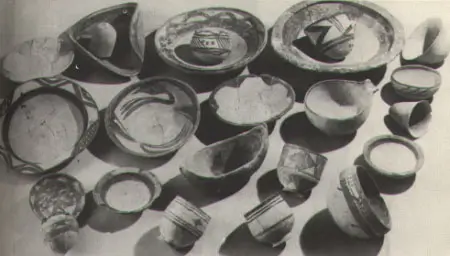
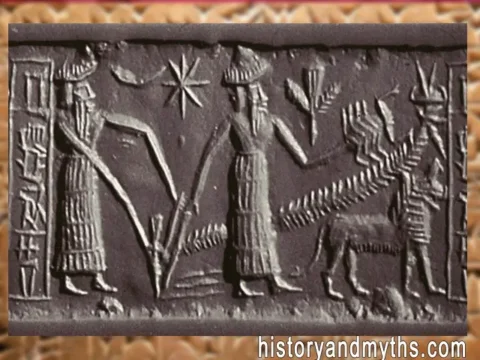
This view was further strengthened by what was found in the Sumerian cylindrical seals of drawings of trees and mountain animals such as (cypress, cedar, ibex and mountain goats with long horns).This view was further strengthened by the discovery of the similarity between Ubaid period pottery However, the appearance of the earlier Eridu pottery, which formed their source, mitigated this argument, and then the ziggurats were the implementation of a theological-mythological depiction of the first mountain of the universe on which the gods appeared according to Sumerian theology, and that it is not possible to rely on one or two singulars to indicate the origin of a people with tens of thousands of vocabulary in their language and writing.
pottery from Eridu 4000-B.C
The Sumerian Origin Debate
No ancient text explicitly records a Sumerian homeland.
Most theories rely on language, archaeology, or mythology.
Trade evidence is often mistaken for migration evidence.
The Mesopotamian model explains cultural continuity best.
The debate reflects limits of prehistoric reconstruction.
4. Indus Valley Theory: Links Between Sumerians and Harappa
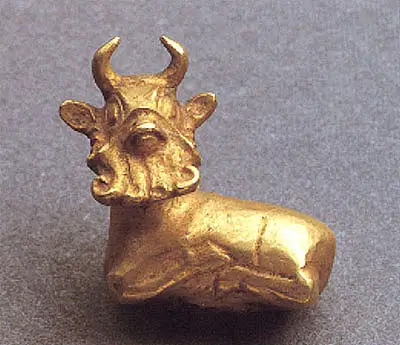
After the exciting discoveries in the Indus Basin (Harappa and Mohenjo-Daro regions) gave a new picture of the origins of ancient civilisations in India, some scholars found that there is a great similarity between Sumerian and Indian cultural and material monuments and seals dating back to about (3000 – 2700 BC). This was further reinforced by the finding in Sumerian cities such as Ur and Kish of seals bearing the characteristics of the seals known in the Indus Valley in terms of shape, style and images of carvings such as the bull with a hump on the neck, the elephant, the crane and the crocodile. The theory of a genuine ethnic relationship between the Sumerians and the Harappa people is particularly attractive to those who try to find a linguistic link between the Sumerian language and the Dravidian language, and there is strong evidence in the form of artistic styles and material objects of a civilisation found at other sites and for trade relations in the third millennium between the Sumerians and the people of the Indian Valley or Baluchistan.
pottery from Eridu 4000-B.C
5. Dilmun Theory: Did the Sumerians Originate in the Persian Gulf?
From the legends of the Greek Babylonian priest Berossus and the list of pre-Flood kings and cities, there is a reference to the fish-man who came out of the water and brought with him the elements of civilization. This is consistent with Sumerian ideas about the Sumerian god of wisdom Enki(Ea), who was the local deity of the city of Eridu, the oldest visible city on the banks of the Gulf. Geoffrey Bibby’s theory is based on the fact that the Sumerian artefacts and thousands of graves found in Dilmun(Bahrain) clearly indicate that Dilmun was the place from which the Sumerians travelled across the Persian Gulf to Failaka Island and then to southern Mesopotamia. He also relies on the fact that the Sumerians referred to Dilmun in their myths as an eternal paradise and that immortal dwelled there. Proponents of this theory go further when they decide that the Magan civilization in Oman, the Tarout civilisation in Arabia, and the Umm Al Nar culture in the UAE and Qatar constitute the Gulf background of the Dilmun civilization and that these civilizations were the origin of the Sumerians and their first home before they appeared in Mesopotamia.
6. Levantine Origin Theory: Were the Sumerians from Syria and the Levant?
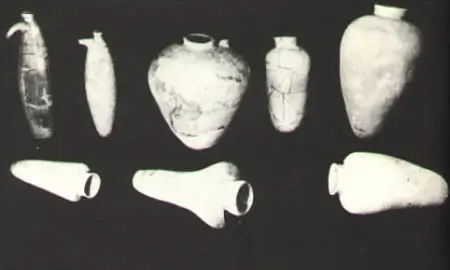
The proponents of this theory take the Sumerian Uruk pottery as proof that it has similarities in its shape and red and grey colours, which were found in northern Syria and Palestine, so they drew a sloping road from those areas that the ancestors of the Sumerians took and then settled in the Sumer region. This argument weakens in the face of the origin of the pottery of the Ubaid and Uruk civilisation and not the other way around
pottery vessels from Uruk 4000-B.C
7. Mesopotamian Origin Theory: Were the Sumerians Indigenous to Iraq?
The theory of the Iraqi origin of the Sumerians solves many of the issues raised by other theories, although some of them are still unresolved.
The first question we ask is: Which places or countries were more developed than Mesopotamia in the whole earth before the appearance of the Sumerians in southern Mesopotamia until we say that the Sumerians came from outside it and brought with them the laws of civilization, including writing?
The answer is that there was no more developed than Mesopotamia at all, because Iraq, since the Mesolithic, Neolithic and Chalcolithic eras, has been developing in an escalating and accelerating manner and making all the places around it gasp after its development. The development of the Sumerians complemented the developments that preceded it. The Mesopotamian Valley developed in mining, agriculture, irrigation, the establishment of cities and crossings, and the emergence of crafts. What prevents these civilisational systems from growing and developing at the hands of people who were later called the Sumerians.
Historian Georges Roux says that Sumerian literature provides us with a picture of a cultured and religious people, but it does not give us information about their origin. The Sumerian stories and legends take place in an environment rich in rivers, lakes, papyrus and slender trees – a typical background of southern Iraq – and give a strong impression that the Sumerians have always lived in this region. There is no confirmation of any earlier Sumerian homeland other than the Mesopotamian Valley.
After the massive Neolithic revolution in the north of the Rafidain Valley and on the slopes of its mountains and the emergence of villages, regular worship and ways of civilization, this revolution reached its peak in the civilization or culture of Samarra in the fifth millennium BC. This civilisation relied on agriculture for its economy, and agriculture in turn depended on fluctuating rainfall. The Samaritans had no choice but to rely on rivers and organise irrigation, and this had to be accompanied by the southward march of the Tigris, so they gradually began to migrate.
The ancient name of the Samarra region in the first millennium BC was (Saramrata) and was also mentioned as (Simraum) and (Saimra). This indicates that this area and its surroundings were related to the name (Sumer), as evidenced by the mention of (Sumer’s wall) by a Roman historian and the existence of the region (Sumar) to the east of Samarra towards Iran. All this indicates that Neolithic Samarra was the original home of the Sumerians.
We do not rule out that the spread of the Neolithic Samaritans was in the land between Samarra on the Tigris and Haditha on the Euphrates. Their descent, each on its own river, began in the middle of the fifth millennium BC with the beginning of the chalcolithic revolution and the use of metals. The Hamrin Mountains may have been a major source of this migration.
It seems that around the fifth millennium BC, a group of people known as The first inhabitants of the Tigris appeared in the areas around the Tigris River in the fertile lands of the southern Mesopotamian Valley, the children of the Samarra civilisation. Those who followed the Euphrates River in the fertile lands of the southern Mesopotamian Valley are called The first inhabitants of the Euphrates. Each of these people had a language that was somewhat different from the other, and as they merged into the cities of the sedimentary plain, what we call Ubaid emerged, who can be called the first Sumerians, as they constituted the direct ancestors of the Sumerians.
Thus, we see that the southern part of Mesopotamia was inhabited by three types of homogeneous peoples between the sixth and fifth millennia BC. They are:
1 – The first inhabitants of the Tigris
They are the people who lived around the southern half of the Tigris River and settled in the upper half of the sedimentary plain. Researchers have researched the remaining names of their language and found that there are the names of some gods such asDagan, Zababa, the sun god AMBA, Ishtar and Adad, and that the region was inhabited by elements speaking Semitic languages with people different from the first Euphrates, they called them the first inhabitants of the Tigris).
2 – The first inhabitants of the Euphrates
They are the northern migrants who established their cities on the Euphrates River and formed the majority of the population of the lower half of southern Iraq, which included the names of well-known cities and the names of crafts and industries necessary and essential for the Sumerian agricultural community later.
3. Ubaid
They are the civilizational mixture of the early inhabitants of the Tigris and Euphrates and all the peasants and artisans who migrated from the northern Mesopotamian Valley and settled its southern sedimentary plain and innovated in the fields of irrigation agriculture, making their own pottery, using metals and building cities. We see that one of the first areas where the Ubaid emerged as the owners of a new civilization was the region of Arido, then Tell al-‘Ubaid and Uruk. The time of their emergence was between (4000 – 3500) BC. BC. They are in our opinion (the first Sumerians) or the ancestors of the Sumerians. They spread their culture and civilization to northern Iraq, Anatolia, Syria, Elam, Arabia and the Gulf and were important qualitative achievements at all levels, as did their Sumerian predecessors who completed the spread of Mesopotamian civilization.
Key Takeaways
The origin of the Sumerians remains unresolved.
Multiple theories compete, none conclusive.
Linguistic uniqueness weakens external-origin models.
Archaeology supports gradual local development.
The Ubaid culture likely formed the Sumerian foundation.
Frequently Asked Questions
Do we know where the Sumerians came from?
No. There is no definitive evidence identifying a single homeland.
What is the most accepted theory?
Many scholars favor a Mesopotamian origin based on cultural continuity.
Did the Sumerians migrate from another region?
Migration is possible, but archaeological proof is lacking.
Is there a linguistic link to other ancient languages?
Sumerian appears to be a language isolate.
What role did the Ubaid culture play?
It likely represents the direct ancestors of the Sumerians.
Why does the debate continue?
Because prehistoric societies left limited written evidence.
Sources & Rights
Roux, Georges. Ancient Iraq. Penguin Books.
Kramer, Samuel Noah. The Sumerians. University of Chicago Press.
van de Mieroop, Marc. A History of the Ancient Near East. Wiley-Blackwell.
Potts, Daniel T. The Archaeology of Elam. Cambridge University Press.
Bottéro, Jean. Religion in Ancient Mesopotamia. University of Chicago Press.
I’m an independent researcher with a formal academic degree in History, specializing in World History and Civilizations. My academic studies covered civilizations across every inhabited continent, while my current research focuses particularly on Ancient Egypt, Mesopotamia, Canaan, Greece, and the mythologies and religions of the ancient world. My articles draw on scholarly research, archaeological evidence, museum collections, and ancient texts, with a strong commitment to historical accuracy, clarity, and responsible interpretation.
For inquiries: [email protected]
Mesopotamian civilization did not begin suddenly with Sumerian cities or the invention of writing. It emerged gradually through waves of migration, environmental change, and profound shifts in religious belief that…
Children in Mesopotamia were not raised primarily to be educated, but to be integrated. Education was only one part of a broader system of social formation that prepared children for…
Mesopotamian reliefs were state-controlled stone carvings used to document power, enforce authority, and shape political memory in ancient Assyria and Babylonia. Carved on palace walls and ceremonial corridors, these low-relief…
Priests in Mesopotamian civilization were not secluded religious figures devoted only to prayer; they were administrators, economists, healers, diviners, and agents of social control operating at the center of urban…
Women in Mesopotamian civilization were not marginal figures confined to the household; they were legally recognized individuals who worked, owned property, signed contracts, appeared in court, and participated in religious…
Tax systems in Mesopotamia were not primitive experiments in revenue collection. They were structured mechanisms that sustained armies, funded monumental construction, supported temples, and bound provinces to imperial authority. In…