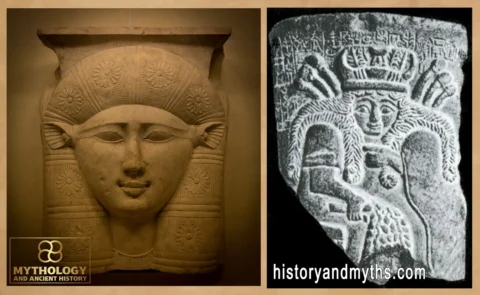
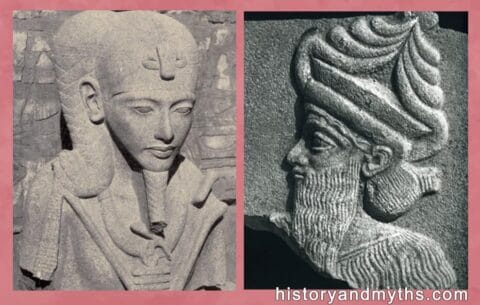
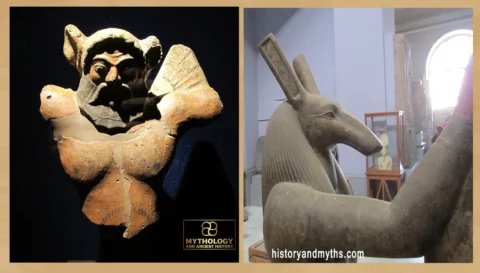
Enki vs Thoth: Gods of Wisdom in Mesopotamia and Egypt
Enki (Ea) and Thoth were major gods of wisdom and sacred knowledge, but they belonged to different civilizations. Enki was a Mesopotamian deity linked to fresh subterranean waters (the Abzu) and creation. Thoth was an Egyptian god of writing, learning, and magic, closely tied to Hermopolis.
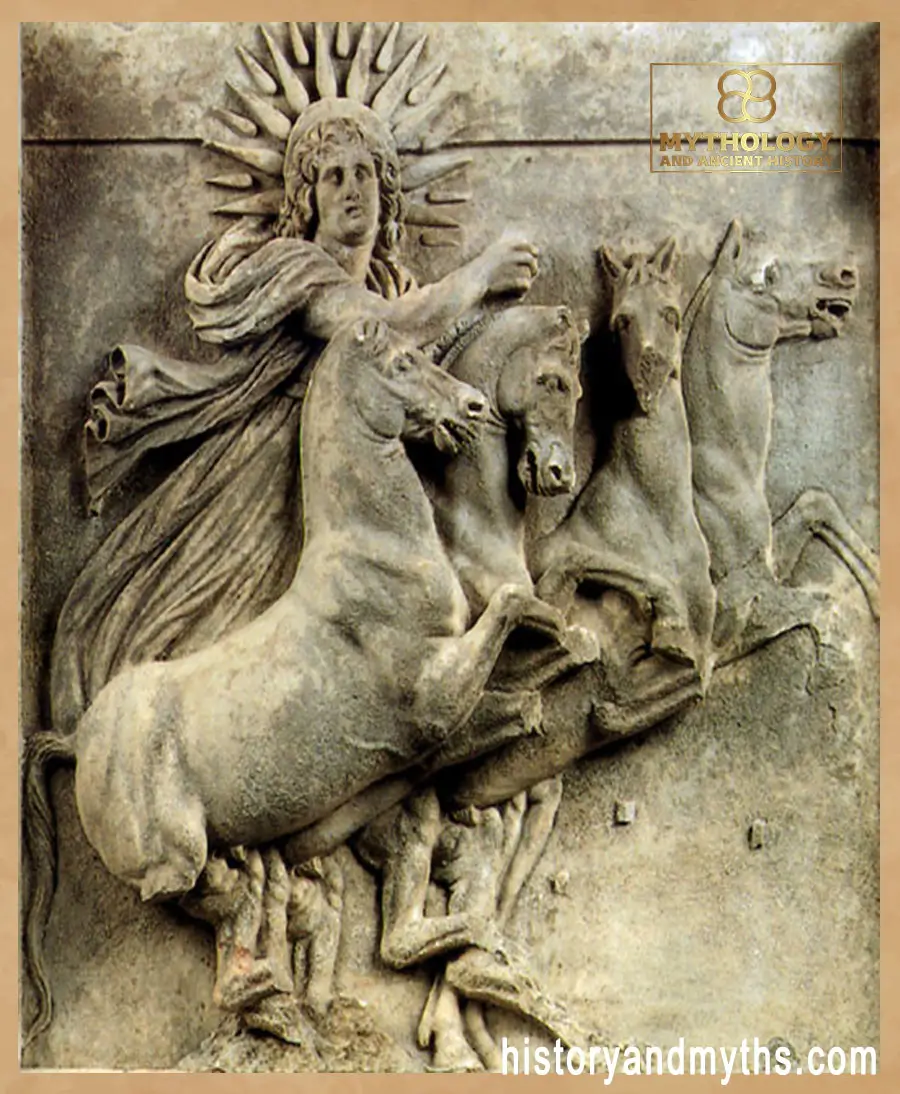
Enki vs Thoth — Quick Comparison
| Feature | Enki (Ea) — Mesopotamia | Thoth — Ancient Egypt |
|---|---|---|
| Core domain | Wisdom, creation, subterranean freshwater (Abzu) | Writing, knowledge, magic, measurement, lunar cycles |
| Cosmic role | A “creator-helper” figure who enables order through skill and divine intelligence | A divine scribe who stabilizes order through record-keeping, law, and ritual knowledge |
| Sacred place | Eridu (traditional center) | Hermopolis (Khmunu / Khemenu) |
| Symbols & imagery | Flowing water imagery; freshwater abyss (Abzu) | Ibis/baboon forms; scribal palette, scrolls, moon symbolism |
| “Knowledge” as a concept | Practical divine mastery: craft, strategy, magic, creative problem-solving | Formal sacred knowledge: writing, calculation, ritual speech, judgment and order |
| Modern comparison | Closer to “wise engineer / divine inventor” | Closer to “cosmic scribe / keeper of sacred records” |
Who Is Enki (Ea) in Mesopotamian Mythology?
In Sumerian mythology, Enki (later known as Ea in Babylonian mythology) is considered is considered one of the great gods. He was the god of wisdom and fresh water and was responsible for magic, arts and crafts. Enki was described as having a sharp mind and able to find solutions to the complex issues facing gods and humans alike. Enki was depicted sitting on his throne in the Abzu with an urn of water in his hand, from which water flows, symbolizing life. Enki was known to be the son of the great god Anu and the brother of the god Enlil, lord of the air, and his sacred city was Eridu, where his ziggurat and his secret place in the depths of the Abzu.
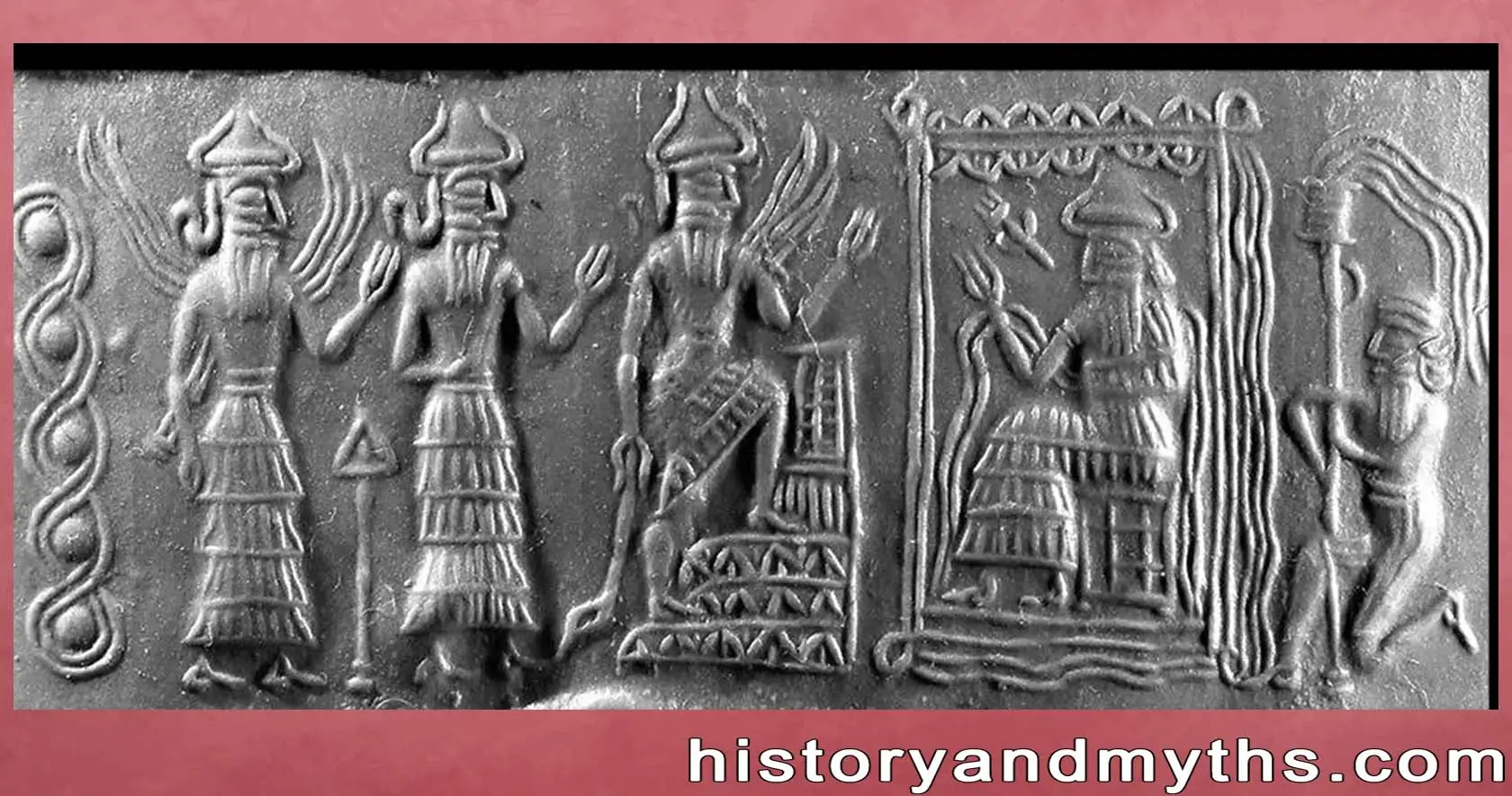
One of his most famous legends tells of his role in saving humanity from the Great Flood. When the god Enlil decided to destroy humans because of their constant noise, Enki warned Ziusudra and gave him instructions to build a ship that would save him from drowning. This story is very similar to the story of the Flood in the later Abrahamic religions.
He was also known for his cunning and intelligence and always resorted to humans and gods to help them with their troubles, for example, when Inanna descended to the underworld and did not return, her assistant Ninshubur went to the god Enlil, but he did not help her, and the god Nanna did not help her, and when she turned to the god Enki Enki, the god of wisdom, helped her to retrieve Inana, as in the well-known story you can read more about it here (Inanna’s Descent into the Underworld )
and also helped the god Ninhursag in the creation of man you can read more about this legend (Enki, Ninhursag, Sumerian Creation Myth)
Who Is Thoth in Egyptian Mythology?
Thoth was the god of the moon, wisdom, learning, sacred texts, mathematics, science and magic, as well as being a messenger and recorder of the Panethians, a master of knowledge and the patron god of scribes. Thoth is often depicted in art as an ibis-headed man, often shown holding a tablet and a scribe, but he was also depicted holding an ankh in one hand representing life, and a scepter in the other representing power.
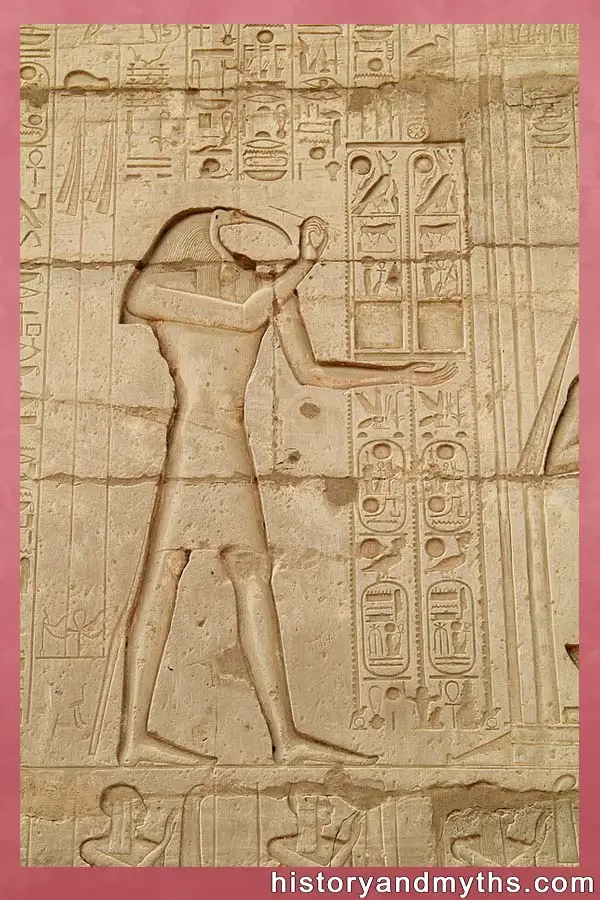
Date 23 March 2016 Source Own work Author Djehuty
On his head, Thoth sometimes wore a crescent moon, but he was also depicted wearing the double crown of Egypt. Thoth was one of the oldest Egyptian gods and was revered throughout Egypt, especially in the city of Hermopolis Magna, where he was worshipped.
The power of his cult was so great that the story was rewritten as Thoth becoming the creator god, creating himself with the power of language, then laying an egg from which Ra and the universe as we know it were born. Although Osiris and Isis were usually credited with bringing civilization to humans, Thoth was thought to have gifted humanity with writing, medicine, magic, and the religious and social practices of Egypt.
He was the scribe of the afterlife and recorded the judgment of the dead in the Hall of Maat. From this role, he earned the titles “God of Balance” and “Master of Balance”. Besides being the scribe of the gods, he was often described as acting as an advisor to Ra and even standing on the sun barge alongside Ra on his nightly journey across the sky.
In many stories of Egyptian mythology, Thoth is rarely the main character, but rather a guiding force, whose almost infinite wisdom and knowledge prevents disasters and brings the world back into balance. In the tale of Osiris, Thoth gave Isis the amulet to revive Osiris after his brother Set brutally murdered him.
Thoth also went to the rescue of Horus, the son of Isis and Osiris, by expelling a magical poison from his body, and supported him in his fight against Set for the throne that was rightfully his. Since Thoth was associated with writing and the moon, it is not surprising that he was also associated with the creation of the lunar calendar that governed many civil and religious practices in Egypt.
Thoth was believed to be the inventor of the 365-day calendar, which replaced the ancient 360-day calendar. According to legend, he obtained the extra five days by gambling with the moon god Khonsu in a game of dice in order to help the goddess Nut. Nut had become pregnant by her husband Geb, but Ra prevented her from giving birth on any day of the Egyptian calendar.
Key Similarities Between Enki and Thoth
Although the Sumerian and Egyptian civilizations were different, there are many commonalities between Enki and Thoth
– They both represent wisdom, secret knowledge, and creative power, and had a role in transmitting science to humans.
– Both are considered intermediaries between the gods and humans, helping to regulate the relationship between them.
– Both were associated with magic and supernatural powers, using their knowledge to solve issues.
– Both were associated with teaching humans important aspects of civilization; Enki taught humans arts and crafts, and Thoth taught them writing and language
Major Differences Between Enki and Thoth
Despite the many similarities, there are fundamental differences between the two gods
– The primary sphere of power: Enki is associated with fresh water and creation, while Thoth is associated with justice and cosmic order.
– Personality and style: Enki was known for his cunning and intelligence, while Thoth was more neutral and balanced.
– Religious Status: Enki was one of the three great gods of Sumer, while Thoth was an auxiliary god within the Egyptian divine complex.
Infographic: One Idea, Two Civilizations
- Enki (Ea) frames wisdom as creative power: the ability to shape reality through water, craft, and divine intelligence.
- Thoth frames wisdom as structured knowledge: writing, timekeeping, law, and the magical authority of names and words.
- Both deities show the same core belief: the universe survives on knowledge—but each culture defined “knowledge” differently.
- Enki is rooted in the Abzu (freshwater abyss), while Thoth is rooted in Hermopolis (city of wisdom and sacred learning).
Are Enki and Thoth the Same God?
The comparison of Enki and Thoth shows how the concept of wisdom manifested itself in different forms in ancient civilizations.
While Enki embodied practical wisdom and clever solutions, Thoth symbolized order and justice. By studying these gods, we can understand how ancient peoples viewed knowledge, and how these beliefs influenced subsequent intellectual and cultural developments.
In your opinion, were the Egyptian and Sumerian views of wisdom exactly the same, or did each civilization have its own unique perspective?
Key Takeaways
- Enki (Ea) is a Mesopotamian god of wisdom tied to freshwater, creation, and the Abzu.
- Thoth is an Egyptian god of writing, magic, knowledge, and cosmic order, linked to Hermopolis.
- Both represent “divine intelligence,” but Enki leans toward practical creative power, while Thoth leans toward sacred record-keeping.
- They are not the same god historically—similarities come from shared ancient questions about knowledge and order.
- Comparing them is useful only if you keep the cultural context intact (Sumer/Akkad vs Egypt).
FAQ: Enki vs Thoth
Are Enki and Thoth the same god?
No. Enki (Ea) is Mesopotamian, while Thoth is Egyptian. They share “wisdom” roles but come from different religions and histories.
What was Enki the god of?
Enki (Ea) was linked to wisdom, creation, and subterranean freshwater (the Abzu), along with divine craft and magical knowledge.
What was Thoth the god of?
Thoth was associated with writing, learning, magic, measurement, and lunar order. He was also imagined as a divine scribe.
Why do people compare Enki and Thoth?
Because both represent sacred knowledge—Enki through creation and watery power, Thoth through writing and cosmic order.
Where was Enki worshipped?
Enki’s traditional cult center was Eridu in southern Mesopotamia, one of the oldest sacred cities of the region.
Where was Thoth worshipped?
Thoth’s major cult center was Hermopolis (Khmunu), a major intellectual and religious city in Middle Egypt.
Was Enki considered a creator god?
Yes. Many Mesopotamian traditions connect Enki with creation and the skills needed to build and maintain the world.
Was Thoth a magic god or a writing god?
Both. In Egyptian thought, writing and magic were closely connected—words, names, and formulas carried real power.
How were Enki and Thoth depicted?
Enki is often tied to water imagery; Thoth is depicted as an ibis-headed man or as a baboon, linked to scribal symbols.
Sources & Rights
- Black, Jeremy, and Anthony Green. Gods, Demons and Symbols of Ancient Mesopotamia: An Illustrated Dictionary. Austin: University of Texas Press, 1992.
- Bottéro, Jean. Religion in Ancient Mesopotamia. Chicago: University of Chicago Press, 2001.
- Dalley, Stephanie. Myths from Mesopotamia: Creation, the Flood, Gilgamesh, and Others. Revised Edition. Oxford: Oxford University Press, 2000.
- Hornung, Erik. Conceptions of God in Ancient Egypt: The One and the Many. Ithaca: Cornell University Press, 1982.
- Quirke, Stephen. Ancient Egyptian Religion. London: British Museum Press, 1992.
- Teeter, Emily. Religion and Ritual in Ancient Egypt. Cambridge: Cambridge University Press, 2011.
Written by H. Moses — All rights reserved © Mythology and History