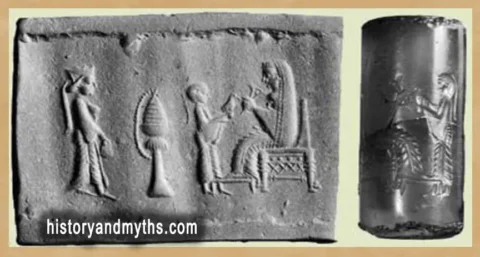
Enki’s voyage to Nippur is one of the most symbolic stories in Sumerian mythology. After building his sacred temple in Eridu, the city most closely associated with wisdom, water, and the Abzu, Enki travels by boat to Nippur to receive the blessing of Enlil, the god of authority and cosmic order. The myth is not only a journey between two holy cities; it is a story about divine legitimacy, temple power, ritual harmony, and the relationship between two of the most important gods in ancient Sumer.
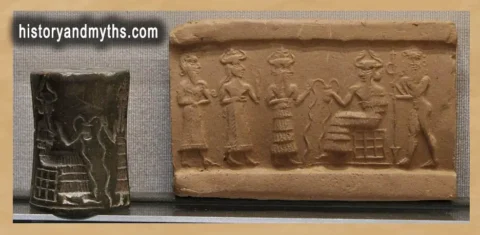
Enki residence in Eridu along the abzu marshes
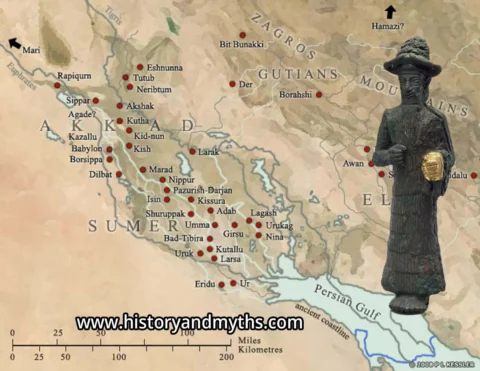
Nippur and Eridu: Two Sacred Cities in Sumerian Mythology
This myth gives us a new counterfactual indication that (Nippur) preceded (Eridu) in existence.
while it is established through the Sumerian kings’ legends that Eridu is the first of the five Sumerian cities before the flood.
Additionally, scientific evidence has proven that Eridu is the first settled city in southern Iraq.
Because Eridu is the home of the god Enki and Nippur is the home of the god Enlil, we believe that this myth points to a religious priestly conflict that attempted to give Nippur importance and precedence over Eridu.
This indicates a form of masculine coup and its centrality, as Enki did not strictly represent a masculine side, while Enlil completely represented that.
Enki, on the other hand, signifies what remains of the mother goddess, as he was her son, husband, and heir.
Myth Overview
Aspect
Details
Myth
Enki’s Voyage to Nippur
Main Deity
Enki
Destination
Nippur, the city of Enlil
Starting Point
Eridu, the city of Enki
Purpose of the Voyage
To receive Enlil’s blessing for Eridu and Enki’s temple
The myth begins with praise for the god Enki and how he built his house of silver and lapis lazuli in his city Eridu, and it was decorated with gold.” According to the myth in this part.
The lord of the abyss, the king Enki………..Enki, the lord who decrees the fates………………. Built his house of silver and lapis lazuli……..Its silver and lapis lazuli, like sparkling light………The father fashioned fittingly in the abyss……..The (creatures of) bright countenance and wise, coming forth from the abyss………Stood all about the lord Nudimmud……….The pure house be built, he adorned it with lapis lazuli….
He ornamented it greatly with gold……….In Eridu he built the house of the water-bank…….Its brickwork, word-uttering, advice-giving……Its . . . like an ox roaring……….The house of Enki, the oracles uttering.
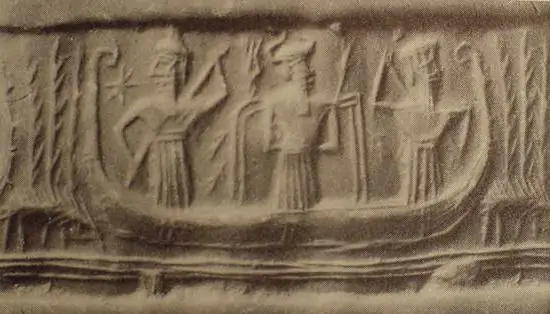
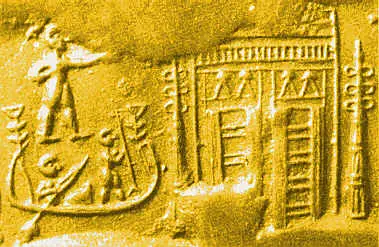
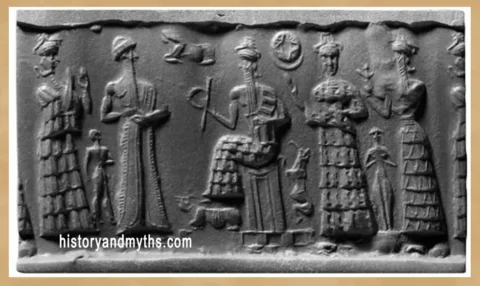
Sumerian ship coming to dock at Enki’s ziggurat residence
The Divine Voyage from Eridu to Nippur
And thereafter, he needs the blessing of the greatest god of Sumer, Enlil, who resides in Nippur. Therefore, he prepares his boat for the journey and emerges from the waters of the Abzu, his abode. According to the myth in this part.
Enki is now ready to proceed by boat to Nippur to obtain Enlil’s blessing………… for his newly-built city and temple. He therefore rises from the abyss:
When Enki rises, the fish . . . rise, ………The abyss stands in wonder, ………….In the sea joy enters, ………………Fear comes over the deep,………Terror holds the exalted river, …………….The Euphrates, the South Wind lifts it in waves. …….
Enki’s Voyage at a Glance
In this Sumerian myth, Enki completes the construction of his magnificent temple in Eridu and then embarks on a sacred voyage to Nippur. There he seeks the blessing of Enlil, the supreme authority among the gods. The story highlights the relationship between divine wisdom and divine authority while emphasizing the religious importance of both Eridu and Nippur in Sumerian tradition.
The Feast of the Gods in Nippur
And when the god Enki arrives at the city of Nippur, he finds a grand feast arranged for him by the god Enlil, who invited the gods (the Anunnaki) to celebrate the completion of Enki’s house.
Drinks are served, and the gods become intoxicated. Then, on this occasion, the god Enlil speaks, and from his words, it appears that he is the father of the god Enki.
This is natural, as Enlil must become Enki’s father to achieve absolute supremacy and to make Nippur the origin of Eridu, which is what the priests of Nippur accomplished. . According to the myth in this part.
And so Enki seats himself in his boat and first arrives in Eridu itself; here he slaughters many oxen and sheep……….. He then proceeds to Nippur where immediately upon his arrival he prepares all kinds of drinks for the gods and especially for Enlil. Then:
Enki in the shrine Nippur, ……………….Gives his father Enlil bread to eat,
In the first place he seated An (the heaven-god), ………………….Next to An he seated Enlil,……..Nintu he seated at the “big side,”
The Anunnaki seated themselves one after the other.
And so the gods feast and banquet until their hearts become “good” and Enlil is ready to pronounce his blessing:
The table below summarizes the symbolic aspects of Enki’s journey from Eridu to Nippur, highlighting key themes of divine authority, cosmic harmony, and theological order.
Element
Symbolic Meaning
Eridu
Origin of civilization and divine wisdom (Enki’s domain)
Enki’s House
Order, language, and sacred speech
The Boat
Ritual journey and spiritual submission
The River
Connection between cosmic centers
Nippur
Supreme authority and blessing of Enlil
Feast of the Gods
Divine hierarchy and social unity
Enlil’s Blessing
Legitimacy of Enki’s power and cosmic order
Enlil says to the Anunnaki: “Ye great gods who are standing about,..
My son has built a house, the king Enki; ……………Eridu, like a mountain, he has raised up from the earth,…………… In a good place he has built it.
Eridu, the clean place, where none may enter, …………….The house built of silver, adorned with lapis lazuli,………. The house directed by the seven “lyre-songs,” given over to incantation, With pure songs . . . ,
The abyss, the shrine of the goodness of Enki, befitting the divine
decrees, …………Eridu, the pure house having been built,
O Enki, praise!
Key Takeaways
Enki builds a magnificent temple in Eridu before beginning his sacred voyage.
Eridu represents wisdom, water, and the domain of Enki.
Nippur serves as the religious center of Enlil’s authority.
Enki travels by boat to obtain Enlil’s blessing and recognition.
The journey symbolizes harmony between wisdom and authority.
The feast in Nippur reinforces the unity of the divine order.
Enlil’s blessing confirms the legitimacy of Enki’s city and temple.
Frequently Asked Questions About Enki’s Voyage to Nippur
Why did Enki travel to Nippur?
Enki traveled to Nippur to obtain the blessing of Enlil after completing his temple and city in Eridu.
What is the significance of Eridu in the myth?
Eridu was the sacred city of Enki and one of the most important religious centers in Sumerian tradition.
Why was Nippur important in Sumerian religion?
Nippur was the city of Enlil and was regarded as the center of divine authority and cosmic order.
What does Enki’s boat symbolize?
The boat symbolizes a sacred journey, ritual legitimacy, and the connection between different divine centers.
What happens when Enki reaches Nippur?
He participates in a divine feast attended by the gods before receiving Enlil’s blessing.
What does Enlil’s blessing represent?
It represents recognition, legitimacy, and acceptance within the divine hierarchy.
What is the main theme of the myth?
The myth explores the relationship between wisdom, authority, sacred cities, and divine order.
Sources
Black, Jeremy, and Anthony Green. Gods, Demons and Symbols of Ancient Mesopotamia: An Illustrated Dictionary. London: British Museum Press, 1992.
Bottéro, Jean. Religion in Ancient Mesopotamia. Chicago: University of Chicago Press, 2001.
Crawford, Harriet. Sumer and the Sumerians. 2nd ed. Cambridge: Cambridge University Press, 2004.
Dalley, Stephanie. Myths from Mesopotamia: Creation, the Flood, Gilgamesh, and Others. Oxford: Oxford University Press, 2000.
Electronic Text Corpus of Sumerian Literature (ETCSL). “Enki’s Journey to Nippur.” University of Oxford.
Foster, Benjamin R. Before the Muses: An Anthology of Akkadian Literature. 3rd ed. Bethesda, MD: CDL Press, 2005.
George, Andrew R. The Babylonian Gilgamesh Epic. Oxford: Oxford University Press, 2003.
Hallo, William W., and K. Lawson Younger Jr., eds. The Context of Scripture. 3 vols. Leiden: Brill, 2003.
Jacobsen, Thorkild. The Treasures of Darkness: A History of Mesopotamian Religion. New Haven: Yale University Press, 1976.
Kramer, Samuel Noah. History Begins at Sumer: Thirty-Nine Firsts in Recorded History. Philadelphia: University of Pennsylvania Press, 1981.
Kramer, Samuel Noah. Sumerian Mythology: A Study of Spiritual and Literary Achievement in the Third Millennium B.C. Philadelphia: University of Pennsylvania Press, 1961.
Lambert, W. G. Babylonian Creation Myths. Winona Lake, IN: Eisenbrauns, 2013.
Leick, Gwendolyn. A Dictionary of Ancient Near Eastern Mythology. London: Routledge, 1991.
Leick, Gwendolyn. Mesopotamia: The Invention of the City. London: Penguin Books, 2001.
Michalowski, Piotr. The Literature of Ancient Sumer. Oxford: Oxford University Press, 2006.
Roux, Georges. Ancient Iraq. 3rd ed. London: Penguin Books, 1992.
Snell, Daniel C. Religion in the Ancient Near East. Cambridge: Cambridge University Press, 2011.
Van De Mieroop, Marc. A History of the Ancient Near East ca. 3000–323 BC. 3rd ed. Oxford: Wiley-Blackwell, 2015.
Wiggermann, F. A. M. Mesopotamian Protective Spirits: The Ritual Texts. Groningen: Styx Publications, 1992.
Zgoll, Annette. The Ancient Mesopotamian Gods and Their World. Münster: Ugarit-Verlag, 2018.
I’m an independent researcher with a formal academic degree in History, specializing in World History and Civilizations. My academic studies covered civilizations across every inhabited continent, while my current research focuses particularly on Ancient Egypt, Mesopotamia, Canaan, Greece, and the mythologies and religions of the ancient world. My articles draw on scholarly research, archaeological evidence, museum collections, and ancient texts, with a strong commitment to historical accuracy, clarity, and responsible interpretation.
For inquiries: [email protected]
The gods of Sumer did not behave like distant supernatural beings who existed outside society. In mythological texts, they ruled cities, issued commands, held assemblies, assigned responsibilities, rewarded loyalty, and…
In Sumerian belief, knowledge was far more than the accumulation of information. It was viewed as a powerful force that made civilization possible, preserved social order, and connected humanity to…
In Sumerian mythology, Enki was not only the god of wisdom but also one of the chief architects of cosmic order. According to this myth, he traveled across the world…
In Sumerian belief, fate was not simply a matter of predicting the future. It was part of a larger divine system that determined how the world should function and what…
The Sumerian underworld was not imagined as a realm of chaos where the dead wandered without order. Like the cities and kingdoms of Mesopotamia itself, the land of the dead…
In Sumerian mythology, the relationship between humans and gods was built on more than simple worship. The Sumerians believed that both existed within a shared system that sustained the world….